

Podcast - The Convergence Era: A Survival Guide for Business Development, Management, and Managers
Preface
We have officially entered the "Intelligence Supercycle," a period where the traditional, linear models of technological disruption have completely collapsed. As futurist Amy Webb recently highlighted, relying on step-by-step trend forecasting is no longer viable; instead, businesses must track "convergences"—the chaotic, simultaneous collisions of artificial intelligence, programmable biology, advanced sensors, and geopolitical shifts.
For organizations, this is a massive wake-up call. Innovation now compounds exponentially, meaning the gap between leaders and laggards will widen in months, not decades. Here is a detailed breakdown of what this shift away from linear planning means for business development, executive management, and frontline managers.
Business Development: Architecting Creative Destruction
For Business Development (BD) teams, the Convergence Era demands a radical shift from passive observation to active, purposeful disruption.
Embrace "Creative Destruction" on Purpose: Capitalism is a perpetual storm that destroys old industries and creates new ones. The most valuable BD leaders will be those willing to dismantle their own legacy systems and revenue streams before the market does it for them.
Harness "Living Intelligence": BD teams must look beyond standard software and prepare for "Living Intelligence"—the convergence of AI, sensors, and bioengineering. This means developing partnerships and strategies for systems that can actively sense, interpret, and modify their physical environments in real-time, creating unbeatable competitive advantages.
Shift from SEO to GEO: As AI search engines increasingly provide conversational answers directly to users, the traditional "10 blue links" are dying. BD and marketing must pivot to Generative Engine Optimization (GEO), structuring content and establishing deep authority so that their brands are actively cited by AI summaries rather than relying on outdated web traffic models.
Dynamic, Hyper-Personalized Offerings: BD teams must transition from static pricing and product lines to dynamic, AI-driven models. For example, dynamic menus and pricing systems that use reinforcement learning to adjust to real-time inventory and customer preferences are becoming the new standard for maximizing revenue and loyalty.
Executive Management: The "Great Rebuild" and Dynamic Governance
At the executive level, managing this transition means abandoning slow, sequential improvement and committing to the "Great Rebuild"—architecting an AI-native tech organization from the ground up.
Killing the Excel Spreadsheet: Running complex, modern global supply chains and financial forecasts on static Excel spreadsheets is "inefficient, chaotic, costly, suboptimal and completely unfit for the modern world". Executives must replace these legacy tools with AI "Risk Detectives." Using machine learning and natural language processing, these systems continuously scan unstructured data—like news stories, regulatory filings, and CEO speeches—to identify hidden red flags and complex risk patterns that spreadsheets miss.
Adopting the Brazilian Non-Linear Advantage: Executives in mature economies, particularly in Europe, face massive hurdles due to legacy linear thinking and heavy regulatory frameworks like the AI Act, which categorizes AI systems by risk and demands rigorous conformity assessments. To survive, they must learn from emerging markets like Brazil. Because Brazilian leaders have historically had to navigate volatile, chaotic environments, they inherently excel at non-linear execution and rapid infrastructure adoption (like their Pix payment system), allowing them to leapfrog legacy bottlenecks.
Always Beta by Design: The defining trait of a future-ready enterprise is perpetual evolution. Executive management must institutionalize an "always beta by design" mindset, embedding adaptability into the corporate structure so the organization can pivot instantly.
The Manager's New Reality: Orchestrating the Silicon Workforce
For middle managers and team leaders, the daily reality of work is undergoing a seismic shock. The middle office is melting; AI is automating the coordination and decision-making tasks that traditionally required human middleware, resulting in flatter and faster organizational charts.
Managing the "Silicon-Based Workforce": Managers are no longer just supervising humans; they are orchestrating fleets of autonomous AI agents. However, 40% of agentic AI projects are predicted to fail by 2027 because companies are making the mistake of automating broken, existing processes rather than redesigning the work for machines. Managers must lead "agent-first process redesign" to tackle composite, cross-departmental tasks.
Implementing "HR for Agents": Managers must treat AI agents like digital employees. This requires entirely new management frameworks, including specific onboarding protocols for digital workers, continuous performance tracking via immutable logs, and "FinOps" (financial operations) to rigorously monitor the compute costs and token-based pricing of continuous AI inference.
Navigating the Jagged Frontier: As AI takes over grunt work and routine coding, human workers will be pushed "up the ladder" into roles focusing on strategy, design, and complex problem-solving. The manager's role will shift to navigating this "jagged frontier"—identifying exactly where AI agents excel and where human "agent supervisors" must step in to handle exceptions, provide ethical oversight, and inject creative intuition.
Conclusion
The organizations that thrive in 2026 and beyond will not be those that simply buy the most expensive AI tools to layer over old processes. The winners will be those who possess the courage to fundamentally redesign their operations, treat AI as a collaborative silicon workforce, and replace rigid linear planning with continuous, dynamic execution
Executive Summary Infographic
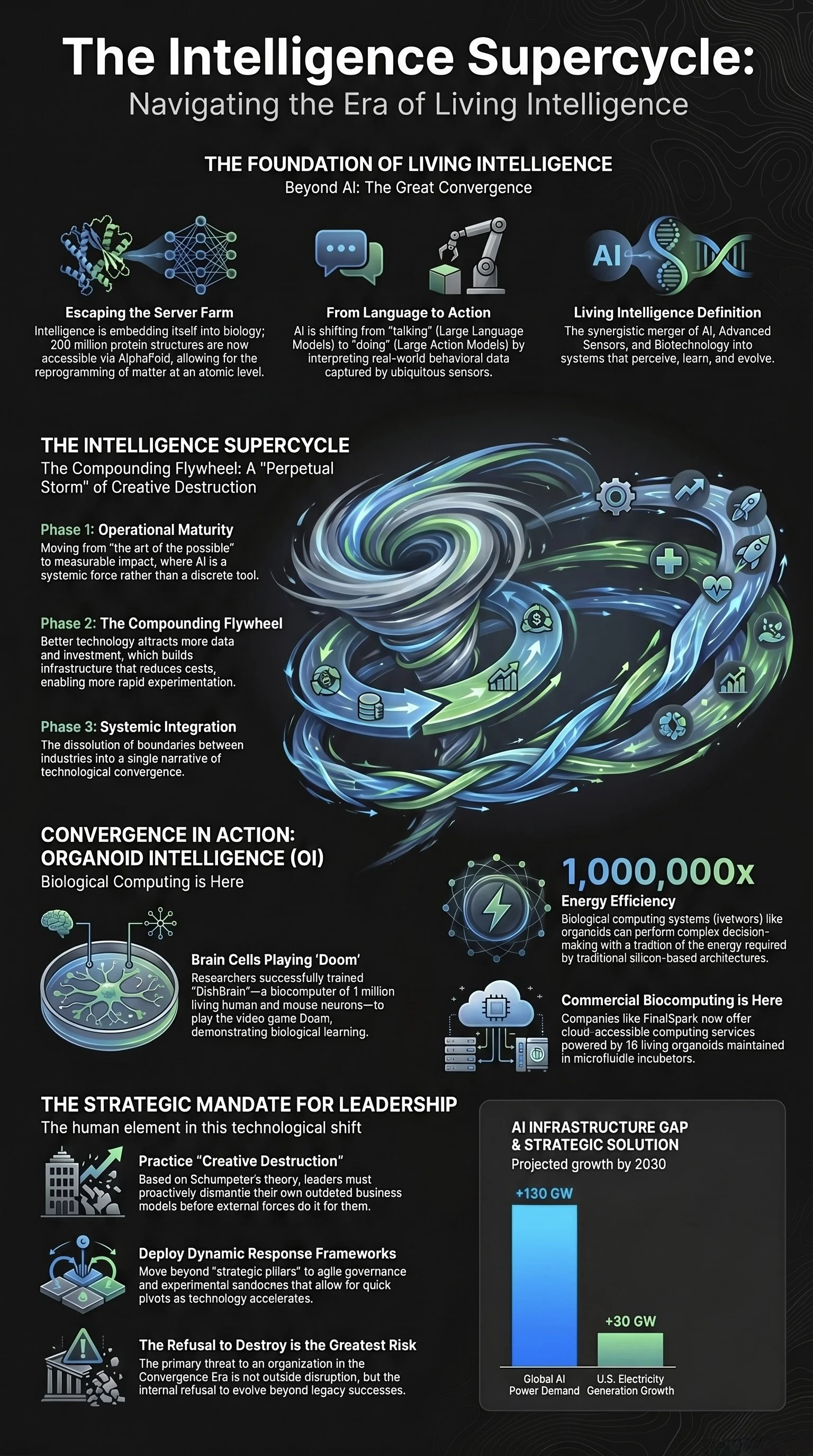
generated by OneBizTutor®, May 25, 2026