

GRhino Newsletter Edition October 2026

Prime Story

Monthly Market Brief: Brazil’s Automotive Renaissance
Record Surge Driven by Green Incentives
By mid-2026, sales of new vehicles in Brazil reached a historic peak, posting a dramatic 15% year-over-year expansion in July compared to the same period in 2025. This surge culminated in nearly 280,000 new vehicle registrations across passenger cars, commercial trucks, and public transit buses in a single month. While federal efforts attempted to spur demand through low-interest loans for taxi and ride-hailing drivers on platforms like Uber and Taxi99, that initiative played an unexpectedly minor role. Instead, aggressive tax reductions targeting alternative powertrains served as the primary economic catalyst, driving rapid consumer adoption of electric and hybrid models. Chinese manufacturers emerged as major beneficiaries of this policy shift, commanding a 23% market share through localized assembly and setting a new operational benchmark for the country.

Shifting Tariff Policies and the Rush for Local Assembly
This consumer shift is rapidly accelerating Brazil’s transformation into a regional manufacturing hub for sustainable mobility. While BYD already operates a facility in Bahia, four additional Chinese manufacturers have announced plans to establish local assembly lines. This influx coincides with a federal policy decision to suspend tax exemptions on BYD’s Completely Knocked Down (CKD) and Semi-Knocked Down (SKD) operations for at least another three years. To cushion this regulatory transition and encourage domestic industrialization, the government introduced a temporary six-month program waiving import duties on incoming CKD vehicles. The initiative features a capped total tax exemption pool of R$ 2.6 billion distributed proportionally among participating automakers, drawing immediate sign-ups from BYD, Great Wall Motor (GWM), GAC, Omoda Jaecoo, and several legacy carmakers.
Investment Pipelines and Strategic Asset-Light Alliances
The industrial landscape is evolving through both massive direct investments and flexible production partnerships. Chinese conglomerate GAC announced a US$ 1.7 billion commitment to construct a local manufacturing facility—most likely in Goiás state—complemented by joint research initiatives with Brazilian universities and an established spare parts distribution network. Meanwhile, Chery Group’s sub-brand Omoda Jaecoo is preparing to anchor its regional production in the interior of São Paulo state. Taking a distinct asset-light route, Geely has partnered with Renault to assemble its electric SUV EX5 directly on Renault’s existing lines, while Leapmotor has allied with Stellantis to leverage the group’s three established assembly plants across Brazil.
Domestic Tech Leads the Heavy Transit Revolution
While international players expand their footprint in passenger cars, Brazil’s commercial transit sector presents a different dynamic driven by a domestic pioneer. Local manufacturer Eletra, founded in 1999 in São Bernardo do Campo, holds market leadership in municipal electric buses ahead of BYD, Scania, Volkswagen, Mercedes-Benz, and Volvo. Engineered entirely with 100% local technology, Eletra has produced nearly 1,100 units by integrating chassis components from Scania and Mercedes-Benz with electric powertrains from Brazilian supplier WEG. Its lineup spans from 10-meter minibuses to 21-meter articulated transit models. Eletra also serves as Volkswagen's primary development partner on the e-Delivery electric truck, designing its energy distribution systems, control units, and core software.
Scaling Urban Fleet Conversion and Infrastructure Capacity
Eletra’s vertically integrated engineering allows it to manufacture new vehicles while offering specialized diesel-to-electric retrofit kits, providing mid-sized cities a practical financial path to phase out aging diesel fleets. Backed by an annual production capacity of 1,800 units that is slated to reach 2,300 units by 2027, the company has established a deep urban presence. In São Paulo alone, Eletra accounts for over 25% of the active municipal bus fleet. Across the capital, roughly 2,000 operating electric buses save 35 million liters of diesel fuel each year, offering operational ranges up to 350 kilometers per charge while preparing for significant battery technology upgrades over the next two years.

click on image and send us an direct email with your questions or doubts
The LatAm Story
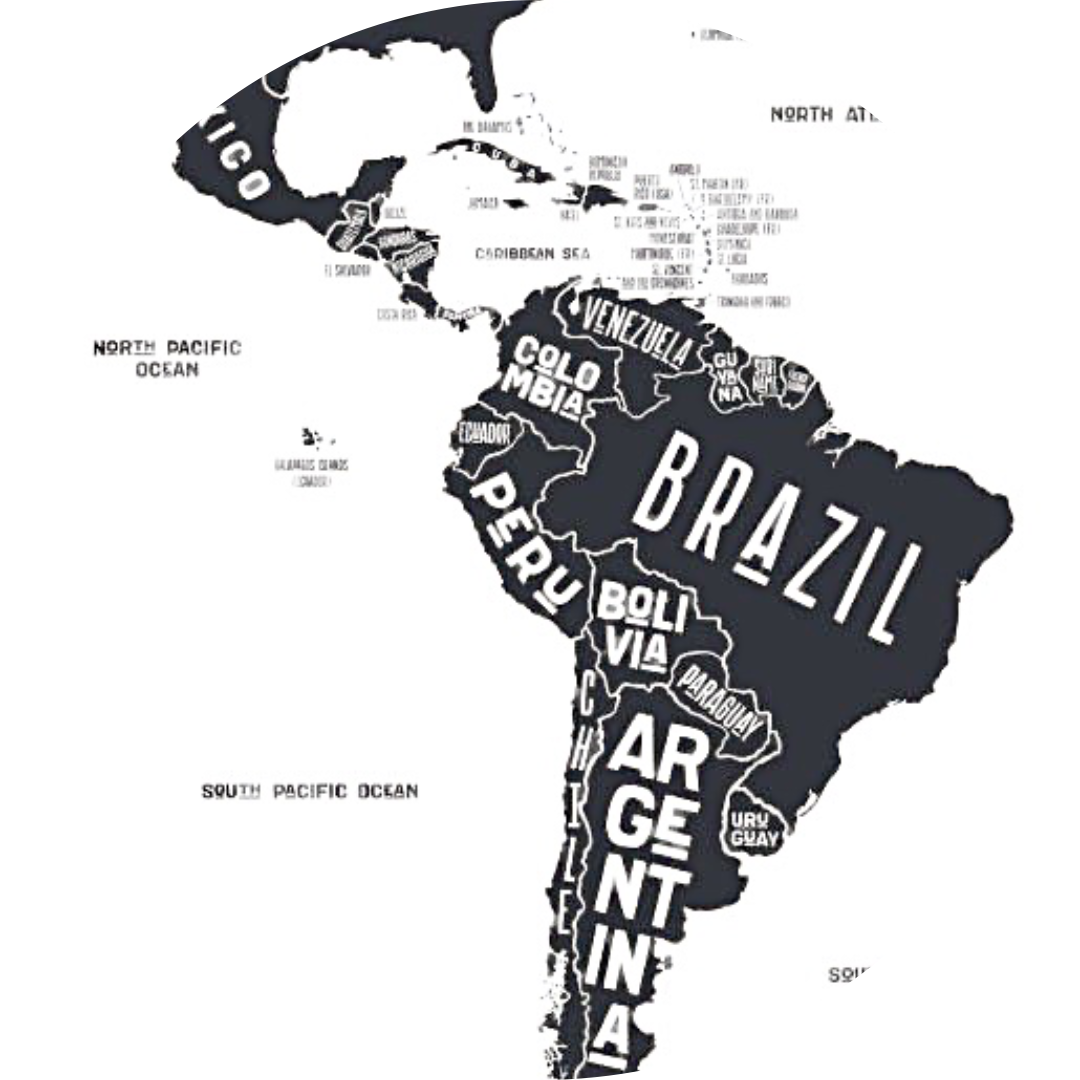
The ARTI Accord and the Mercosur Dynamic
In early 2026, Argentine President Javier Milei signed the United States–Argentina Agreement on Reciprocal Trade and Investment (ARTI) with the Trump administration, initiating a dramatic shift in South American geopolitical alignment. Beyond its official trade provisions, the agreement serves as a wedge designed to sabotage the EU-Mercosur free trade agreement and destabilize the internal functionality of the Mercosur economic bloc. Under its asymmetric terms, Argentina grants preferential access to American goods, machinery, and motor vehicles, effectively circumventing the trade bloc's common external tariffs and undercutting regional partners.
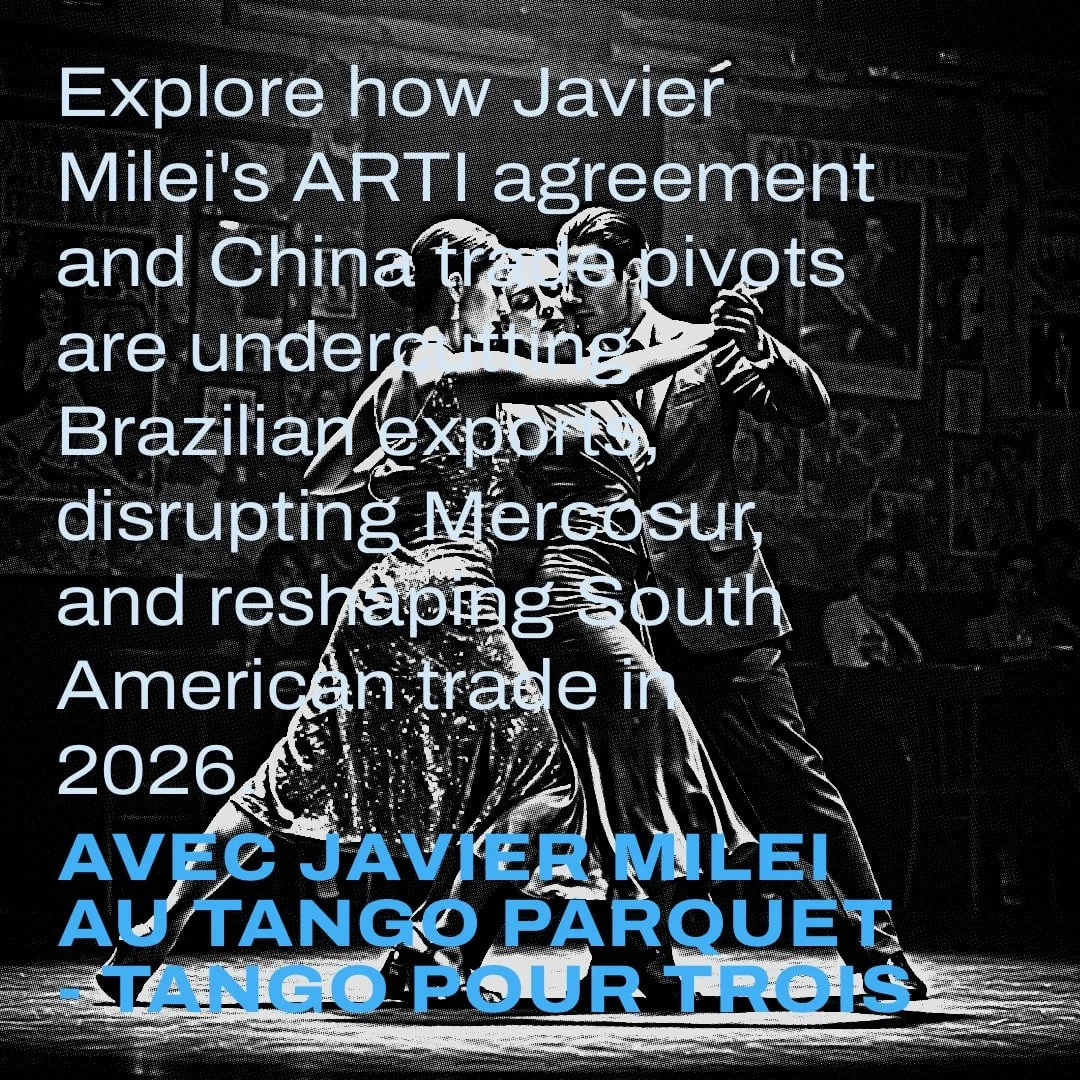
Tactical Rhetoric Versus Real-World Realities
To navigate this realignment, the Milei administration is executing a multi-directional maneuvering strategy that risks alienating its primary partners. When engaging with the Trump administration—a key ideological ally—Buenos Aires relies on sharp rhetoric, publicly vilifying China as an economic and ideological adversary. Yet behind closed doors, Argentina remains deeply integrated into Beijing’s Belt and Road Initiative. Rather than distancing itself from China, Argentina is actively replacing traditional Brazilian imports with Chinese goods at all costs, creating a stark contrast between its anti-communist political posturing and its actual commercial behavior.
The Economic Toll on Regional Integration
The immediate economic impact of this pivot is falling hardest on regional trade partners, particularly Brazil. Historically Argentina’s most vital commercial partner, Brazil has watched its key industrial exports systematically displaced. This shift is most pronounced in the automotive sector, where the market share of Brazilian-built vehicles in Argentina has plummeted from a dominant 82% to just 56%. While marketed by Buenos Aires as pragmatic maneuvering, this willingness to prioritize American and Chinese interests at the expense of regional integration reveals a fragmented foreign policy focused on short-term deals rather than a coherent long-term development strategy.
Brazil’s Strategic Tightrope
For Brazil, Argentina’s foreign policy shift presents an intricate diplomatic and economic challenge. Brasilia must protect its industrial base and market access from being squeezed out by simultaneous American and Chinese pushes into South America. At the same time, Brazilian leadership bears the responsibility of stabilizing Mercosur, preserving the integrity of its customs union, and pushing the EU-Mercosur agreement forward despite persistent efforts from Buenos Aires to derail the historic framework.—iMB Team ARG🇦🇷 for iMB.Solutions Ltda.
Background Information Hub
Generative AI Tools in Project Missions
Step into the AI Arsenal: the cutting-edge generative tools we deploy in client projects, internal operations, and partner collaborations—tested, trusted, and ready for battle.

The Death of the Dashboard—How LDOO Is Standardizing Conversational Analytics
Marketing teams and growth agencies have spent years trapped in dashboard fatigue. Data isn't sparse; it’s scattered across dozens of browser tabs—from GA4 and Meta Ads to Search Console and Shopify. The result is a perpetual cycle of manual export, spreadsheet wrangling, and slide-deck formatting just to answer basic client questions.
LDOO (pronounced el-doo) addresses this friction by replacing static dashboards with native conversational AI. Rather than layering a chatbot over existing visualizations, LDOO hooks directly into multi-channel marketing data, allowing users to query performance metrics in plain English. The platform queries connected channels simultaneously, returning senior-analyst-grade narrative explanations grounded strictly in real numbers rather than generative estimations.
Every answer inside LDOO acts as an operational launchpad. Insights can instantly transform into white-labeled client PDF reports, automated weekly deliveries, or live interactive client portals. Furthermore, its proactive anomaly engine triages performance shifts across accounts, notifying teams of audience saturation or conversion drops before clients spot them. By building memory around client baselines and seasonal trends, LDOO shifts marketing teams from assembling data to executing strategy.
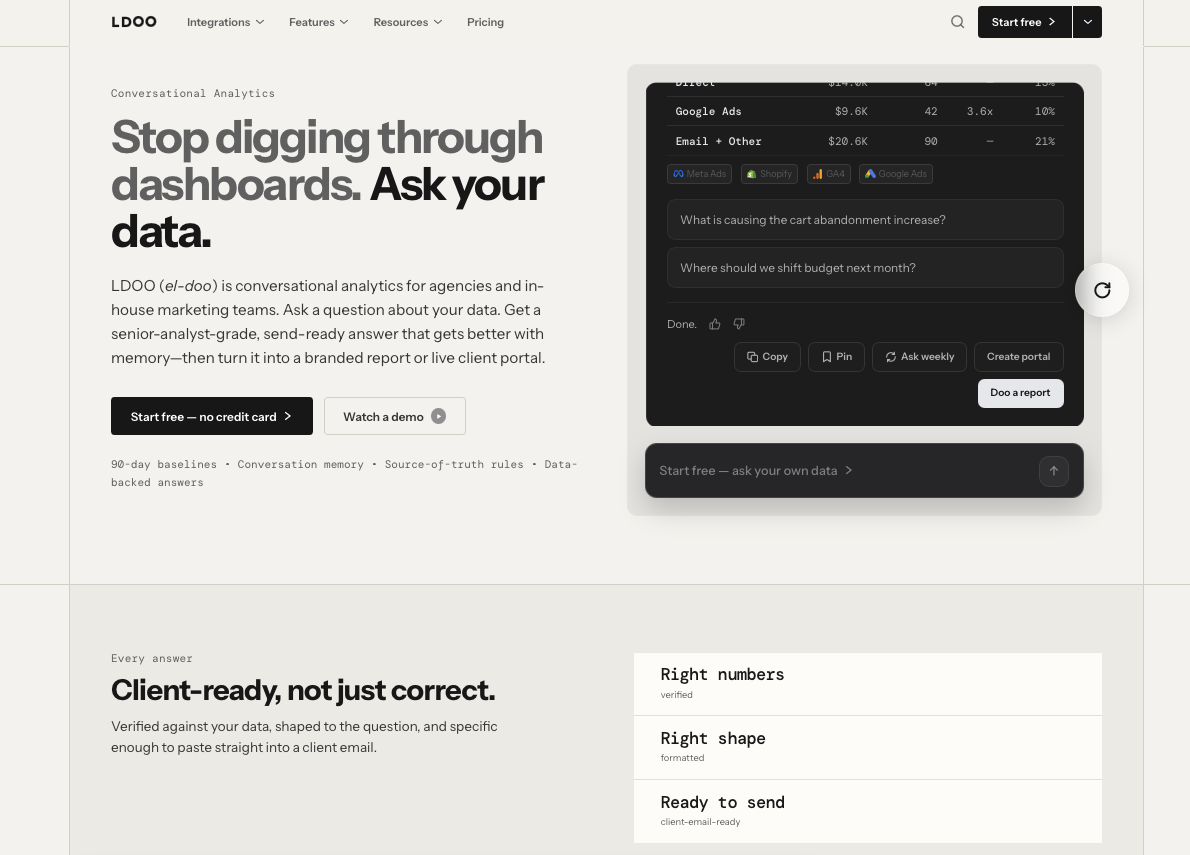
click on webpage image and access LDOO
Evaluating LDOO: Pros & Cons
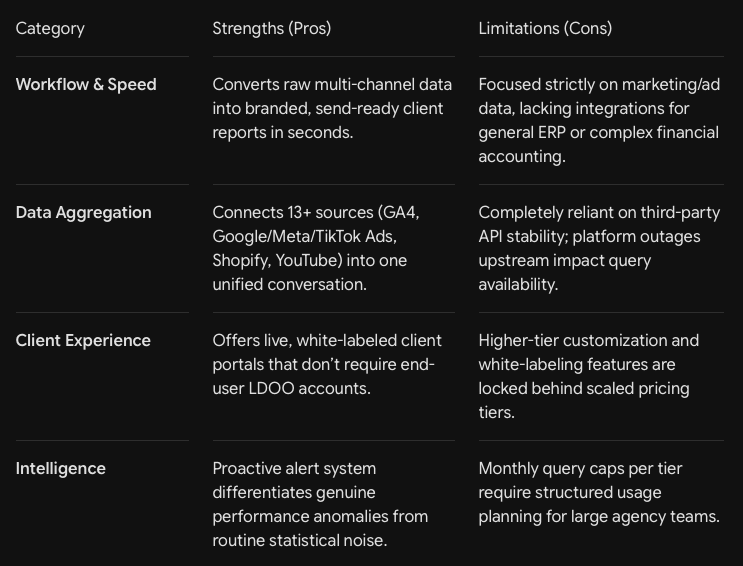
extracted from internal project assessment evaluation, iMB.Solutions Ltda., São Paulo, Brazil - September 2026
At iMB.Solutions, deploying LDOO directly within client business development engagements allows our project teams to bridge the gap between raw marketing metrics and strategic revenue growth. By connecting LDOO’s conversational engine straight into a client’s multi-channel data stack—unifying platforms like GA4, Meta Ads, Search Console, and Shopify into a single plain-English interface—we eliminate the manual overhead of spreadsheet wrangling and dashboard maintenance.
During active business development sprints, our consultants can run instant multi-channel audits, isolate conversion bottlenecks, and detect creative fatigue across ad accounts before budget is wasted. More importantly, we can package these findings into white-labeled, real-time client portals and automated alerts, giving client executives senior-analyst-level transparency into their growth KPIs without drowning them in static slide decks. By shifting the workload from manual data assembly to rapid strategic execution, iMB.Solutions leverages LDOO to validate growth hypotheses faster, optimize channel spend in real time, and scale client revenue initiatives with complete operational momentum.
LDOO offers a high-velocity alternative to traditional analytics dashboards by using plain-English AI conversational queries across multi-channel marketing stacks. For iMB.Solutions’ interim management and business development mandates, it converts complex commercial datasets into immediate, actionable operational intelligence.
Pros & Cons Evaluation
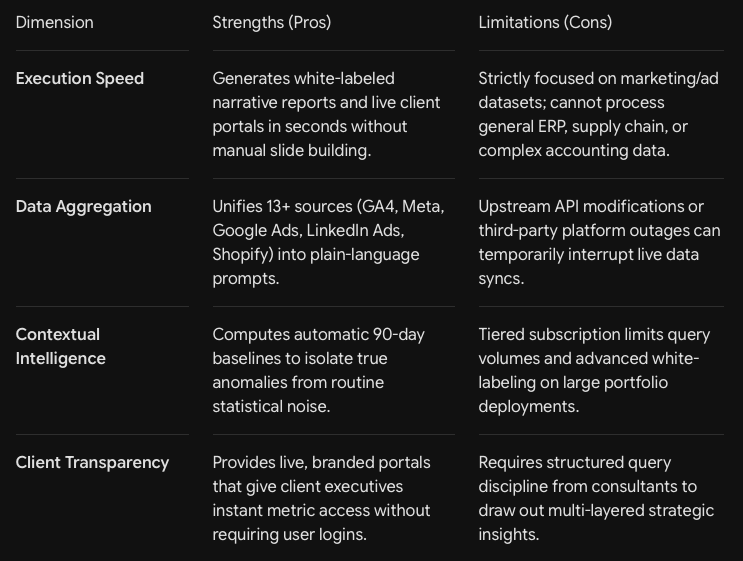
extracted from internal project assessment evaluation, iMB.Solutions Ltda., São Paulo, Brazil - September 2026
Strategic Value for our Client Project Missions
Integrating LDOO into iMB.Solutions' project toolchain provides a tactical accelerator, particularly when interim partners take over distressed marketing operations or spearhead international market entry. During the crucial first 30 days of a business development mandate, consultants can execute rapid multi-channel audits to pinpoint wasted ad spend, customer acquisition bottlenecks, or creative decay without spending weeks building custom BI dashboards.
LDOO also complements iMB’s proprietary OneBizTutor® platform. While OneBizTutor® models macro-business architecture and validates market entry strategies, LDOO monitors day-to-day commercial execution. This pairing allows our interim and management on-demand leaders to deliver clear, narrative-driven KPI updates to client executive boards, maintaining complete transparency while redirecting valuable consultant hours toward high-impact business development execution.
LDOO represents a high-value operational tool for iMB.Solutions. By removing reporting friction and sharpening audit precision, it allows interim teams to validate growth hypotheses faster and execute commercial pivots with clear data backed by real numbers.
Contact

Discover What Matters Most to You—Backed by 150+ Project Missions!
Curious about the impact of our insights at iMB.Solutions? We put our articles, blogs, and case studies to the test—running three independent AI-driven queries with Perplexity, Google Gemini, and Mistral. The result? A powerful keyword cloud reflecting the topics that truly resonate.
Do you see yourself in these trends? Let’s connect and explore how our expertise—shaped by 150+ project missions over two decades—can drive your success.