

Checkmate or Chaos? Javier Milei’s High-Stakes Geopolitical Gambit to Redraw the Global Trade Map

Blog cover image, BizDev Circular, Substack & LinkedIn, Feb. 26, 2026
Pretext
On December 27, 2025, we published the inaugural issue of the BizDec Circular, titled: Of Popes, Politics, and Pure Hypocrisy: The Endless EU-Mercosur Saga – and Milei as a Geopolitical Bomb! At that time, mid-January 2026 was the rumored "D-Day" for the signing of a deal 25 years in the making. That day came to pass on January 17, 2026, in Asuncion, Paraguay. But beneath the handshakes and champagne in Asunción, a deeper, more dangerous strategy was being executed.

click on visual and access the blog
Through our network in Argentina—established during a 2024 mission involving the tokenization of mineral reserves for a proposed national stablecoin—we learned of a "silent sabotage strategy" brewing between Buenos Aires and Washington. When the full text of the United States–Argentina Agreement on Reciprocal Trade and Investment (ARTI) landed on our desk in early February, the speculation became reality: the "sleeping agent of Trump and MAGA" in South America had been awakened.
Argentina is no longer merely balancing between global powers; it is performing a high-wire act of regulatory sabotage. President Javier Milei, chainsaw in hand, is currently pirouetting between Donald Trump’s "America First" fortress and the European Union’s increasingly fragile multilateral embrace.
The "Dollar Pump": A Survival Syringe for 2026
The stakes are existential. Argentina faces a $20 billion debt repayment cliff in 2026, with a Central Bank gasping for air amidst net reserves cited as significantly negative. Estimates for debt service reach as high as $22 billion for public administrations alone.
In this desperate race against the calendar, Milei has executed a "pincer maneuver."
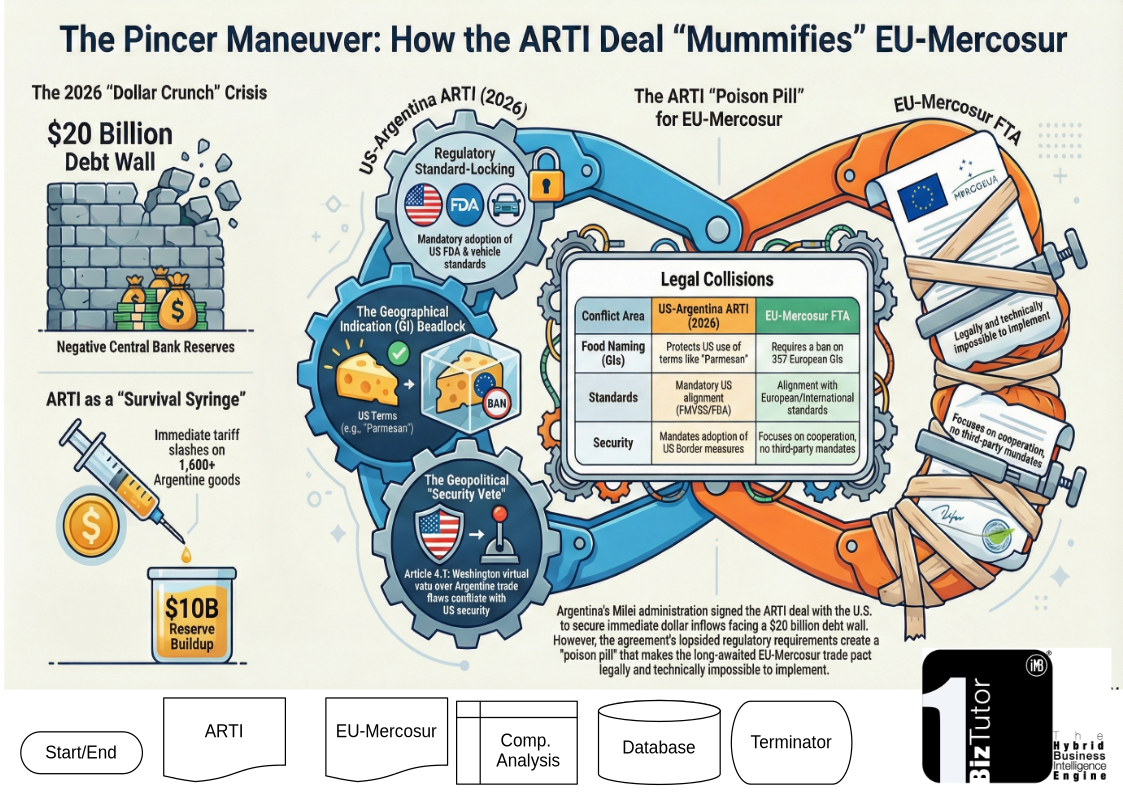
While the EU-Mercosur deal was signed on January 17, the ARTI deal followed on February 5, 2026. The ARTI is less a trade agreement and more a "survival syringe" of hard currency:
Immediate Liquidity: U.S. Treasury Secretary Scott Bessent recently intervened with an $808 million Special Drawing Rights (SDR) assistance package to cover a critical IMF interest payment in February 2026.
Asymmetrical Reciprocity: The U.S. eliminated reciprocal tariffs on 1,675 Argentine products, aiming to inject over $1 billion in immediate export revenue.
The Beef Quota: The U.S. granted an unprecedented expansion of the preferential beef quota to 100,000 tons, with 80,000 additional tons incorporated for 2026.
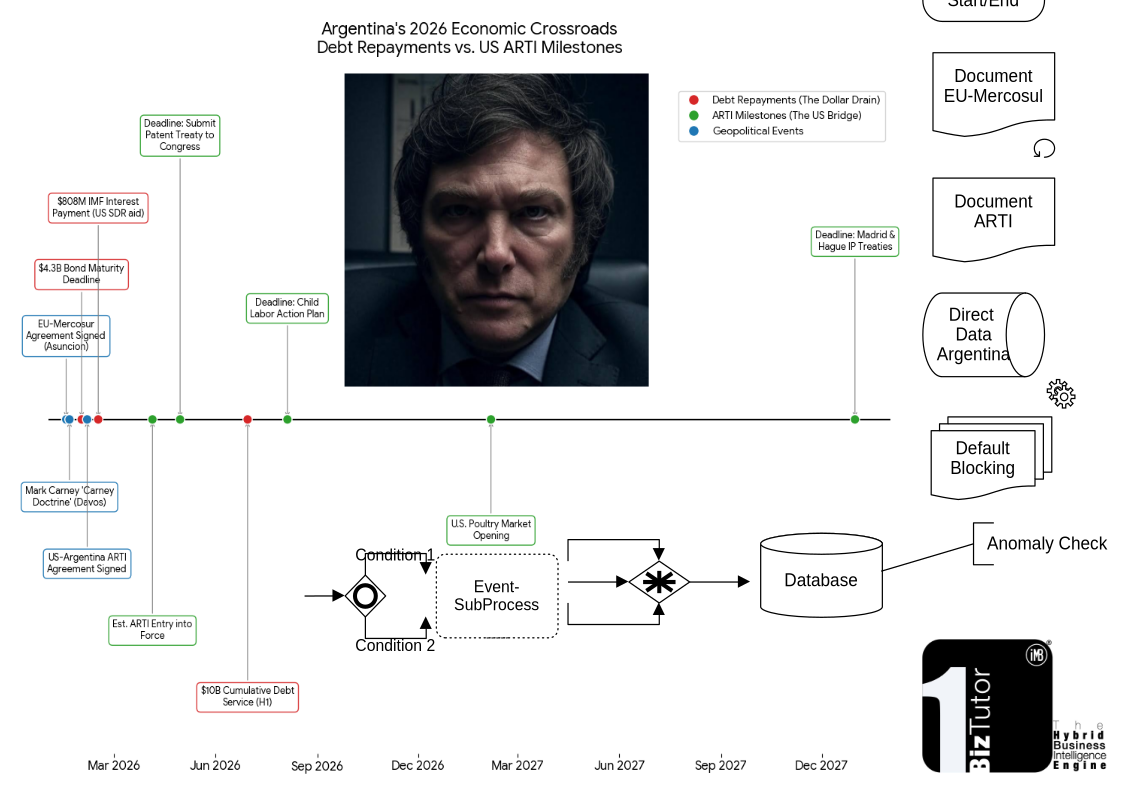
Analysis by OneBizTutor: contracts, events, data base, anomalies in events/processes/contracts | Feb. 23, 2026
The timeline has been created, illustrating the intense pressure on Argentina throughout 2026. This timeline maps critical debt repayment deadlines against the strategic implementation milestones of the US-Argentina ARTI agreement, highlighting the pincer maneuver described in former analysis.
Key Takeaways from the Timeline:
The Debt Pressure Cooker (Jan–Feb 2026): The year begins with a massive liquidity crunch, including a $4.3 billion bond maturity and immediate IMF interest payments. The US SDR assistance in February serves as the first survival syringe, directly linked to the signing of the ARTI.
ARTI Implementation Milestones: Within months of signing, Argentina must meet rigid regulatory and legislative deadlines, such as submitting the Patent Cooperation Treaty to Congress by April 30, 2026.
The One-Year Market Opening: By early 2027, Argentina is committed to opening its market to U.S. poultry—a deadline that creates an immediate collision with domestic agricultural interests and potentially conflicts with EU-Mercosur sanitary norms.
Strategic Locking (2027 and beyond): The timeline extends into late 2027, by which point Argentina must have submitted multiple international IP treaties (Madrid, Hague, Budapest) to Congress, further cementing its alignment with the U.S.-led regulatory axis.
This timeline reinforces the narrative that the ARTI is not just a trade deal, but a tactical schedule for political and financial survival at the cost of long-term regional and European strategic alignment.
The Cheese Conflict: A Legal Torpedo
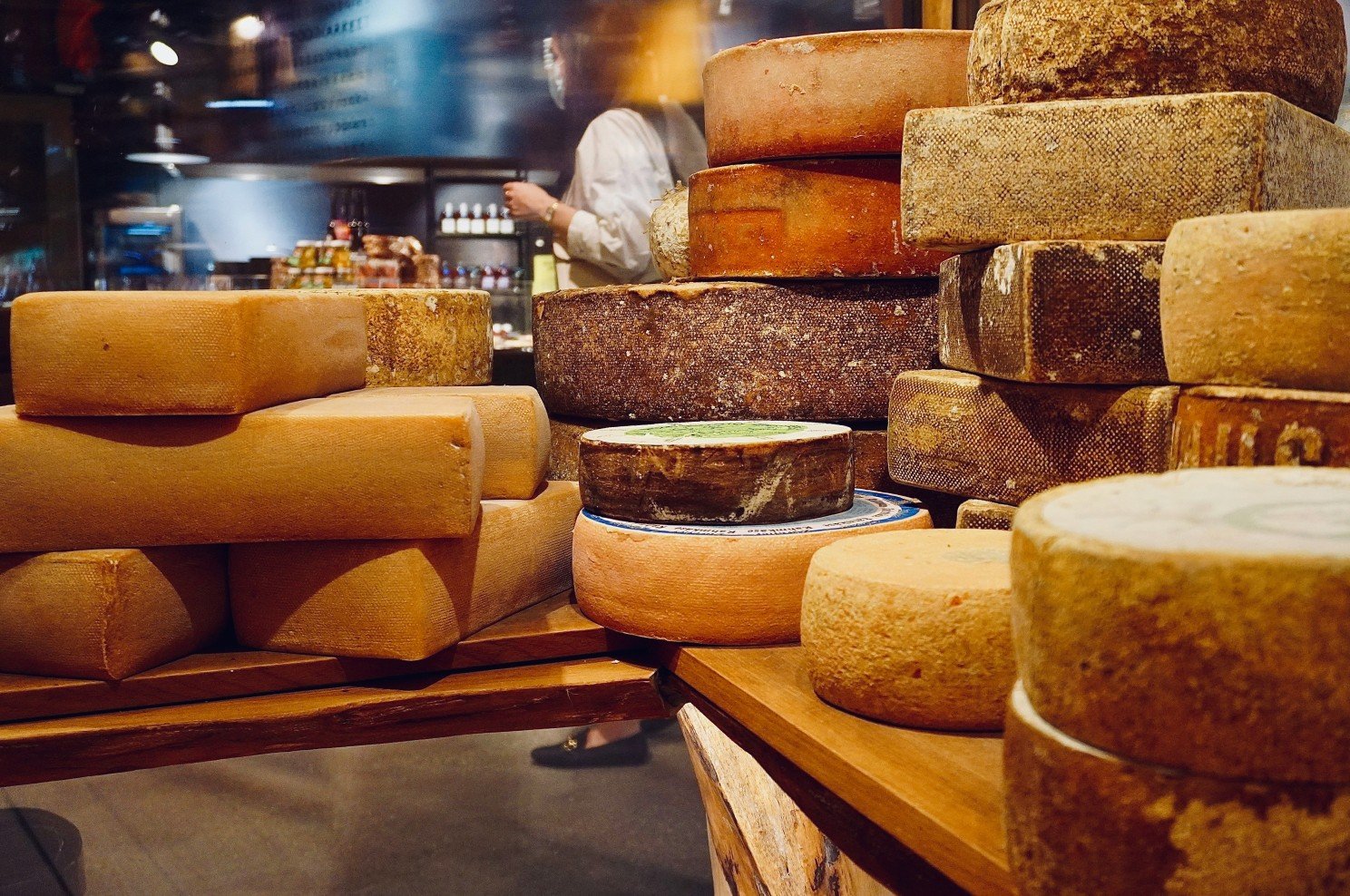
While the ARTI provides a fiscal lifeline, it serves as a legal torpedo aimed at the EU. The primary collision point involves Geographical Indications (GIs)—the EU’s hard-won victory requiring Argentina to ban 357 European terms like "Parmesan," "Feta," and "Gorgonzola" for non-European products.
However, ARTI Article 2.5 explicitly forbids Argentina from restricting U.S. market access for these same terms. This creates a "legal impossibility." Argentina cannot simultaneously honor the EU’s demand for exclusivity while permitting U.S. exporters to use those names. With the EU deal currently referred to the European Court of Justice (ECJ) for a review expected to last 18 to 24 months, Milei is using this window to cement U.S. dominance.
Standard-Locking: The U.S. Regulatory Zone

Milei is "locking in" U.S. technical standards to systematically exclude European competitors. Under ARTI, Argentina has committed to:
Pharma & Tech: Accepting U.S. FDA pharmaceutical certificates and Federal Motor Vehicle Safety Standards (FMVSS) as-is.
The Regulatory Squeeze: European firms adhering to UNECE or EMA standards now face duplicative testing, while U.S. firms enjoy a frictionless path.
Digital Concessions: Argentina is barred from imposing Digital Services Taxes and must recognize U.S. data protection and electronic signatures as "adequate"—a massive win for Silicon Valley.
The Security Veto - Argentina as a U.S. Proxy
The sleeping agent in South America turned into a proxy.

The ARTI effectively grants Washington a veto over Argentine trade policy. Under Article 4.1, Argentina "shall adopt border measures with similar effect" to U.S. national security actions.
Nuclear Ban: The agreement explicitly bars Argentina from purchasing nuclear technology or fuel from "certain countries"—targeting Russian and Chinese interests.
Critical Minerals: Argentina must prioritize the U.S. for lithium and copper to combat "market manipulating economies".
The Investor’s Dilemma – Navigating the "America First" Trap
For European strategic investors, the ARTI is not just a trade agreement between two nations; it is a profound alteration of the Argentine business landscape that creates a structural disadvantage for non-U.S. entities. While the EU-Mercosur agreement promised a level playing field across a 780-million-person market, the ARTI’s "standard-locking" and security clauses have effectively turned Argentina into a high-risk zone for European capital.
The "Standard-Locking" Barrier
The most immediate risk for European manufacturers is the regulatory divergence codified in the ARTI. Argentina’s commitment to accept U.S. FDA and FMVSS standards "as-is" gives U.S. firms a friction-free entry point that European competitors do not yet share.
Duplicative Costs: European firms adhering to UNECE (automotive) or EMA (pharmaceutical) standards may still face local conformity assessments that their U.S. rivals now bypass.
Supply Chain Fragility: Investors in the Argentine "Rust Belt" who rely on European machinery may find themselves at a cost disadvantage as U.S. equipment enters duty-free and without technical friction.
The Geographical Indication (GI) Legal Minefield
European investors in the agri-food sector face a direct legal collision. The EU-Mercosur deal was designed to protect 357 European GIs, such as Parmigiano Reggiano and Roquefort, by banning imitations.
The Conflict: ARTI Article 2.5 explicitly permits the use of these terms for U.S. goods if they are "customary in common language".
The Risk: A European dairy company investing in Argentina under the assumption of GI protection may find the market flooded with "U.S. Parmesan," creating brand dilution and legal uncertainty that could take years to resolve in international courts.
Critical Minerals and the "Security Veto"
For European auto OEMs and battery manufacturers, Argentina’s lithium and copper reserves were a primary driver for the EU-Mercosur deal. ARTI, however, introduces a "Security Veto" that could sideline European projects.
U.S. Prioritization: Argentina has committed to prioritizing the U.S. as a trade and investment partner for critical minerals over "non-market economies".
National Security Alignment: Under Article 4.1, Argentina must adopt measures with a "similar effect" to U.S. national security actions. If the U.S. restricts certain technologies or foreign entities, European companies with complex international supply chains (including ties to Chinese or Russian components) could find their Argentine operations blocked or seized under the guise of "economic security".
The Default Shadow: Tactical Liquidity vs. Long-Term Risk
Finally, the ARTI’s role as a "survival syringe" for Argentina’s $20 billion debt cliff creates a precarious environment. While the U.S. has provided short-term SDR aid to avert an IMF default, this liquidity is tactical, not structural.
Political Volatility: European investors, who typically seek 10-to-20-year stability, must now weigh the risk that these U.S.-aligned reforms may not survive a future administration or could trigger social unrest due to "extreme fiscal discipline".
Strategic Takeaway: For European business developers, the "Asunción Dream" of an Atlantic trade bridge is now complicated by the "Washington Reality."
Investing in Argentina currently requires not just a business plan, but a sophisticated geopolitical risk strategy to navigate a market that is increasingly a U.S. strategic proxy.
The Carney Doctrine and the "Mercosur Divorce"
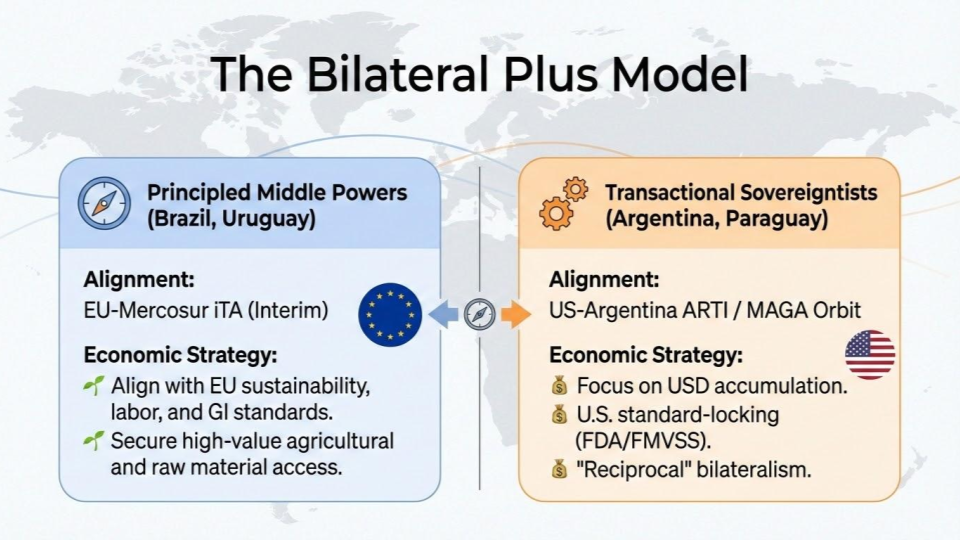
As the rules-based order fades, a "two-speed" Mercosur is emerging. This shift was articulated by Canadian Prime Minister Mark Carney at Davos on January 20, 2026. Carney’s "Carney Doctrine" advocates for "value-based realism," urging middle powers to form agile, ad-hoc coalitions when integration becomes a source of subordination.
The resulting "Bilateral Plus" model highlights the fragmentation:
Our Final Take - Living the Truth in a World of Fortresses
Understand the ARTI agreement:
The ARTI provides the tactical breathing room required to survive the 2026 debt crisis and reject the "populist ghosts" of the past, but the cost is the slow dissolution of the Mercosur customs union. In a world of fortresses, Argentina’s answer is already written in the greenbacks currently flooding its depleted reserves.
This blog was originally published on the Substack platform and LinkedIn in the BizDev Circular newsletter on February 26, 2026. The newsletter was part of the digital media outlet of iMB.Solutions. Due to the reorganization of the media outlets, all publications by iMB.Solutions will now be concentrated on the website. Blogs and newsletters that are important in the current context have been transferred to the iMB.Solutions website. BizDev Circular will no longer be continued on the Substack and LinkedIn platforms.