

The "Pincer Maneuver": Dollar Diplomacy and the Mummification of EU-Mercosur
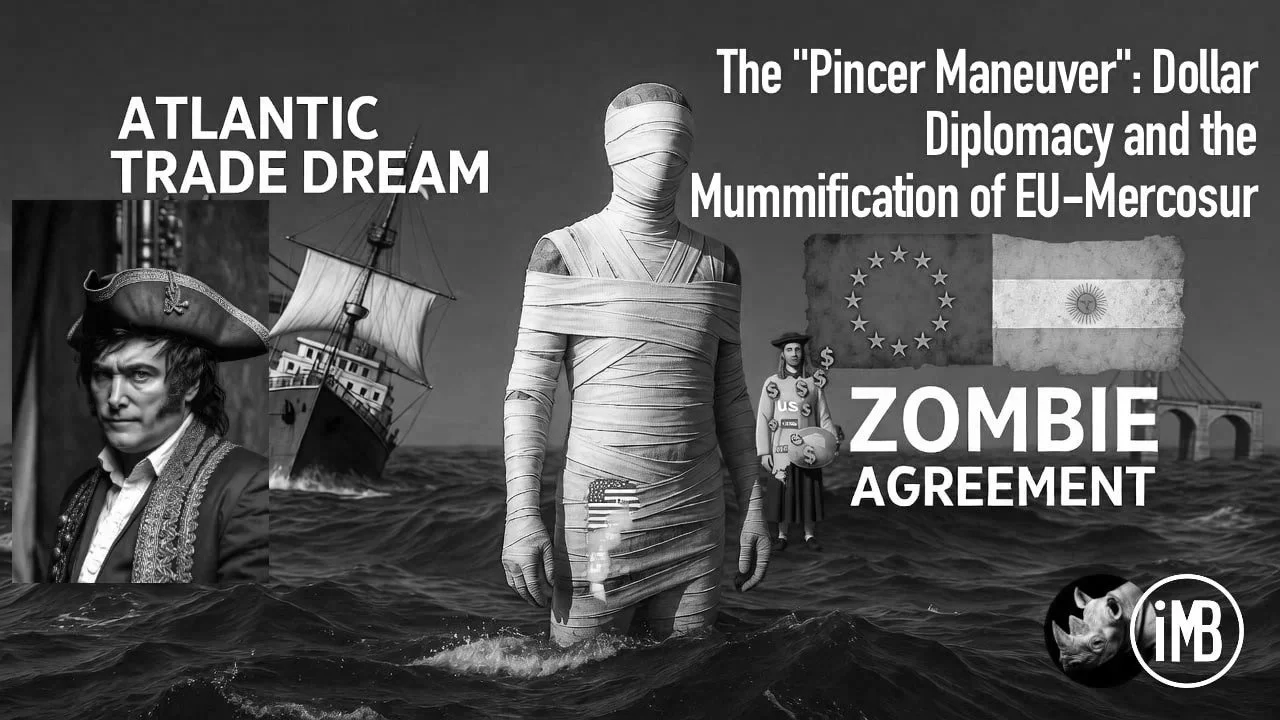
Blog cover image, GreyRhino Newsletter, Substack & LinkedIn, Feb. 12, 2026
How the US-Argentina ARTI Could Mummify the EU-Mercosur Deal
Special Analysis | February 2026 | São Paulo | Buenos Aires | Brussels | Vienna
The global trade landscape shifted on its axis this month with the formalization of the United States-Argentine Republic Agreement on Reciprocal Trade and Investment (ARTI). While presented as a "modernized partnership" for prosperity, a deeper analysis of the text suggests a more surgical objective: the strategic alignment of Argentina with U.S. economic and security interests, effectively creating a "poison pill" for the long-delayed EU-Mercosur Free Trade Agreement (Brussel, Vienna).
Imagine Javier Milei, chainsaw in one hand and trade deals in the other, pirouetting between Donald Trump's "America First" fortress and the EU's multilateral embrace. In this edition, we'll unpack a fascinating dialogue that's unfolded over the past days – starting with a deep dissection of the freshly inked U.S.-Argentina Agreement on Reciprocal Trade and Investment (ARTI), signed just one week ago on February 5, 2026, and evolving into a strategic showdown with the EU-Mercosur Partnership Agreement, sealed on January 17, 2026 after a quarter-century saga.

The visual was generated by generative AI. Neither visual depicts a real situation.
How Argentina's desperate hunt for U.S. dollars in 2026, driven by looming IMF repayments, turns the ARTI deal into a tactical lifeline – potentially at the EU-Mercosur pact's expense. We'll evaluate this with clear-eyed precision, think outside the box for solutions, and keep the vibe solution-oriented. After all, crises are just opportunities in disguise, right? If Milei's libertarian revolution is a rock concert, these trade deals are the amplifiers – but watch out for feedback loops!
Milei at a recent presser, touting ARTI as Argentina's "dollar magnet" – a symbolic push for reserves amid IMF crunch time.
We'll build a clear argumentation line from asymmetry to sabotage scenarios, peppered with feasible futures – all while channeling a motivating vibe to inspire proactive thinking.
After all, in trade wars, the bold don't just survive; they thrive. What if Argentina turns these tensions into triumphs?
The framed "strategic partnership" for prosperity, the agreement is increasingly viewed by analysts, with whom we spoke during the past week (São Paulo, Buenos Aires, Brussels, Vienna), as a tactical pincer maneuver designed to secure President Javier Milei’s political survival while effectively placing the EU-Mercosur Free Trade Agreement into a state of permanent "zombie" status (Buenos Aires).
While framed as a "reciprocal" partnership, the text reveals a lopsided structure where Argentina makes deep, binding commitments to reform its domestic regulations and security posture in exchange for conditional US institutional support and limited tariff relief.
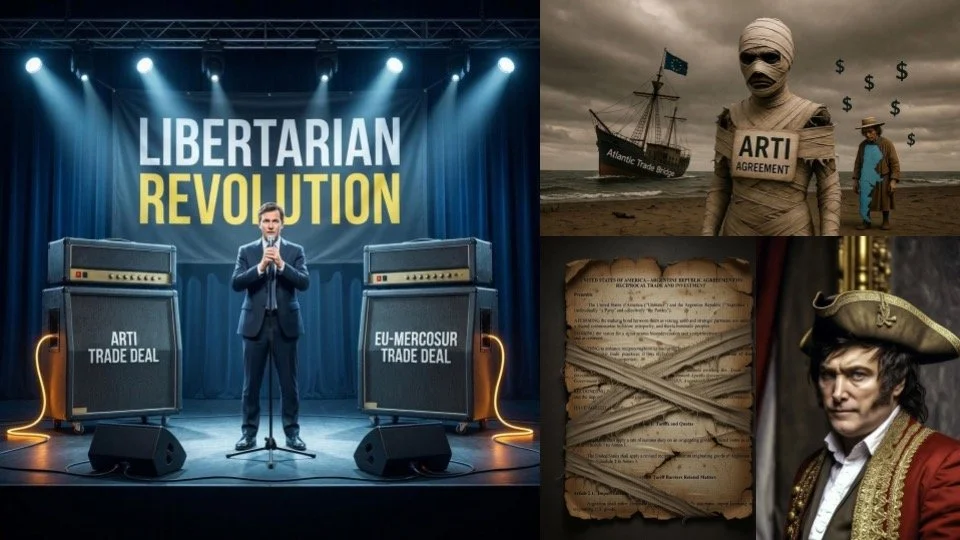
All four visuals were generated by generative AI. Neither visual depicts a real situation.
The ARTI Enigma: A Lopsided Lifeline or U.S. Leverage Lock?
To set the stage, recall our deep dive into the ARTI pact – that 37-page powerhouse signed February 5, 2026, slashing tariffs on 1,600+ Argentine goods into the U.S., quadrupling beef quotas to 80,000 tons duty-free this year, and dangling U.S. financing carrots via EXIM and DFC for minerals and infrastructure. It's asymmetrical, no doubt – Argentina commits to dismantling barriers, aligning standards, and cozying up on sanctions, while U.S. pledges are more "we'll see" conditional.
Our opinion: Still a 80/20 U.S. tilt, but for a nation clawing out of crisis, it's a pragmatic power-up. Entry into force? Around early April, but export boosts could kick in sooner, funneling those precious dollars.
Collision Course: ARTI's Shadow Over EU-Mercosur
As we unpacked, ARTI casts a long shadow over the January 17 EU-Mercosur deal – that mega-FTA spanning 700 million people, promising tariff cuts on 92% of Mercosur exports but now frozen by a narrow European Parliament vote sending it to the ECJ for 18-24 months. Clashes on GIs (U.S. cheese terms vs. EU protections), standards, and geopolitics (ARTI's anti-China vibes vs. Mercosur's neutrality) could ignite friction.
Threat level?
High, but not terminal – especially with EU-Mercosur already zombied by legal limbo.
Critical Points for Argentina
The agreement centers on integrating Argentina into the US economic and security sphere through several key mechanisms:
Agricultural Market Openings: Argentina must allow market access for US poultry and poultry products within one year and significantly simplify registration for US beef, pork, and dairy.
Regulatory Alignment: Argentina is required to accept US-specific standards (e.g., FDA for medical/pharma, FMVSS for autos) and US conformity assessment procedures without additional domestic testing.
Intellectual Property (IP) Overhaul: Argentina must resolve issues from the US Special 301 Report, including repealing specific patentability resolutions and increasing criminal penalties for IP infringement.
Critical Mineral Integration: Argentina commits to facilitating U.S. investment in its critical minerals (lithium, copper) and "prioritizing" the US as a partner over "market manipulating economies".
Extent of Unilateral Favor Toward the US
The agreement leans heavily in favor of US commercial and geopolitical interests through "asymmetrical reciprocity":
One-Way Standard Recognition: Argentina must accept goods meeting US standards (like FMVSS for vehicles) as-is. In contrast, the US only agrees to accept Argentine vehicle parts "subject to U.S. enforcement procedures," retaining full control over entry.
Digital Trade Dominance: Argentina is barred from imposing Digital Services Taxes or similar taxes that might discriminate against US tech giants. It also must recognize the US as having "adequate" data protection, facilitating the outward flow of personal data from Argentina.
Conditional "Work With" vs. Mandatory "Shall": The language frequently uses "Argentina shall" for Argentine obligations (e.g., eliminating taxes, adopting sanctions) while using "The United States shall work with" or "may take into account" for US benefits, such as defense trade or investment financing.
Tax Prohibitions: Argentina is prohibited from imposing value-added taxes (VAT) that discriminate against US companies "in law or in fact," potentially limiting the government's ability to use tax policy to support local industry.
Areas of Disadvantage and Potential Harm to Argentina
The following areas present substantial risks to Argentina's national sovereignty and economic stability:
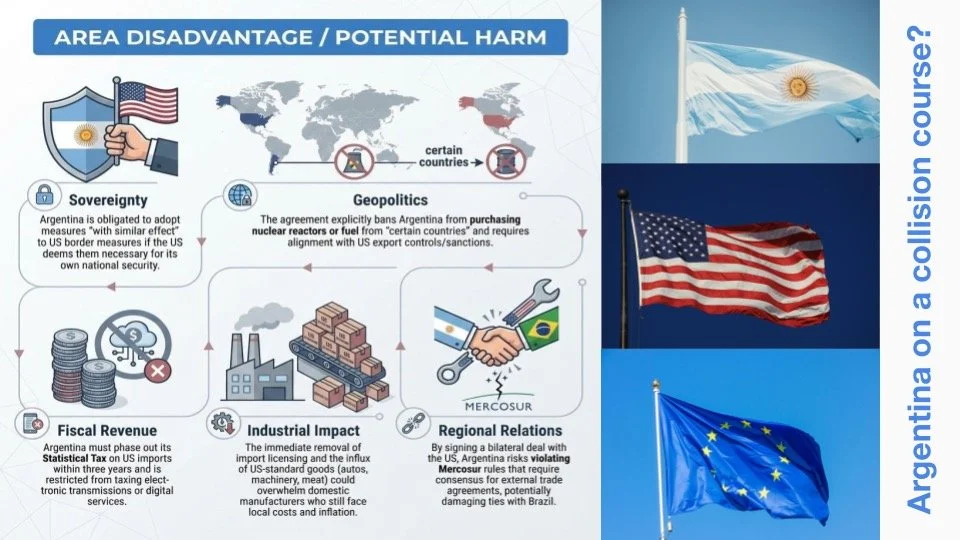
analyzed by OneBizTutor®, Feb. 9, 2026, 11:57 a.m., São Paulo, Brazil
Note: Article 6.4 gives the US the power to "take action in accordance with its law" if it considers Argentina non-compliant, providing a unilateral enforcement mechanism that the US has historically used to impose retaliatory tariffs.
Negative Impacts on Mercosur Cohesion
The signing of bilateral agreements like the ARTI is viewed as a significant threat to the unity of the Mercosur customs union:
Conflict with Joint Negotiation Rules: Mercosur membership requires member states to jointly negotiate trade deals. Argentina’s bilateral commitment to the U.S. bypasses this, potentially leading to tense negotiations with Brazil, Uruguay, and Paraguay.
Violations of the Common External Tariff (CET): The ARTI provides "preferential access" for U.S. goods, which may conflict with the CET. Argentina may need to rely heavily on the National List of Exceptions (LETEC), which was recently expanded to allow up to 150 product codes per country to manage such discrepancies.
Divergent Macroeconomic Policies: A long-standing threat to Mercosur has been the failure of parties to coordinate divergent macroeconomic policies, which remains a hurdle for deep integration.
Strategic Threats to the EU-Mercosur Agreement
The ARTI is seen by some analysts as a shift away from a "bloc-to-bloc" trade model toward a bilateral model that could undermine the EU's negotiation position.
Bypassing Bloc Solidarity: Mercosur traditionally requires its members to negotiate trade deals as a unified bloc. By signing a bilateral deal with the U.S., Argentina is breaking this "joint negotiation" norm, which may encourage other members like Uruguay to seek their own independent deals, potentially fragmenting the union.
Preferential Market "Crowding": The ARTI grants the U.S. preferential access to Argentine sectors that the EU also targets, such as automotive, machinery, and pharmaceuticals. If U.S. companies establish a dominant position under ARTI's early implementation, European firms may find it harder to gain market share even after the EU-Mercosur deal is ratified.
Geopolitical Alignment: The ARTI includes commitments for Argentina to align with the U.S. on national security, export controls, and "non-market" practices. This could complicate Argentina's ability to maintain the "strategic autonomy" typically preferred by the EU-Mercosur framework.
Areas of Potential Collision for Argentina
Argentina faces specific legal and technical "collisions" where the obligations of the two agreements may contradict each other:
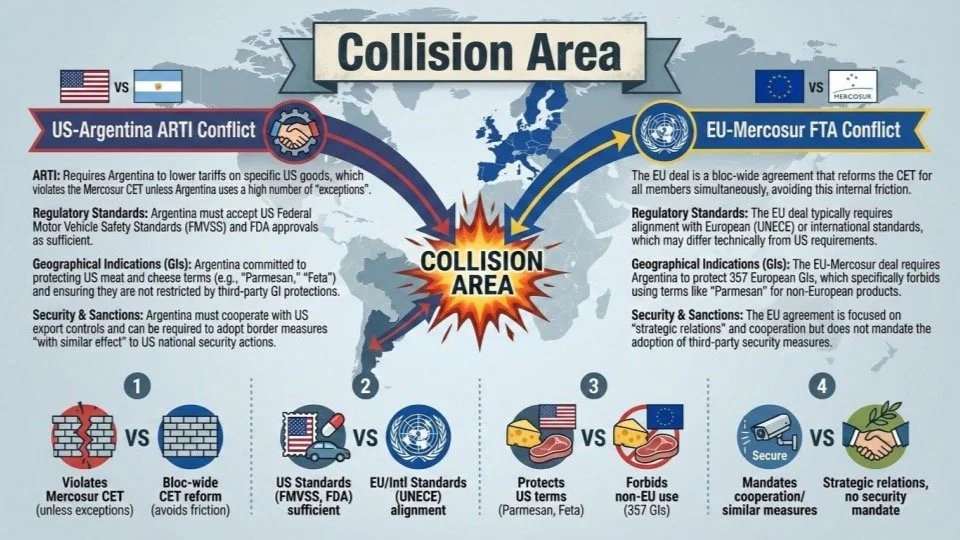
analyzed by OneBizTutor®, Feb. 9, 2026, 12:26 p.m., São Paulo, Brazil
Impact on National Policy
Argentina may find itself in a "regulatory squeeze" where its domestic agencies (like SENASA or ANMAT) must manage two distinct sets of rules for the same products. For instance, a vehicle imported from the US would follow ARTI rules (FMVSS), while a vehicle from Germany would follow EU-Mercosur rules, creating a dual-track system that increases administrative complexity.
Furthermore, if Argentina fails to reconcile these "reciprocal" commitments, it could face legal challenges within Mercosur's dispute resolution system or from the European Court of Justice, which is currently reviewing the EU-Mercosur deal for legal consistency.
The Tactical Imperative: The 2026 Dollar Crunch
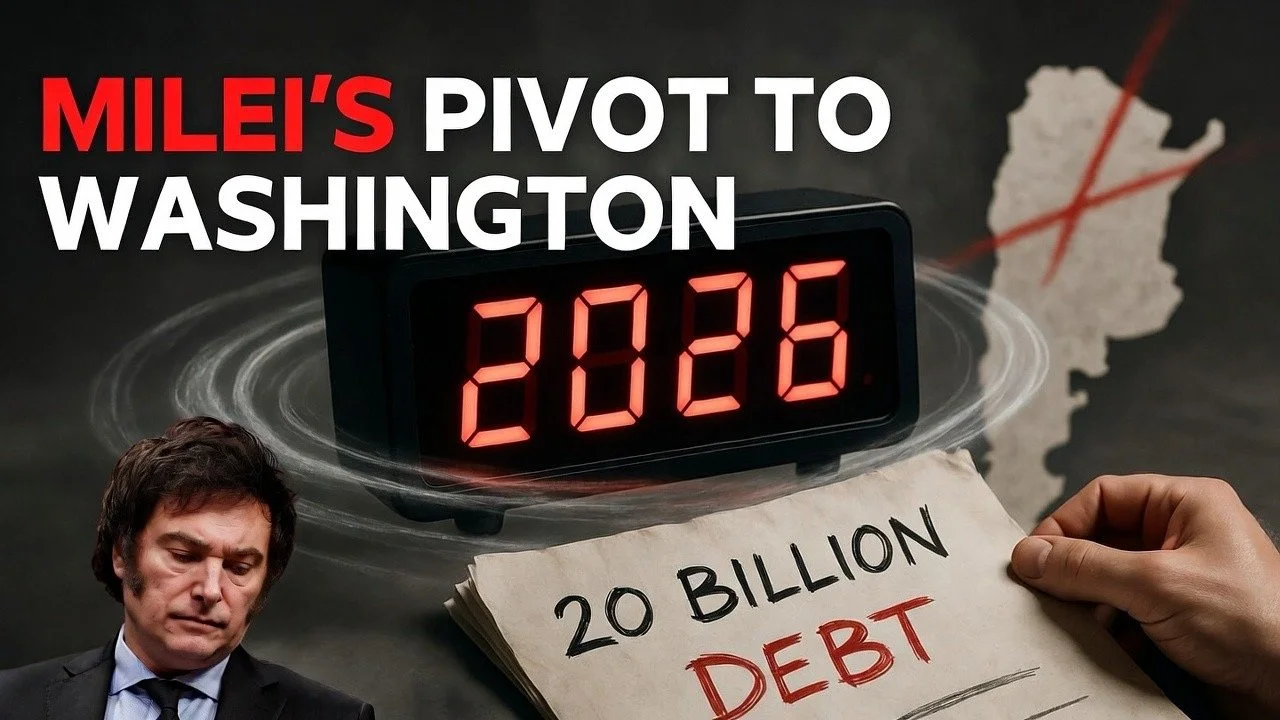
At the heart of Milei’s pivot to Washington is a desperate race against the calendar. Argentina faces an estimated US$20 billion in debt repayments in 2026. To avoid a catastrophic default, the administration must accumulate billions in hard currency—a task made difficult by a Central Bank whose reserves were recently cited as being $11 billion in the negative.
The IMF Shadow: With substantial principal and interest payments due in the first and second halves of 2026, Argentina’s "usable reserves" are projected to hit critical levels.
The US Lifeline: The ARTI acts as a "tactical bridge". Already, U.S. Treasury Secretary Scott Bessent has stepped in with last-minute Special Drawing Rights (SDR) assistance to cover an $808 million interest payment in February 2026.
USD Accumulation: The agreement is designed to catalyze an immediate $1 billion increase in export revenue through slashed tariffs on 1,675 Argentine products.

The alignment between President Javier Milei and Donald Trump, codified in the US-Argentina ARTI (2026), creates a strategic "pincer maneuver" against the long-delayed EU-Mercosur agreement. Milei’s anarcho-capitalist ideology—which views antitrust regulations as "state distortions" and rejects the classic liberal mandate for competition—effectively allows him to prioritize US-style corporate concentration over the EU’s highly regulated, competition-based trade model.
In this scenario, the US-Argentina ARTI acts as a "poison pill" that could transform the EU-Mercosur deal into a zombie agreement: a treaty that is technically signed but practically unenforceable due to conflicting bilateral obligations.

The Dollar Imperative: IMF Pressures Fueling Trade Tactics
Now, let's dive into this compelling new scenario – one that underscores Argentina's raw economic vulnerability and Milei's survival instincts.
The thesis: Under extreme pressure to hoard USD for 2026 IMF repayments, Milei leverages ARTI's asymmetry for quick dollar inflows, but only by deliberately slowing EU-Mercosur. This aligns with Trump-Milei ideology and cushions market turmoil ahead of debt deadlines, prioritizing political longevity.
Evaluating the Scenario: High Plausibility with Strategic Nuance
In our opinion, this holds water – plausibility 9/10 – blending tactical necessity with ideological synergy. Break down, drawing on fresh data as of February 11, 2026.
The IMF Crunch: A Dollar Drought in the Making
Argentina's drowning in debt – over $300 billion total, with the IMF as its biggest creditor at ~$55 billion outstanding. 2026 repayments? Brutal: Over $10 billion in H1 alone, including $4.3 billion in January bonds, $1.6 billion IMF interest, and $2.5 billion other obligations. Full-year public debt service hits ~$22 billion, plus $10 billion private. Recent moves? A $800 million+ interest payment due Monday (February 9), backed by U.S. support, amid a $13 billion reserve shortfall from 2025 targets. Gross reserves stand at $46.24 billion (Milei-era high after $1.13 billion January buys), but "usable" ones hover at a precarious $10 billion – teetering toward negative without fresh inflows. The $20 billion IMF program (signed April 2025) offers $1 billion disbursements, but tied to reviews – next one's imminent, hinging on waivers for that shortfall. It's like Milei's got a leaky bucket for dollars – and IMF deadlines are the storm clouds.
ARTI as Tactical Dollar Pump: Quick Wins Amid Asymmetry
ARTI's U.S. favoritism shines here – tariff cuts boost Argentine exports (beef, soy, minerals) immediately upon entry (April), potentially injecting billions in USD via trade surpluses. DFC/EXIM financing could fast-track FDI in energy/minerals, targeting $10 billion reserve buildup in 2026. Why "quick"? U.S. market access is reciprocal but skewed: Argentina opens wide, U.S. tweaks minimally – ensuring faster flows to Buenos Aires. Recent central bank tweaks (loosening controls) align perfectly, aiming for $10 billion accumulation. Insight: This isn't just trade; it's a survival syringe for reserves.
Slowing EU-Mercosur as the Trade-Off: Necessary or Opportunistic?
Here's the rub: To maximize ARTI dollars, Milei might/will deprioritize EU-Mercosur – already stalled by ECJ until 2027-28. No provisional application means delayed EU tariff relief, avoiding regulatory conflicts (e.g., GIs, standards) that could slow U.S. gains. Ideologically? Spot-on – Trump's "America First" echoes Milei's anti-regulation bent, favoring U.S. giants over EU's sustainability strings. Survival motive? Crystal clear: Avoid default-induced turmoil before midterms or payments – Milei's reforms (4% projected GDP growth, inflation down to 18%) hang in the balance. No recent Milei tweets on this (our X sweep came up empty...), but his silence speaks volumes – focus on U.S. wins. Risks? High: Fracturing Mercosur (Brazil's Lula eyes EU), EU backlash, lost diversified exports. But feasible? Yes – stall via "freedom audits" or Mercosur flexibilization.
IMF headquarters – the lender looming large over Argentina's 2026 dollar quest.
Evaluation of the Scenario: Plausibility and Risks
In our view, the idea that Milei could wield ARTI to undermine EU-Mercosur holds water—it's not tinfoil-hat territory, but a calculated power move aligned with his ideology. Here's why it's credible, based on the latest as of February 11, 2026:
Milei's Ideological Fit: Milei diverges strongly from classic liberalism's anti-monopoly zeal (think Adam Smith railing against cartels). His "contemporary libertarian" vibe—echoing anarcho-capitalism—often tolerates "natural" market dominance by big players (e.g., tech giants or resource extractors) as long as government's not propping them up. He's privatizing state-owned enterprises (SOEs) per ARTI's nods to his Ley de Bases, potentially creating space for U.S. monopolistic firms in minerals, energy, and tech. This contrasts with EU-Mercosur's emphasis on competition, sustainability, and labor/environmental safeguards, which Milei has subtly criticized as "restrictive" (e.g., in his January 17 signing speech, he warned against EU quotas or safeguards diluting market access). His Trump ties amplify this: Trump's "America First" reciprocity favors U.S. dominance, and Milei's posts gush over Trump (e.g., thanking him for a "Board of Peace" invite on January 17). If Milei sees EU rules as stifling "freedom," ARTI could be his tool to pivot Argentina toward U.S.-style deregulation, zombifying the EU deal into a signed-but-stalled relic.
Current Status Fuels the Fire: EU-Mercosur signed January 17, 2026, creating the world's largest FTA zone (700M+ people), but it's already teetering. The European Parliament referred it to the ECJ on January 21 (narrow 334-324 vote), freezing ratification for 18-24 months over "deal-splitting" legality. Provisional application (for trade parts) is blocked by this "legal stay," so no 2026 tariff cuts. Meanwhile, ARTI—signed yesterday (February 5)—enters force in ~60 days, slashing tariffs on 1,600+ Argentine goods to the U.S. and opening Argentina to U.S. standards. Conflicts abound: ARTI lets U.S. firms bypass EU-style GI protections (e.g., cheese/meat terms), accepts U.S. SPS standards without extra tests, and bans discriminatory taxes—potentially clashing with EU demands. If Milei prioritizes ARTI, it could make EU compliance messy, turning Mercosur into a "zombie" by default.
Evidence of Intent? Mixed but Telling: Milei hails EU-Mercosur as a "milestone" and pushes Argentine ratification, but he calls it a "starting point" for deals with "freedom-supporting" nations (code for U.S.?). In Davos (January 2026), he aligned with U.S. reforms, rejecting "state regulation." No overt sabotage on X—his feeds focus on domestic wins and Trump love—but analysts note ARTI accelerates his U.S. pivot, potentially at Mercosur's expense. Plausibility score: 8/10. It's dangerous because it could fracture Mercosur (Brazil's Lula is pro-EU, pro-China), isolate Argentina, and spark EU retaliation (e.g., no tariff relief). But humorous aside: If Milei's chainsaw diplomacy "torpedoes" the EU deal, he might just blame it on "populist ghosts" from Argentina's past!
Overall, this scenario isn't inevitable—EU internal drama is already zombifying the deal—but ARTI gives Milei leverage if he wants to play hardball. It harms classic competition by favoring U.S. giants, but fits his vision of "efficient" markets.
Options for Milei to Torpedo the EU Agreement
Milei can use several specific levers within the ARTI to undermine the EU-Mercosur framework without necessarily withdrawing from Mercosur entirely.
1. The "Geographical Indications" (GI) Poison Pill
The most immediate legal collision involves the protection of food terms.
The Conflict: The EU-Mercosur deal requires Argentina to ban the use of 357 European GIs (e.g., prohibiting Argentine companies from using the names "Parmesan," "Feta," or "Gorgonzola"). Implement ARTI's Article 2.2 (accept U.S. standards without extra tests) and Article 2.5 (allow U.S. cheese/meat terms), creating de facto barriers for EU goods needing stricter conformity. If EU complains, invoke ARTI's rules of origin (Article 6.3) to favor U.S. inputs, diluting Mercosur's common tariff and making EU access "unfairly restricted."
The Torpedo: ARTI Article 2.5 explicitly states Argentina shall not restrict US market access due to the use of these cheese and meat terms.
Impact: By guaranteeing US exporters the right to use these names, Milei creates a legal impossibility: Argentina cannot simultaneously ban these terms for the EU and permit them for the US without violating one of the agreements.
2. Regulatory Alignment and "Standard-Locking"
Milei can "lock in" US standards to create a technical barrier for European firms.
ARTI Lever: Argentina committed to accepting US Federal Motor Vehicle Safety Standards (FMVSS) and FDA approvals for medical devices and pharmaceuticals as sufficient evidence for market entry.
The Torpedo: By adopting US standards unilaterally, Milei makes the Argentine market a "US-only" zone for specific high-value industries. European firms, which adhere to different (often stricter) UNECE or EMA standards, would face additional costs and "duplicative testing" that the ARTI was specifically designed to remove for US companies.
3. National Security and Export Control "Shields"
Milei can use the "National Security" provisions of ARTI to block EU-affiliated investments or supply chains.
ARTI Lever: Article 4.1 requires Argentina to adopt measures with "similar effect" to US border measures if the US deems them necessary for national security. Use ARTI's Section 4 (mirror U.S. border measures, coordinate sanctions) to impose U.S.-style export controls or investment screens on EU firms if they "undermine reciprocity" (e.g., if EU enforces deforestation rules on Argentine soy). This turns EU-Mercosur into a security headache, justifying delays under national law.
The Torpedo: If the US imposes restrictions on certain technologies or entities (such as those involved in the green transition where the EU leads), Milei is contractually obligated to follow suit. This effectively gives Washington a "veto" over parts of Argentina’s trade policy with the EU.
4. Ratification Sabotage (The "Legislative Deep-Freeze")
While Milei formally signed the EU-Mercosur deal in January 2026, he maintains total control over its progression.
The Strategy: Milei can delay sending the treaty to the Argentine Congress for ratification or use his "Decree of Necessity and Urgency" (DNU) powers to prioritize ARTI implementation. Stall EU-Mercosur in Congress by tying it to "freedom audits." Cite ARTI's reciprocity clause (Article 6.4) to argue EU safeguards violate "non-reciprocal" trade, demanding amendments. This keeps it zombied while ARTI rolls out, shifting business to U.S. partners.
Impact: By stalling domestic ratification while fast-tracking US-linked RIGI (Incentives Regime for Large Investments) projects, he ensures that US capital captures key sectors (lithium, copper, energy) before European competitors can benefit from the FTA.
5. Fragmenting Mercosur from Within
Milei has stated he would leave Mercosur if necessary for the US deal. As Mercosur's pro-tempore president (until July 2026), advocate for bloc reforms allowing bilateral deals outside the common external tariff. Frame EU-Mercosur as "outdated" vs. ARTI's "modern" U.S. alignment, sowing discord with Brazil/Paraguay and weakening ratification unity.
The Strategy: Rather than an exit, he can pursue an "Empty Chair" policy—ignoring Mercosur’s joint negotiation rules to sign further bilateral deals with the US.
Impact: This encourages other members (like Uruguay) to break ranks, effectively turning Mercosur into a shell organization and making the EU’s "bloc-to-bloc" agreement meaningless.
6. Public and Diplomatic Sabotage
Amplify rhetoric—e.g., tweet that EU's "socialist" labor/environment clauses (clashing with ARTI's lighter touch) promote "monopolies of regulation." Partner with Trump to pressure EU (imagine a joint X rant calling it "Euro-bureaucracy gone wild!"). This erodes political will without formal action.
These options could effectively zombie the deal, but they're a double-edged sword—risking lawsuits, lost EU investment, and Mercosur collapse.
Quick Take ONE. The ARTI Framework: "Reciprocity" or Regulatory Annexation?
The ARTI "Poison Pill": Torpedoing the EU Deal
While Milei formally signed the EU-Mercosur deal in early 2026, the ARTI contains specific "poison pill" provisions that make the European agreement technically and legally almost impossible to implement.
1. The Geographical Indication (GI) Deadlock
The EU-Mercosur deal hinges on protecting 357 European GIs—meaning Argentina must ban the use of terms like "Parmesan" or "Feta" for non-EU products. However, ARTI Article 2.5 explicitly forbids Argentina from restricting U.S. market access due to the "mere use" of these same terms. Argentina cannot honor both; by favoring the U.S., Milei effectively renders the EU's main agricultural victory void.
2. Regulatory "Standard-Locking"
Argentina has committed to accepting U.S. Federal Motor Vehicle Safety Standards (FMVSS) and FDA pharmaceutical approvals as-is. This creates a massive technical barrier for European firms that adhere to UNECE or EMA standards, as they may now face "duplicative testing" while U.S. firms enjoy a frictionless path.
3. Security and "Similar Effect" Measures
Under Article 4.1, Argentina "shall adopt a measure with similar effect" to any U.S. border measure deemed relevant to national security. This gives Washington a virtual veto over Argentine trade with third parties—including the EU—should those trade flows conflict with U.S. security goals.
Strategic Threats to the EU-Mercosur Agreement
The ARTI is seen by some analysts as a shift away from a "bloc-to-bloc" trade model toward a bilateral model that could undermine the EU's negotiation position.
Bypassing Bloc Solidarity: Mercosur traditionally requires its members to negotiate trade deals as a unified bloc. By signing a bilateral deal with the U.S., Argentina is breaking this "joint negotiation" norm, which may encourage other members like Uruguay to seek their own independent deals, potentially fragmenting the union.
Preferential Market "Crowding": The ARTI grants the U.S. preferential access to Argentine sectors that the EU also targets, such as automotive, machinery, and pharmaceuticals. If U.S. companies establish a dominant position under ARTI's early implementation, European firms may find it harder to gain market share even after the EU-Mercosur deal is ratified.
Geopolitical Alignment: The ARTI includes commitments for Argentina to align with the U.S. on national security, export controls, and "non-market" practices. This could complicate Argentina's ability to maintain the "strategic autonomy" typically preferred by the EU-Mercosur framework.
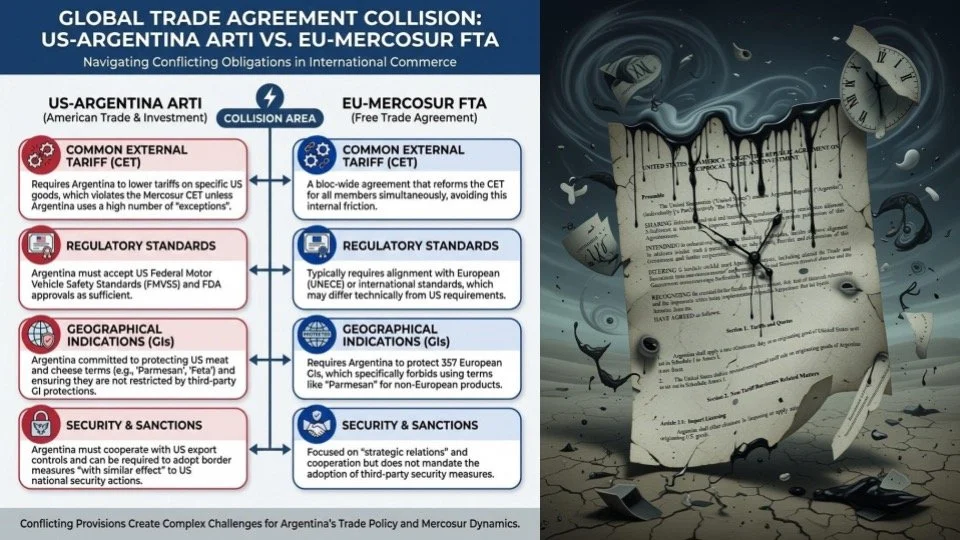
analyzed by OneBizTutor®, Feb. 9, 2026, 12:44 p.m., São Paulo, Brazil
The ARTI is not a traditional free trade agreement; it is an asymmetrical regulatory alignment. The document reveals a structure where Argentina makes binding, sovereign concessions in exchange for conditional U.S. institutional support.
One-Way Standard Recognition: Argentina "shall accept" goods complying with U.S. Federal Motor Vehicle Safety Standards (FMVSS) and FDA approvals as-is. Conversely, the U.S. only agrees to accept Argentine parts "subject to U.S. enforcement procedures".
The "National Security" Veto: Under Article 4.1, if the U.S. adopts a border measure for national security, Argentina "shall adopt a measure with similar effect". This effectively integrates Argentina into the U.S. export control and sanctions regime, potentially targeting "non-market actors".
Fiscal Shackles: Argentina is prohibited from imposing Digital Services Taxes or VAT that might "discriminate" against U.S. tech giants.
Quick Take TWO. The Collision Course: ARTI vs. EU-Mercosur
The coexistence of the ARTI and the EU-Mercosur deal creates a "regulatory squeeze" for Argentina, with three primary areas of legal collision:
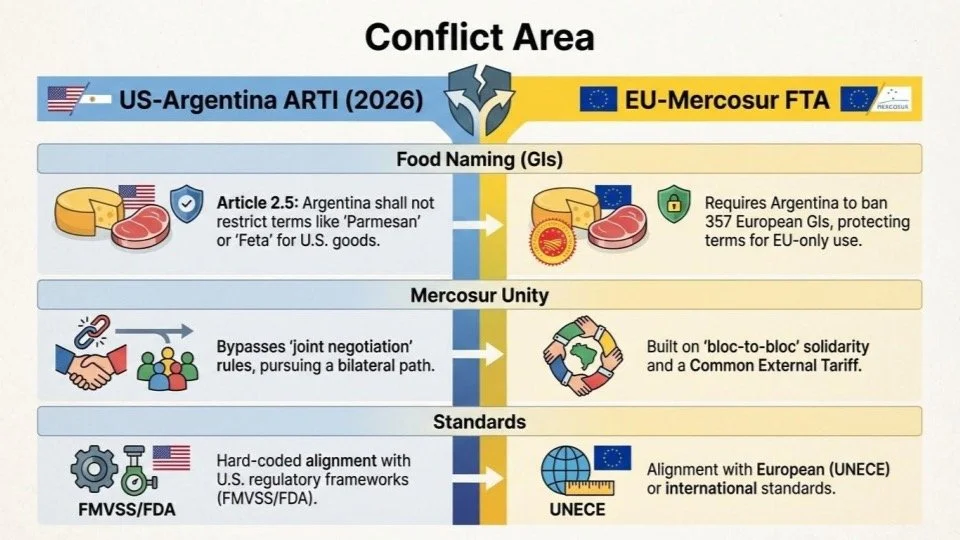
analyzed by OneBizTutor®, Feb. 9, 2026, 01:21 p.m., São Paulo, Brazil
Quick Take THREE. Feasible Scenarios: Milei’s "Torpedo" Strategy
President Javier Milei’s alignment with contemporary libertarian thought—which prioritizes corporate concentration and bilateral deals over multilateral competition—suggests several paths to turn the EU agreement into a "zombie" treaty.
Scenario A: The GI Impossibility
By guaranteeing U.S. exporters the right to use terms like "Parmesan", Milei creates a legal deadlock. Argentina cannot honor the EU's demand for exclusivity while simultaneously honoring the ARTI’s demand for U.S. access. This alone could stall EU ratification indefinitely.
Scenario B: The "Legislative Deep-Freeze"
Milei can use his executive power to fast-track ARTI-related incentives (like the RIGI program) while leaving the EU-Mercosur deal to languish in the Argentine Congress. By the time the EU deal is ready, U.S. capital may have already "captured" the lithium and energy infrastructure.
Scenario C: The Fragmentation of Mercosur
If Argentina continues to ignore the Common External Tariff to favor U.S. imports, the customs union may effectively dissolve. This would render the EU’s "bloc-to-bloc" framework meaningless, as there would no longer be a unified "Mercosur" to trade with.
The Ideological Axis: Monopolistic Libertarianism
The scenario fits perfectly within the shared worldview of the Trump and Milei administrations. In a sharp departure from classical liberal views of competition, this contemporary "monopolistic" libertarianism favors the creation of powerful economic blocs centered on strategic alliances rather than multilateral parity.
Market Capture: By offering "discounted" dollar-linked securities and RIGI incentives, the Milei administration is enticing U.S. capital to capture critical mineral and energy sectors before European rivals can even begin the ratification process.
Political Survival: For Milei, the ARTI isn't just a trade deal; it's a "Wunderkind" insurance policy. Avoiding market turmoil in the weeks before IMF repayments is worth the cost of de-industrialization in sensitive sectors like chemicals, machinery, and vehicles.
The Great Decoupling: Is a "Two-Speed" Mercosur the Only Way Forward?
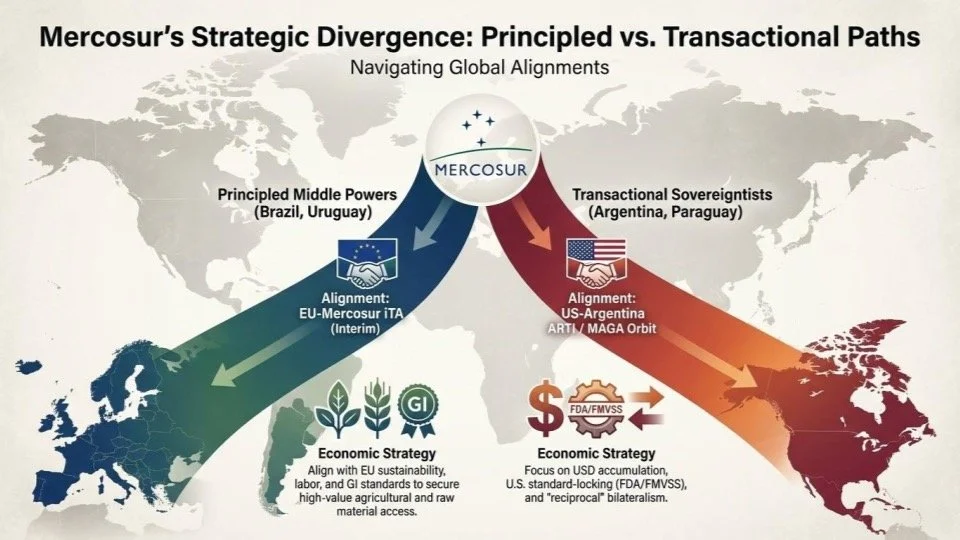
As the global trade order shifts from a "transition" to a "rupture," the consensus among pragmatists is hardening. The recent signing of the U.S.-Argentina ARTI has not only provided President Javier Milei with a tactical USD lifeline for IMF repayments but has effectively acted as a centrifugal force, spinning Argentina out of the traditional Mercosur orbit. In this context, a bold new strategy is emerging: the formal fragmentation of Mercosur to allow "middle powers" like Brazil and Uruguay to finalize their Atlantic bridge to Europe, leaving the MAGA-aligned bloc to its own devices.
The idea we floating—pragmatically accepting that the MAGA/Trump approach to fracturing economic blocs like Mercosur could succeed, and thus pivoting to let more centrist or EU-aligned members (Brazil and Uruguay) pursue bilateral or accelerated EU deals while leaving Argentina and Paraguay in the U.S. orbit—is bold, realistic, and surprisingly consistent with the multipolar realism Mark Carney articulated so powerfully at Davos last month.
The Carney Doctrine: Strategic Autonomy for Middle Powers
At the January 2026 World Economic Forum in Davos, Canadian Prime Minister Mark Carney delivered a speech that has become the manifesto for this new era. Carney argued that the "rules-based order is fading" and that middle powers can no longer "live within the lie" of integration when it becomes a source of subordination.
Rupture, Not Transition: Carney described the current state of trade as a fundamental break, where great powers use economic integration as a weapon.
Buying Autonomy: He urged nations to develop "strategic autonomy" in energy, food, and critical minerals—essentially building "buyers' clubs" and coalitions of the like-minded to avoid being forced to choose between hegemons.
The Power of Honesty: For Carney, pragmatism dictates that when the rules no longer protect you, you must protect yourself by forming ad-hoc coalitions.
Carney's January 20 speech framed the current global rupture as the end of the old "rules-based order" illusion—where integration was assumed to be mutually beneficial without coercion—and called for middle powers to adopt "value-based realism": principled yet pragmatic coalitions that build resilience against great-power dominance. He explicitly championed plurilateral bridges (e.g., linking TPP and EU frameworks to create massive new trading zones of 1.5 billion+ people) and urged adaptive partnerships over rigid multilateralism.
In that spirit, decoupling Mercosur's paths isn't betrayal—it's a pragmatic response to the hard reality: Trump's bilateral "reciprocal" deals (like ARTI with Milei's Argentina) are designed to peel off ideologically aligned players, rewarding loyalty with quick dollar access, tariff relief, and geopolitical signaling while undermining bloc cohesion.
The Mercosur Divorce: Ideology vs. Integration
The ideological chasm between Lula’s Brazil (focused on multilateralism and green standards) and Milei’s Argentina(focused on U.S./Trump/MAGA-aligned transactionalism) has reached a breaking point. And that's good!
The Argentina-U.S. Axis: Argentina has prioritized U.S. dollar accumulation to service its $20 billion debt, accepting asymmetrical terms in the ARTI that conflict with Mercosur’s Common External Tariff.
The Brazil-Uruguay Urgency: Brazil and Uruguay remain committed to the EU-Mercosur Partnership Agreement (EMPA), viewing it as a vital counterweight to U.S. and Chinese dominance.
The "MAGA Orbit": Paraguay and Argentina increasingly fit the profile of nations favoring the U.S. as a "Board of Peace" trading partner, prioritizing bilateral reciprocity over regional bloc solidarity.
Mercosur is already cracking under this pressure. Argentina's ARTI commitments—binding market openings, standards alignment, sanctions coordination, and GI concessions—lock it into a U.S.-centric trajectory that clashes with EU-Mercosur's sustainability, labor, and GI safeguards. Paraguay, often the quiet follower, may tag along for similar reasons (commodity exports + ideological sympathy).
Meanwhile, Brazil (under Lula) and Uruguay remain committed to diversified, multilateral ties—Brazil especially values China and EU balances. The EU-Mercosur pact, signed January 17 but frozen by the Parliament's January 21 ECJ referral (likely 18–24 month delay), is effectively zombified for now.
Why force a fractured bloc to wait when Brazil and Uruguay could negotiate standalone or "Mercosur-lite" FTAs with the EU?
Feasible Scenario: The "Bilateral Plus" Model
If the EU and Mercosur leaders follow Carney’s logic, the "zombie" bloc can be bypassed through a two-speed integration model:
analyzed by OneBizTutor®, Feb. 9, 2026, 01:28 p.m., São Paulo, Brazil
Torpedoing the Deadlock
By allowing Brazil and Uruguay to conclude an Interim Trade Agreement (iTA) with the EU independently, the "poison pills" in the ARTI—such as the conflict over Geographical Indications (GIs)—become Argentina's problem alone. This "Carney-esque" pragmatism acknowledges that a "world of fortresses" is inevitable, and the best defense is to choose your fortress wisely.
This isn't fragmentation for its own sake—it's strategic realignment that honors Carney's call for middle powers to act proactively:
Brazil gains faster EU market access for soy, beef, and biofuels without Argentina/Paraguay vetoes or U.S.-style alignments.
Uruguay (already exploring bilateral flexibility) accelerates its export diversification.
EU secures meaningful South American supply chains and counters U.S. leverage without endless Mercosur gridlock.
Argentina/Paraguay stay in Trump's orbit—gaining short-term dollar inflows for IMF survival—but accept the trade-off of reduced regional leverage.
Conclusion: A New Economic Orbit & The "Zombie" Agreement - Living the Truth
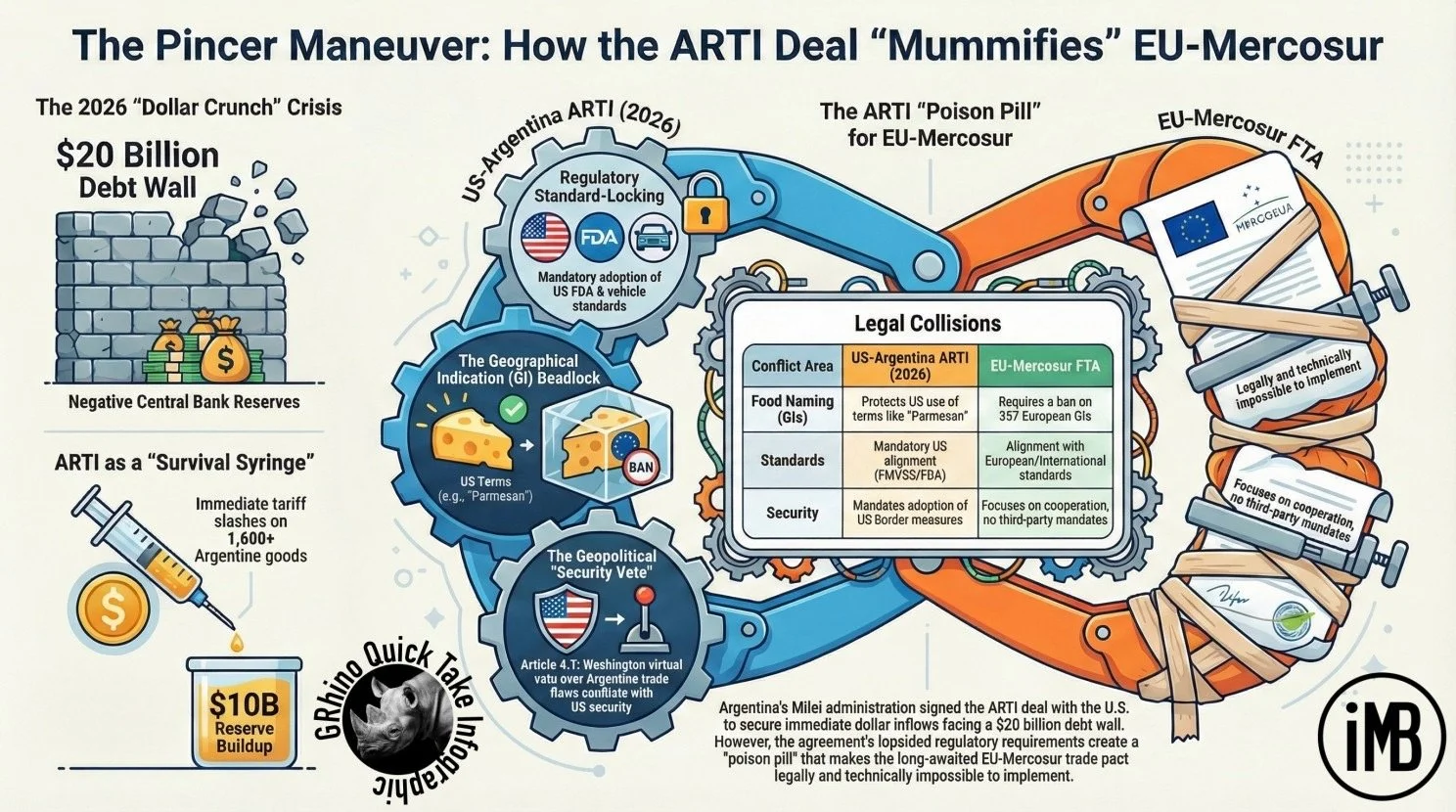
The ARTI represents a pivot from "Strategic Autonomy" to "Security Integration." By tying Argentina's regulatory, tax, and security policies to Washington, the Milei administration is signaling that its future lies within the U.S. economic orbit, even if the price is the slow mummification of its traditional European and regional ties.
Argentina’s trajectory suggests that the EU-Mercosur deal will remain a "zombie agreement"—periodically revived in rhetoric but mummified in practice by the binding, asymmetrical weight of the ARTI. As Argentina integrates into the U.S. economic orbit to service its debt, the dream of an Atlantic trade bridge to Europe appears to be sinking under the weight of the dollar.
The strategy is clear: rather than letting the EU-Mercosur deal mummify, the EU should pivot to those who still value the rules-based order. As Prime Minister Carney noted, "the strong do what they can, and the weak must suffer what they must"—unless the "not-so-powerful" countries band together to build their own resilient world.
The consistent implementation of Carney's vision would be middle powers (EU members, Brazil, Uruguay, Canada itself) forging agile, value-aligned coalitions that sidestep great-power coercion rather than clinging to outdated bloc formats.
This isn't defeatist—it's innovative survival in a ruptured order. Clinging to a dysfunctional Mercosur risks everyone losing; selective decoupling could create win-win pathways while respecting ideological realities. The EU should quietly greenlight Brazil-Uruguay tracks now—before ARTI's April entry-into-force cements the split further.
Scenarios Unfolded: From Triumph to Turmoil – And Innovative Paths Forward
analyzed by OneBizTutor®, Feb. 9, 2026, 01:44 p.m., São Paulo, Brazil
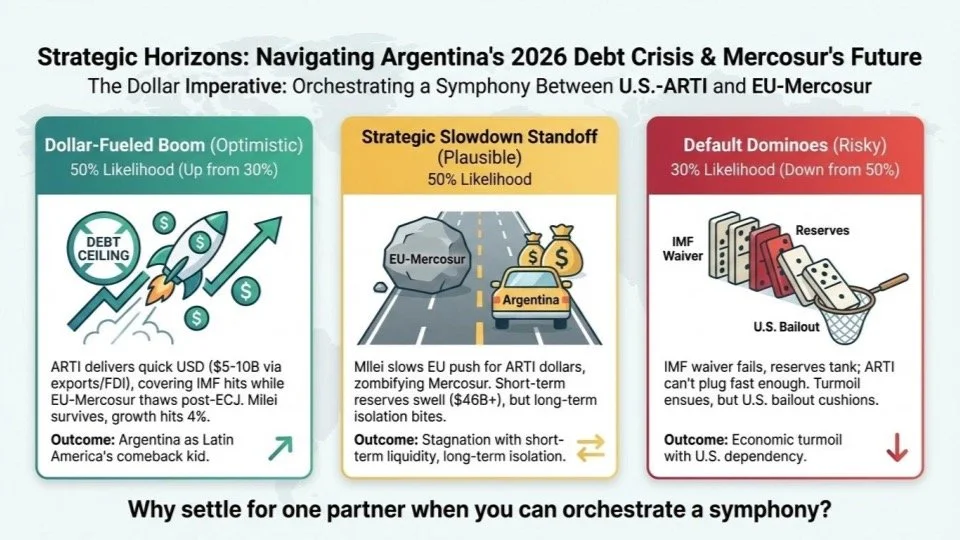
For President Milei, the ARTI provides the tactical breathing room needed to survive the 2026 debt crisis. For Brazil and the EU, a "two-speed" Mercosur provides the only path to a strategic partnership that isn't held hostage by the shifting winds of MAGA-style disruption. Incorporating the dollar imperative, we refresh our scenarios innovatively:
Dollar-Fueled Boom (Optimistic, 50% Likelihood – Up from 30%): ARTI delivers quick USD ($5-10B via exports/FDI), covering IMF hits while EU-Mercosur thaws post-ECJ. Milei survives, growth hits 4%. Outcome: Argentina as Latin America's comeback kid.
Strategic Slowdown Standoff (Plausible, 50% Likelihood): Milei slows EU push for ARTI dollars, zombifying Mercosur. Short-term reserves swell ($46B+), but long-term isolation bites.
Default Dominoes (Risky, 30% Likelihood – Down from 50%): IMF waiver fails, reserves tank; ARTI can't plug fast enough. Turmoil ensues, but U.S. bailout cushions.
Why settle for one partner when you can orchestrate a symphony?

All four visuals were generated by generative AI after the software read the overall risk assessment. Neither visual depicts a real situation.
This blog was originally published on the Substack platform and LinkedIn in the GreyRhino Newsletter on February 12, 2026. The newsletter was part of the digital media outlet of iMB.Solutions. Due to the reorganization of the media outlets, all publications by iMB.Solutions will now be concentrated on the website. Blogs and newsletters that are important in the current context have been transferred to the iMB.Solutions website. GreyRhino Newsletter will no longer be continued on the Substack and LinkedIn platforms.