

The Latent Empire: Strategic Autonomy, Institutional Resilience, and Brazil’s Pivotal Choice
Intro
For decades, Brazil’s physical and economic scale has promised far more than its international projection delivers. As a continental nation boasting vast natural capital, a deep diplomatic tradition, and world-class industrial and agricultural capabilities, the country continues to convert only a fraction of its inherent leverage into global influence, bargaining power, and sovereign freedom of action. In an era where global interdependence has taken on a distinctly coercive edge, where trade flows, technology stacks, and critical material inputs are routinely weaponized by major powers, Brazil’s longstanding habit of defining autonomy merely as non-aligned equidistance is no longer sufficient. True sovereignty requires real alternatives, structural competitiveness, and state continuity.
As the country navigates a decisive electoral contest between President Luiz Inácio Lula da Silva and Senator Flávio Bolsonaro, the political discourse is frequently consumed by personal controversies and partisan rhetoric. Yet beneath the campaign noise lie fundamental structural choices that will determine whether Brazil converts its raw potential into state power or remains perpetually trapped in cycles of institutional instability and unfulfilled promise.
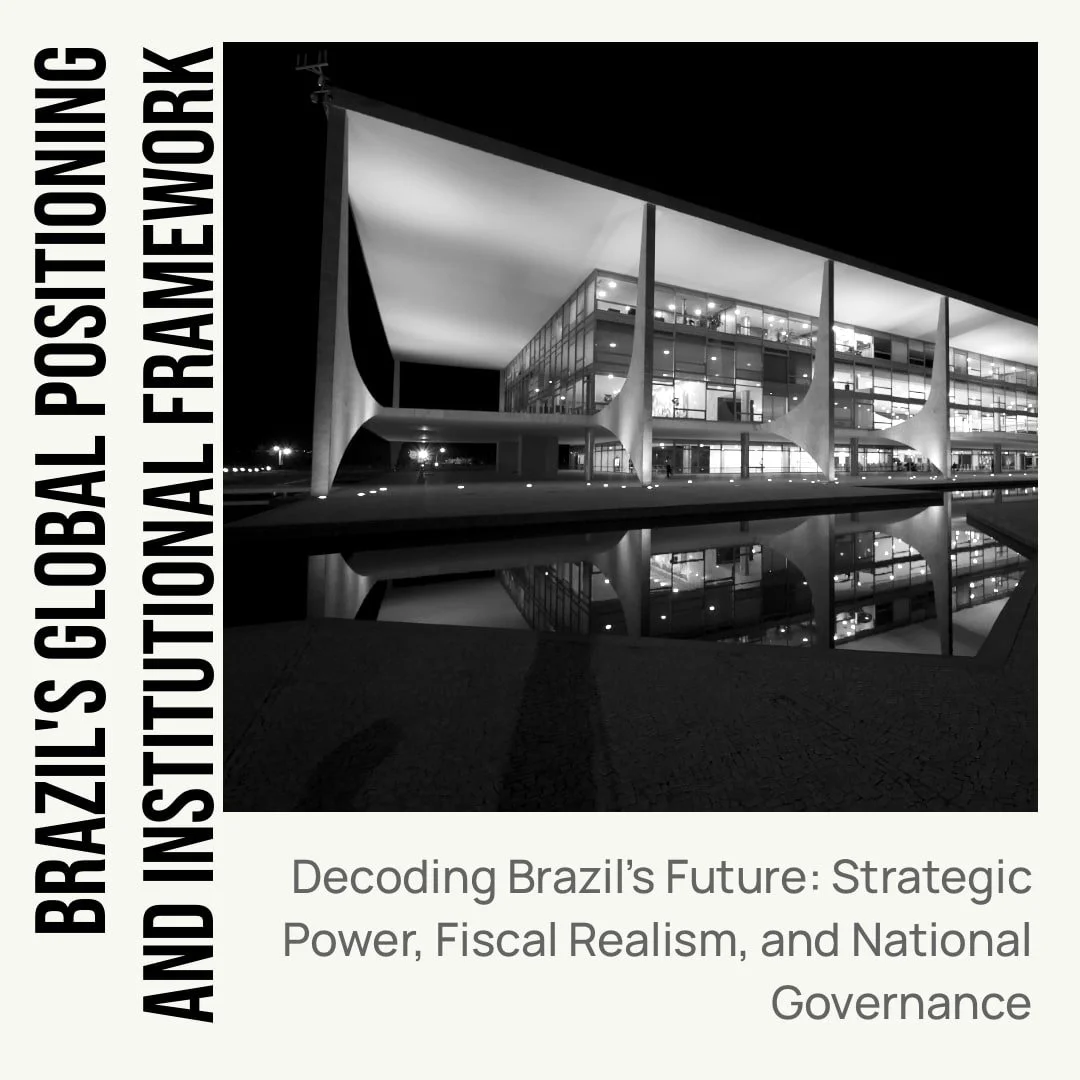
From Potential to Power: The Architecture of Strategic Autonomy
The modern international order operates on asymmetric dependencies. The United States, China, and the European Union systematically leverage market access, supply chain bottlenecks, and technological standards to constrain the strategic choices of other nations. For Brazil, achieving true autonomy cannot mean autarkic isolationism. Exposure to foreign competition forces domestic firms to modernize, accelerates technology transfer, and integrates local production into global value chains. Isolation merely insulates legacy inefficiencies and outdated business models from the pressures that drive innovation.
However, strategic openness without a national industrial strategy breeds structural vulnerability. Some dependencies carry far greater geopolitical weight than others:
The Rare Earths Dilemma: Possessing vast reserves of rare earth minerals yields negligible geopolitical leverage if a country merely exports raw ore. Strategic power materializes only when a nation masters the midstream and downstream processing technologies, refining raw elements into high-value components for electronics, renewable energy, and defense systems.
Agribusiness and Fertilizer Vulnerability: While Brazil stands as a global agricultural powerhouse, its reliance on imported fertilizers exposes its primary export sector to external supply shocks and geopolitical coercion.
The Embraer Paradigm: Embraer serves as a prime counter-example of intentional state capacity. By combining cutting-edge aerospace engineering with sustained public research and market-driven export execution, Brazil transformed domestic intellectual capital into a globally dominant high-tech enterprise.
Moving up the value chain requires diplomatic architecture capable of converting political relationships into tangible economic and technological access. Brazil’s identity, continental yet Atlantic, peaceful, and culturally plural, gives it a rare capacity to mediate across geopolitical divides. Yet soft power remains mere decoration unless translated into indispensable contributions to partner nations.
This dynamic starts in South America. Geographic footprint alone does not guarantee regional leadership; leadership must be earned through cross-border infrastructure, energy integration, shared security initiatives, and trade policies that make neighboring economies more prosperous and secure. Crucially, this requires institutional continuity. While elected governments rightly alter policy priorities, core state institutions like the Ministry of Foreign Affairs (Itamaraty), the Central Bank, and research agencies must maintain long-term strategic projects across presidential terms.
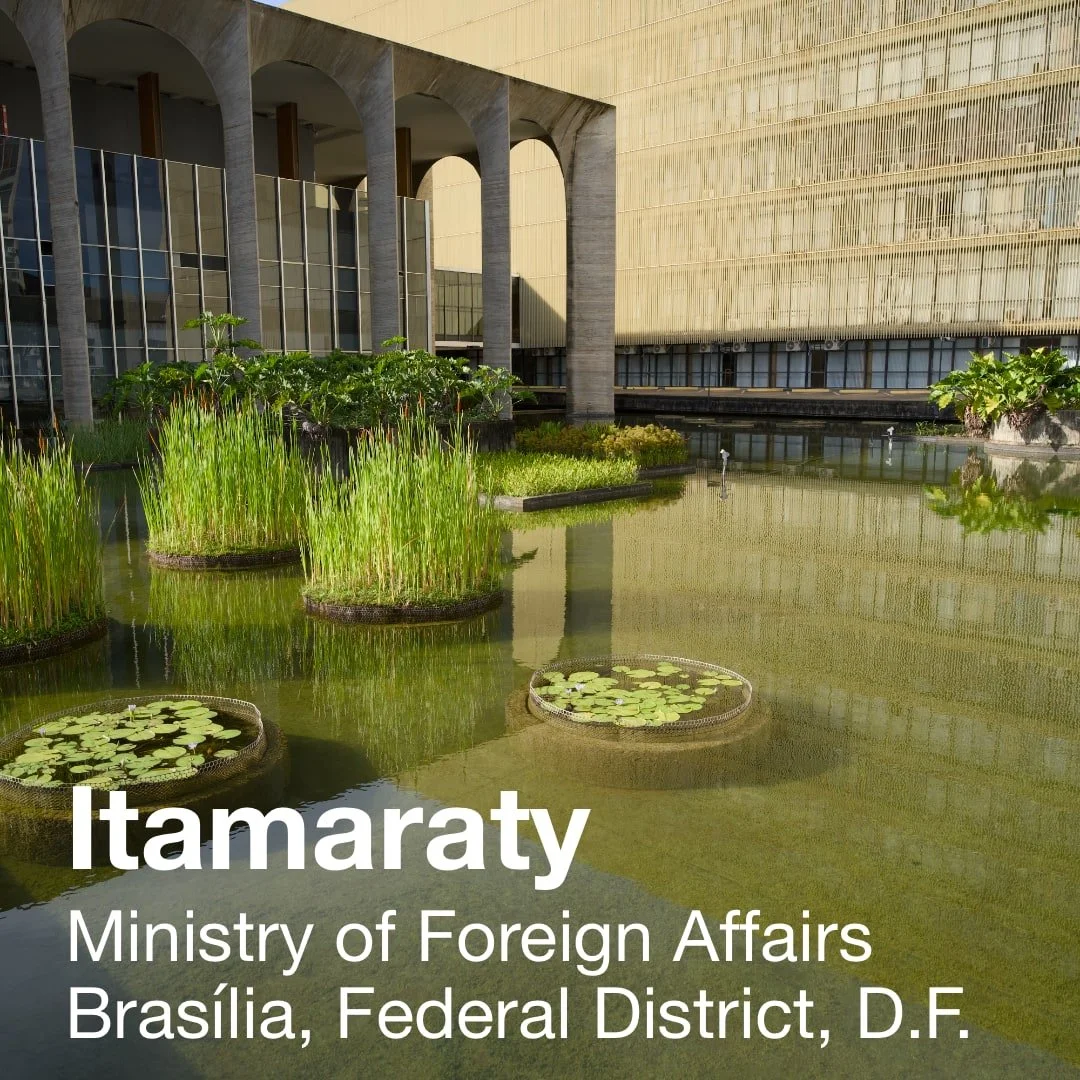
business visit May 2026, captured by Frank P. Neuhaus
The Seven Structural Imperatives Beyond Electoral Noise
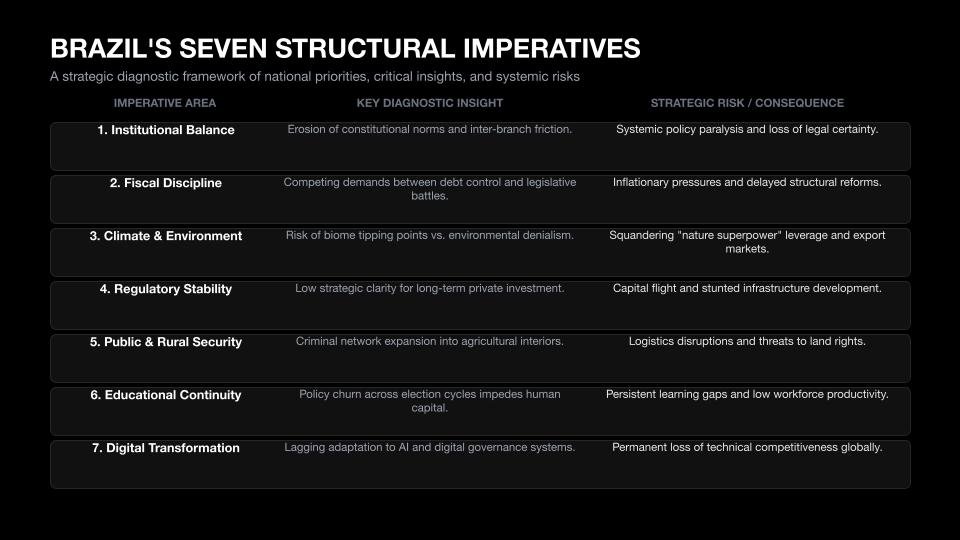
To understand what is genuinely at stake in Brazil's governance trajectory, eight prominent leaders across political science, macroeconomics, climate research, private enterprise, and social development have outlined seven critical structural imperatives that will shape the nation’s future.
iMB.Solutions Ltda., São Paulo, Brazil, Oct. 9th., 2026
1. Institutional Balance and Democratic Resilience
Democratic stability provides the essential floor for economic calculation. Political scientist Sérgio Abranches highlights systemic vulnerabilities within Brazil's institutional framework, including the ongoing minimization or denial of past anti-democratic actions, severe polarization within coalition presidentialism, and escalating friction between Congress and the Supreme Federal Court (STF). Rancher and former president of the Sociedade Rural Brasileira Pedro de Camargo Neto reinforces this from an agricultural perspective: without strict adherence to constitutional boundaries by the Executive, Legislative, and Judicial branches, private enterprise loses the legal predictability required for multi-decade investments.
2. Fiscal Realism vs. Legislative Distraction
Economist Armando Castelar Pinheiro (FGV / UFRJ) notes that Brazil’s economic path hinges on managing public debt, stabilizing benchmark interest rates (Selic), and creating conditions for sustainable long-term GDP growth. However, Solange Srour, director of macroeconomics at UBS Global Wealth Management, warns that technical fiscal management risks being derailed by congressional warfare. If legislative cycles are consumed by retaliatory political battles, such as amnesty debates or judicial impeachment proceedings, the political capital required to enforce fiscal discipline and overhaul burdensome tax codes will be completely depleted.
3. Climate Realism vs. Environmental Denialism
Climatologist Carlos Nobre warns that anti-environmental legislative efforts—such as proposals relaxing environmental licensing ("PL da devastação") or restricting the use of satellite imagery in monitoring illegal land clearing—threaten to push critical biomes like the Amazon, Cerrado, Pantanal, and Caatinga past irreversible tipping points. Connecting ecological preservation to national hard power, Instituto Igarapé president Ilona Szabó argues that Brazil's ultimate competitive advantage is becoming a global "nature superpower." Achieving this requires unifying environmental protection, rural law enforcement, and green economic development.
4. Regulatory Clarity and Capital Deployment
Long-term economic growth depends on predictable regulatory frameworks. Horácio Lafer Piva, board member at Klabin, stresses that a lack of overarching national strategy, compounded by frequent regulatory shifts, directly depresses capital investment from domestic and foreign businesses alike. In a rapidly reconfiguring global economy, slow governance and institutional uncertainty carry a compounding economic penalty.
5. Rural Security and Organized Crime
Public security is no longer confined to urban centers. Pedro de Camargo Neto highlights how organized crime networks have expanded into agricultural zones, threatening supply chains, land ownership rights, and local governance. Failing to enforce law and order in the countryside transforms public security from a social issue into a direct bottleneck on national agricultural export productivity.
6. Educational Persistence Over Political Re-invention
Priscila Cruz, executive president of Todos Pela Educação, observes that Brazil's primary educational bottleneck is not a lack of innovative proposals, but the systemic failure to sustain effective policies across changing political administrations. Closing learning gaps and elevating workforce productivity requires state and federal leaders to refine and scale established basic education frameworks rather than dismantling initiatives every four years for political rebranding.
7. Digital Transformation and AI Governance
Sérgio Abranches emphasizes that the global economy is undergoing a fundamental structural transition driven by digital technology and artificial intelligence. Brazil must rapidly build capacity to govern, regulate, and deploy digital systems across industry, public administration, and education. Falling behind in digital infrastructure risks rendering the nation structurally subordinate in the modern technological landscape.
Comparative Governance Pathways: Evaluating Economic and Institutional Models
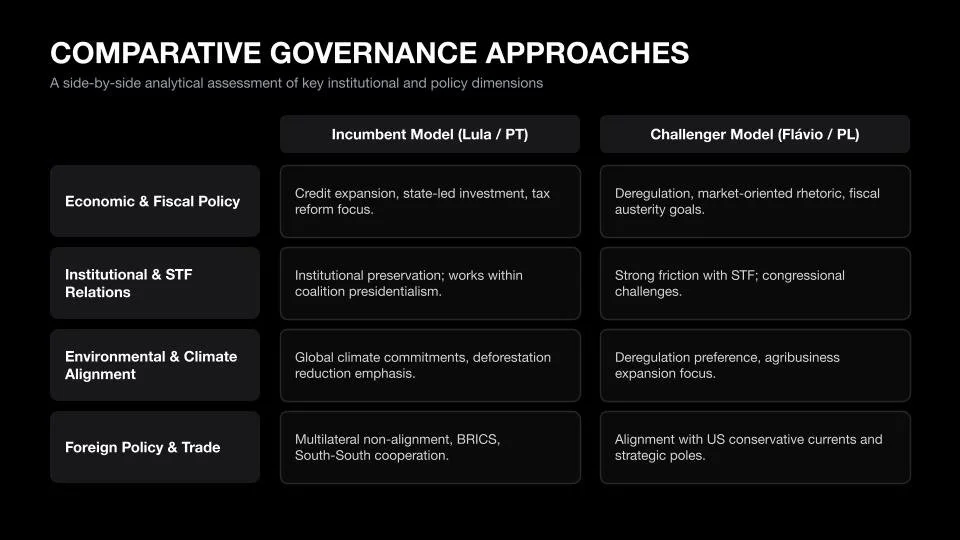
The choice facing Brazilian electors highlights contrasting visions for managing state power, economic balance, and foreign policy.
iMB.Solutions Ltda., São Paulo, Brazil, Oct. 9th., 2026
The Incumbent Trajectory: Fiscal Compromises and Multilateralism
Under President Luiz Inácio Lula da Silva, the economic framework has focused on state-led investment, credit expansion, and tax simplification. However, analysts note that growing public debt and elevated interest rates require firmer fiscal adjustments to prevent long-term macroeconomic instability. Internationally, Lula favors traditional multilateral diplomacy, active engagement in climate forums, and South-South integration, though balancing relationships between major competing geopolitical blocs remains an ongoing challenge.
The Challenger Trajectory: Market Deregulation and Institutional Realignment
Senator Flávio Bolsonaro presents an alternative model centered on market deregulation, conservative social priorities, and stronger legislative alignment. Proponents point to proposals aimed at reducing red tape and fostering private sector activity. Critics, however, highlight significant risks, including potential escalation of conflict with the judiciary, rolling back environmental protections in favor of short-term expansion, and a foreign policy tightly aligned with specific foreign political movements, which could compromise Brazil's traditional diplomatic flexibility.
Rivaling global superpowers on every front is an unrealistic goal for any developing nation. The viable ambition for Brazil is to cultivate sufficient economic strength, institutional stability, and technological capacity to negotiate with international partners from a position of mutual necessity rather than structural submission. Converting raw natural wealth, demographic scale, and cultural breadth into true global leverage requires moving beyond transient campaign promises. Ultimately, the true test of Brazilian statecraft is whether its leaders can build enduring state policies that protect democratic institutions, secure fiscal stability, and command global respect.
Final Thought about the Greater Risk
A Fourth Lula Term Could Be Troublesome in Economics — But a Flávio Bolsonaro Administration Would Be Catastrophic Across the Board
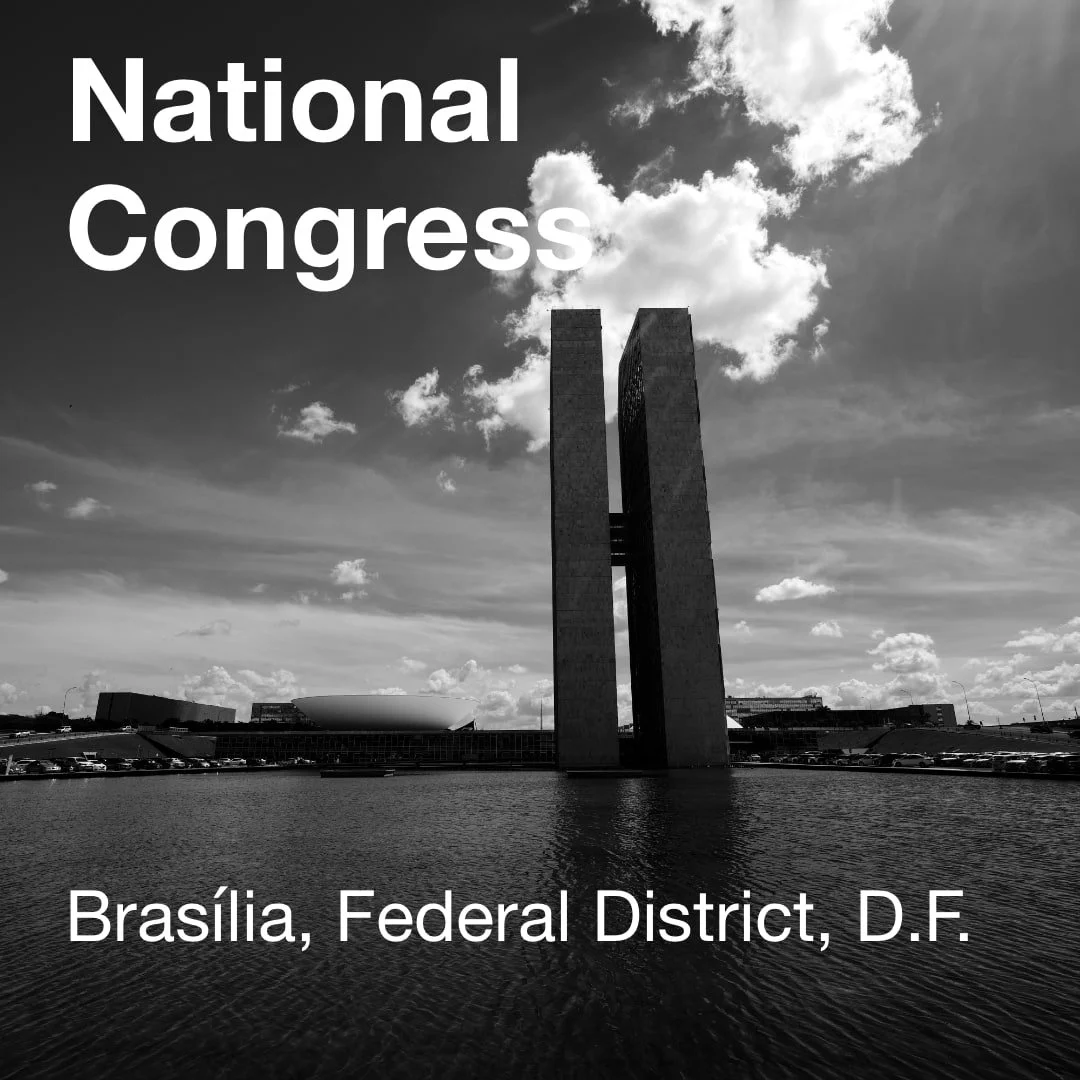
President Luiz Inácio Lula da Silva may be the focus of economic headlines, but Senator Flávio Bolsonaro represents a far more dangerous threat to Brazil’s future. While Lula has yet to fully grasp the need for serious fiscal adjustment and public-account rebalancing, Flávio Bolsonaro and his family show no regard whatsoever for the values that truly define a civilized society — democracy, culture, the environment, international relations, and religious freedom. The stakes could not be higher.
A fourth Lula administration would likely be problematic in the economic sphere, but it would at least remain predictable. A Flávio Bolsonaro administration, by contrast, would be catastrophic in multiple areas, with consequences that are difficult to calculate. Even in economics, the picture is far less clear-cut than many pundits admit. An incredible huge part of the Brazilian financial market still treats economic policy as a purely technical exercise, detached from culture, institutions, and foreign policy. That assumption is dangerously outdated.
In the international arena, Brazil would almost certainly become a junior partner to Donald Trump’s United States, with little room for independent voice. On the environment, expect a return to the war against environmentalists, climate-change denialism, and a sharp rise in illegal deforestation. Institutionally, the clashes with the Supreme Federal Court (STF) would intensify, and the campaign to free former President Bolsonaro from prison — over the attempted-coup charge — would gain momentum.
In health, everyone still remembers the elder Bolsonaro’s disastrous pandemic management: open disdain for vaccines, mocking of the dead, and promotion of unproven treatments such as chloroquine. Education would be marked by a fixation on military schools and an aggressive campaign against public universities and progressive teachers. Public security could move in the opposite direction, with fewer restrictions on firearm ownership. Culture would be reduced to a caricature of artists as a lazy social subclass. Even the recent controversy over Our Lady of Aparecida took on a new, toxic dimension thanks to the radical Evangelic pastors surrounding the Bolsonaro family and their religious intolerance.
Lula entered office with a clearly retrograde economic philosophy. All the current positive indicators rest on unsustainable levels of public debt. He will be forced to adjust — either through his own will or to avoid a deeper crisis. Flávio Bolsonaro, however, would not face the same constraints. Backed by Donald Trump, with control of Congress and the ability to appoint judges who would deliver a pro-government majority at the STF, he could pursue his extremist agenda with almost complete freedom.
The next decade will be decisive. Brazil is at a crossroads: either a government that understands the rules of democracy and the environment, or one that treats them as obstacles to be dismantled. The choice is not between Lula and Flávio Bolsonaro. It is between a risky but recognizable path and a potentially catastrophic one. The difference, in the end, could not be greater.