

PODCAST DEBATE: Burning Empires in the Intelligence Supercycle: The Strategic Mandate for Creative Destruction
The End of Linear Strategy
In March 2026, we at iMB.Solutions Ltda participated in SXSW in Austin, Texas, USA, for the third time. Drawing on insights from various project missions undertaken in 2026—and with a keen eye on the increasingly evident disruptive trends—we have concluded that a fresh perspective is essential; equally critical is the need to rapidly develop, test, and adapt new project management skills and organizational structures.
This blueprint paper summarizes the key takeaways from SXSW 2026 and highlights emerging trends observed during our 2026 project missions—conducted primarily in Brazil and Argentina—in collaboration with clients from France, the USA, Argentina, and Brazil.
For decades, corporate strategy relied on tracking isolated, sequential technological trends. Today, that linear playbook is not just outdated—it is a fatal liability. As futurist Amy Webb definitively demonstrated at SXSW 2026 by holding a symbolic "funeral" for her annual trend report, the era of predictable technological disruption is dead.
We have formally entered the Intelligence Supercycle, a convergence era where artificial intelligence, programmable biology, advanced sensors, and global capital are colliding and compounding simultaneously. In this highly volatile environment, the most consequential threat to an enterprise is no longer external competition, but its own refusal to dismantle outdated internal operations.
Creative Destruction on Purpose
The core thesis of the "Burning Empires in the Intelligence Supercycle" audio blog/podcast debate is that survival now demands "creative destruction on purpose." Our authoritative stance is clear:
Corporate leaders must possess the discipline to deliberately burn down their own legacy empires—whether that means abandoning rigid Excel-based planning or dismantling outdated human-centric workflows—at the exact right moment to build anew.
Organizations that merely attempt to layer advanced AI over broken, legacy processes (a mistake known as "paving the cow path") are destined for pilot purgatory and structural failure.
The Forces Redefining the Enterprise
To architect the enterprise of the future, leaders must master the structural convergences transforming business by 2026:
The Agentic Economy & The New Labor Equation: We are rapidly transitioning to a silicon-based workforce where output and GDP decouple from human headcount. Autonomous AI agents are no longer passive tools; they execute complex, end-to-end composite workflows, demanding that organizations engage in "agent-first process redesign".
Living Intelligence: AI is escaping the cloud to embed itself in the physical world. The fusion of biological and digital systems means that biology is now "programmable infrastructure," creating systems that can actively sense, adapt, and evolve in real-time.
The Strategic Verdict
To survive the Convergence Era, executives must shift from being passive observers of disruption to active architects of an AI-native organization. The "Burning Empires" audio overview serves as the ultimate blueprint for this transition. The mandate is absolute: adapt to continuous, dynamic governance cycles, or allow the market to violently restructure your business for you.
Executive Summary Infographic
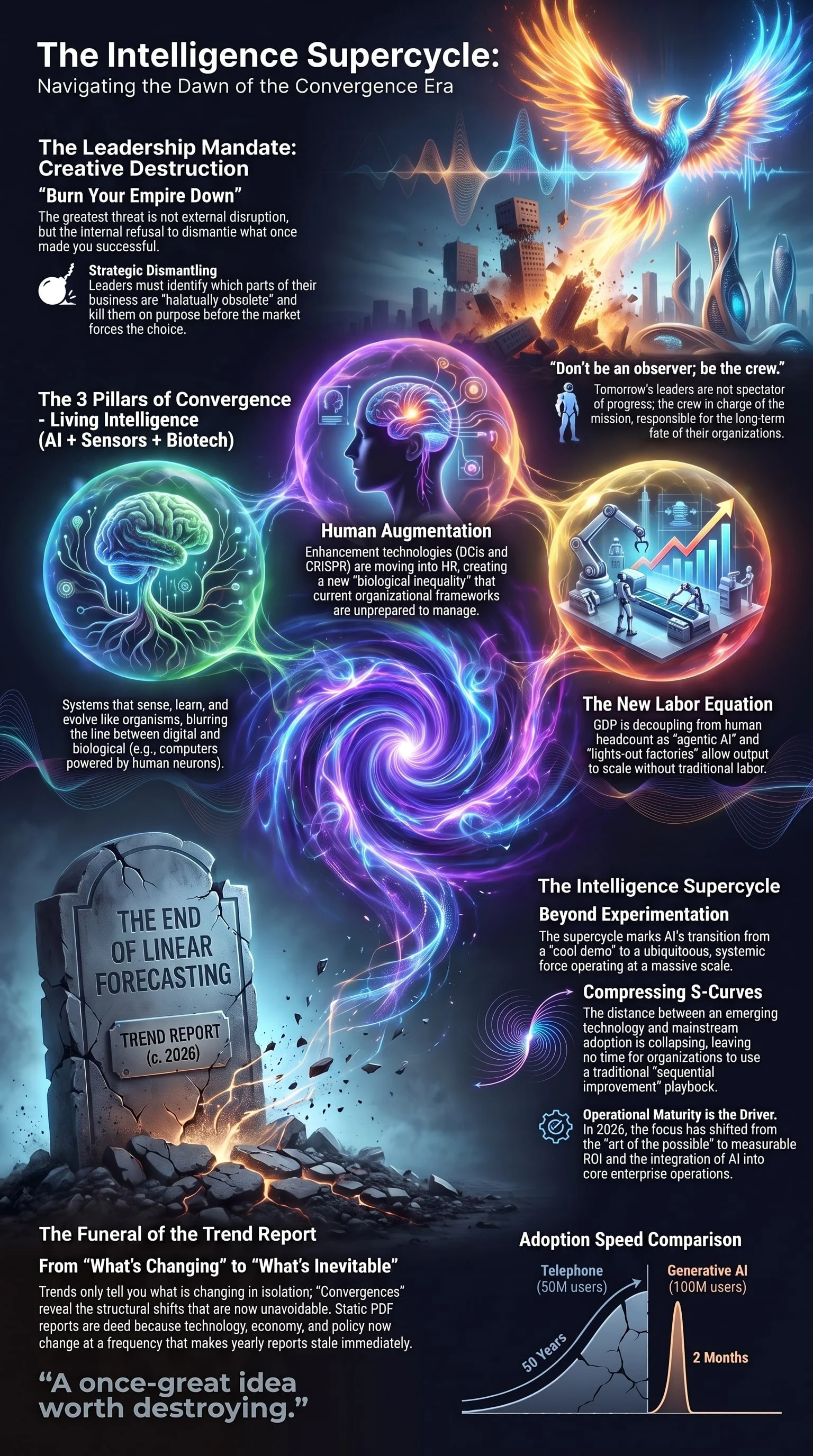
generated by OneBizTutor®, iMB.Solutions Ltda., August 2026, São Paulo, Brazil
Disclaimer
In preparing this newsletter/blog/audio blog/podcast/video, we used the following AI-based tools: OneBizTutor, our agentic AI platform applied within our project missions.
Google Gemini Notebook Pro, to review and scan source materials and support the identification of relevant literature. Grammarly Pro, for language and grammar correction, and stylistic guidance on sentence clarity. Claude (Sonnet 4.5), Anthropic, for brainstorming ideas, formulating clear phrasing concepts we had already developed, structuring sections and arguments, and iterative editing support during the drafting and revision process. None of these generated the content of this newsletter and/or blog. The research question, the design and conduct of project missions and relevant market research for clients, the data collection, the analysis, and the interpretation of findings are our own independent work. Where AI tools were used for language or formulation support, the underlying ideas and arguments originated from us. All AI-assisted text was critically reviewed, verified, and edited before inclusion.