

Intro
Navigating Argentina’s business landscape in 2026 demands a complete recalibration from market-share growth to high-friction risk containment. In the podcast "Surviving the Deregulation Paradox in Argentina," business analysts unpack ground-level intelligence from 196 C-suite leaders and operating managers to reveal how recent economic shifts impact corporate balance sheets.
Unpacking the 2026 Deregulation Paradox
Market deregulation in the absence of judicial reform has transformed—rather than eliminated—operational corruption. By dismantling federal oversight bodies like the Oficina Anticorrupción and internal audit units within the ARCA tax and customs agency, the state has created an accountability vacuum. Mid-level inspectors exploit technical holds (Canal Rojo) on critical spare parts, creating $100,000+/day demurrage traps. Paying informal "facilitation fees" triggers direct corporate criminal liability under the US Foreign Corrupt Practices Act (FCPA) and Argentina’s Ley 27.401.
P&L Pressures: Atraso Cambiario and Logistics Decay
The podcast episode explores how corporate P&L statements are squeezed by two primary policy drivers:
Real Peso Appreciation (Atraso Cambiario): A managed crawling peg exchange rate lagging inflation inflates domestic input, labor, and transport costs in hard USD terms.
Infrastructure Collapse (Obra Pública Zero): The total freeze on federally funded public works has led to severe road decay on routes like Ruta Nacional 7, forcing 90% of cargo onto trucks while utility rate hikes fail to prevent summer power grid blackouts.
Four Feasible Playbooks for International C-Suites
The episode outlines four executive frameworks to safeguard capital:
Minimum Viable Footprint (MVF): Scaling down to skeleton entities for brand licensing without committing new equity.
Regional Nearshoring: Relocating assembly to Paraguay under the Maquila Regime (Law 7547) for a 1% re-export tax, or shifting regulated manufacturing to Brazil.
Dual-Track Logistics: Routing spring/summer exports through Chilean Pacific ports (Valparaíso) to bypass Atlantic red tape.
RIGI Enclave Integration: Focusing B2B sales exclusively on energy and mining mega-projects backed by the Large Investment Incentive Regime (RIGI), structured under foreign governing law (NY/UK) with offshore USD settlements.
The Infographic Executive Summary
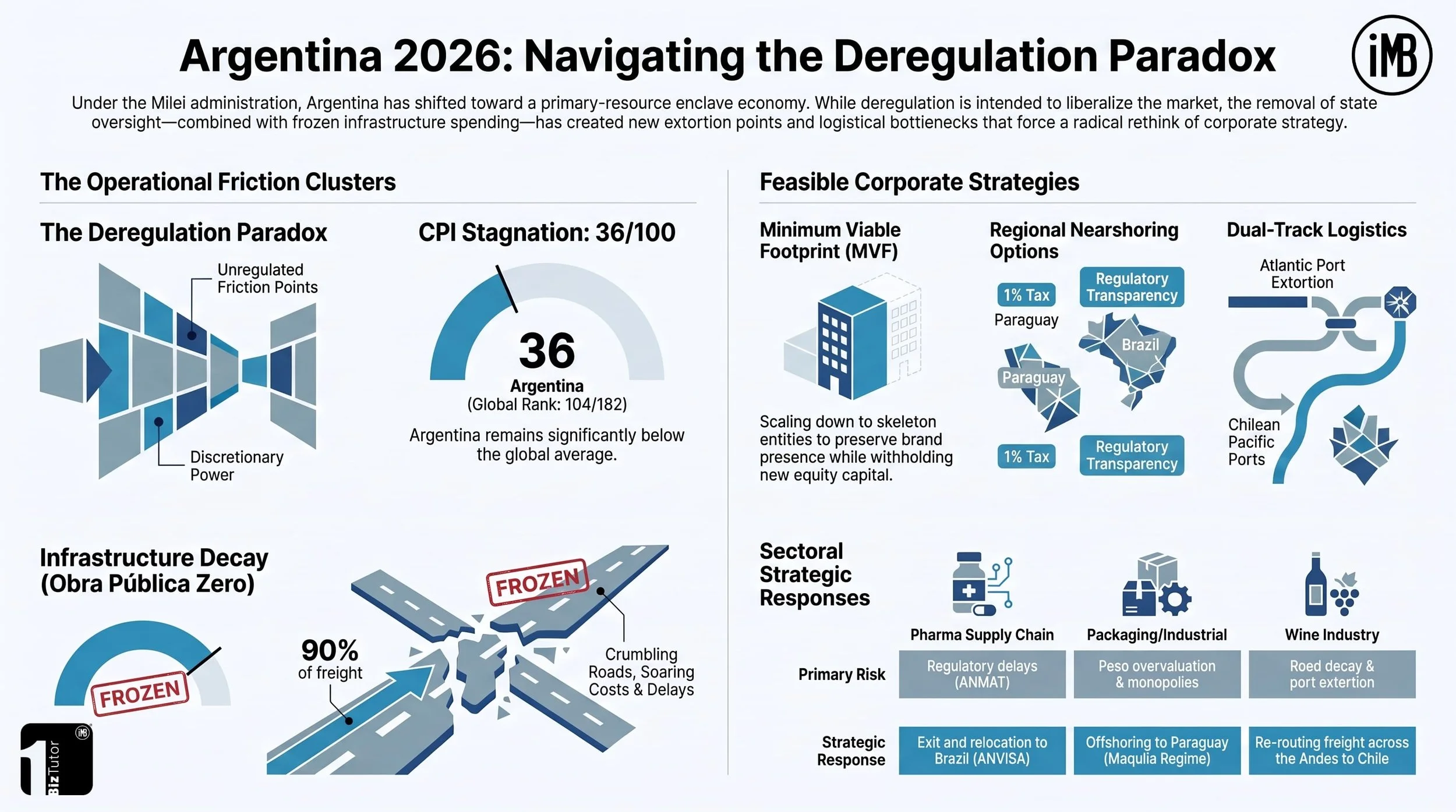
generated by OneBizTutor®, iMB.Solutions Ltda., São Paulo, Brazil - October 2026