

Case Study: Brazil’s Electrified Transit Hegemony - An Industrial Strategy Perspective on Regional Leadership and Domestic Value Chains

Client: Confidential European EV Component & Engineering Company
Business Development Project: Market Feasibility and Entry Strategy – Brazil (São Paulo Focus)
1st Stage Consultancy & Project Management: iMB.Solutions Ltda.
Key Tool: OneBizTutor®
Executive Summary
The Brazilian electric commercial vehicle market has transitioned into a phase of aggressive industrial scaling, boasting a 30.04% CAGR. The primary challenge for European entrants is the highly insulated nature of the market, which is governed by strict local-content financing requirements and the dominance of domestic system integrators. This study identifies the São Paulo Metropolitan Area as the critical entry point, where the municipal fleet (SPTrans) has already surpassed 1,000 zero-emission buses.
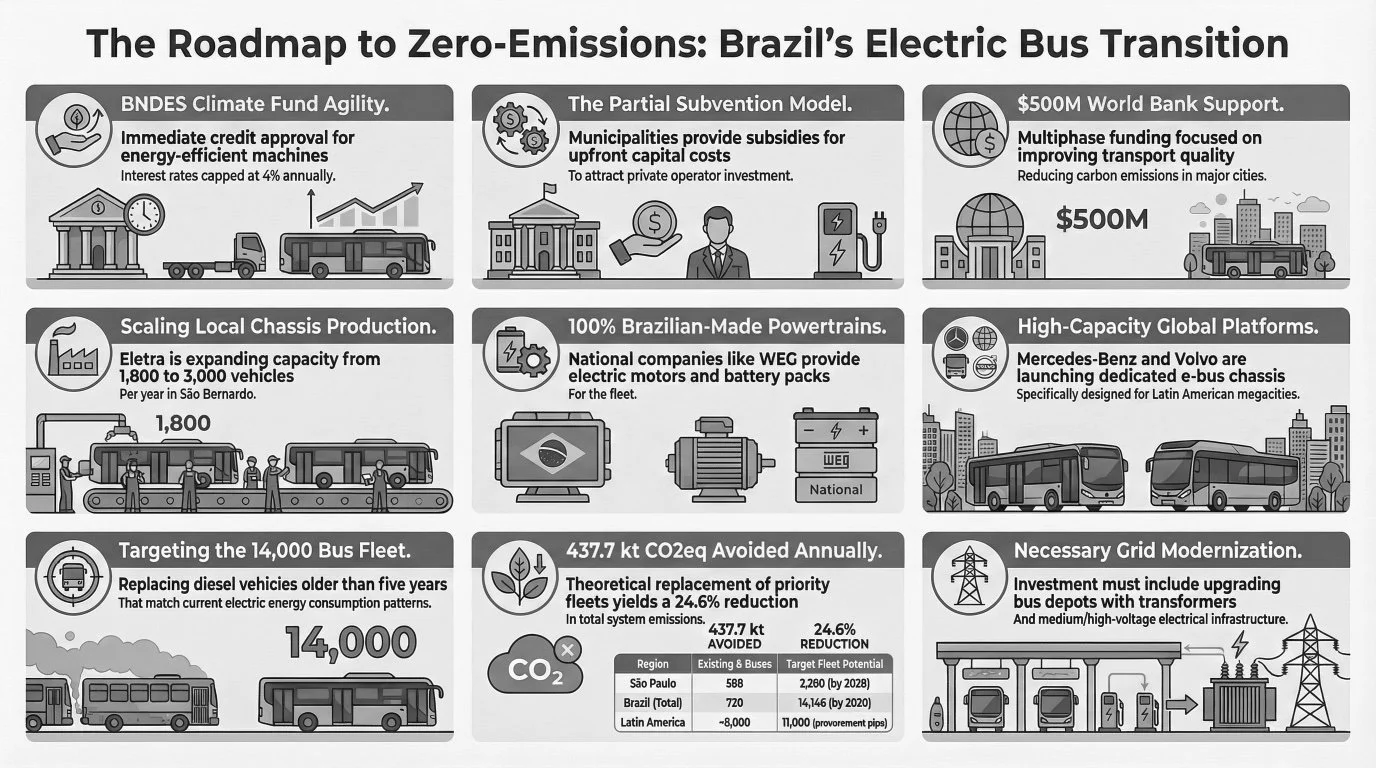
extract from project milestone presentation, generated by OneBizTutor® Q1 2026, iMB.Solutions Ltda., São Paulo, Brazil - modified for blog publishing
Strategic Context: The Transformation of Brazilian Public Transport
The transition toward electro-mobility in Brazil is a critical industrial and social intervention designed to solve a structural financial crisis in public transport. Currently, passenger demand remains approximately 20% below pre-pandemic levels, undermining a system that is a cornerstone of social inclusion for 53 million daily passengers—80% of whom are low-income.
Revitalizing this sector is essential not only for urban productivity but for maintaining the equitable access to services that underpins Brazilian social stability.
The "Case for Change" is underscored by the severe externalities of the legacy diesel model. Aging fleets and pollution contribute to public health crises and productivity losses that cost major hubs like São Paulo up to 8% of local GDP. Conversely, electric buses (e-buses) present a superior Total Cost of Ownership (TCO); despite higher upfront CAPEX, they offer at least a 30% reduction in energy and maintenance costs with a significantly longer service life. This client project evaluates as well, how the synergy between domestic manufacturing and agile credit systems—specifically the BNDES and World Bank-backed frameworks—will position Brazil to lead the Latin American electrified fleet by 2026. This strategy is anchored in the industrial expansion of the ABC region.

Avenida Paulista, São Paulo, Brazil (2026), editorial rights iMB.Solutions Ltda.®
The Industrial Core: Eletra and the Expansion of Domestic Chassis Production
Domestic chassis production is the linchpin of Brazil’s industrial strategy. By internalizing this segment, Brazil reduces its historical dependency on international supply chains and effectively counters the dominance of Asian giants such as Yutong Bus and BYD. Unlike importers who face exchange rate volatility and lengthy lead times, a domestic chassis provider offers "ready-to-operate" units with nationalized maintenance cycles.
Eletra, based in São Bernardo do Campo, is spearheading this shift with a R$ 40 million investment to expand its industrial park. While Eletra has a history of integrating with established OEMs like Scania and Mercedes-Benz, its move toward a "100% Brazilian" chassis line marks a shift toward technological autonomy.
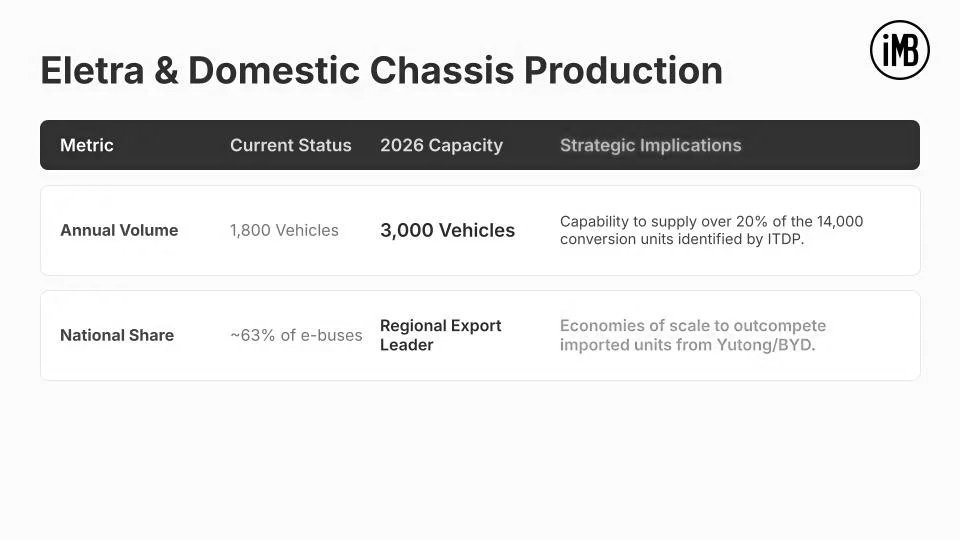
extract from project milestone presentation, generated by OneBizTutor® Q1 2026, iMB.Solutions Ltda., São Paulo, Brazil - modified for blog publishing
The "So What?" Layer: Internalizing production allows Brazilian manufacturers to satisfy evolving local content requirements while providing logistical security. By producing locally, Brazil transforms the energy transition into a driver for high-skilled domestic job creation, moving away from being a mere destination for foreign-made technology.
Technological Sovereignty: Integrating WEG and National Powertrain Technology
Technological sovereignty in the electric vehicle (EV) value chain requires domestic control over the powertrain—the motor and battery systems. This prevents Brazil from simply trading foreign diesel engines for foreign electric components.
The partnership between Eletra and WEG is the cornerstone of this sovereignty. Eletra vehicles utilize the WEG Powertrain, featuring advanced three-phase motors and frequency drives, supported by WEG’s US$ 20 million investment in local battery plants. This integration involves a sophisticated synergy: Eletra provides the chassis, WEG the powertrain, and partners like Caio or Marcopolo provide the bodywork. Notably, while the Caio eMillenium utilizes Eletra's integration, Marcopolo’s Attivi represents the first electric bus featuring Marcopolo's own chassis, signaling healthy competition within the domestic ecosystem.
Key Benefits of National Integration:
Zero Emissions: Elimination of NOx and PM2.5 at the tailpipe.
Regenerative Systems: Braking technology that recovers energy to extend range (approx. 250 km).
Logistical Security: Immediate parts availability and nationalized maintenance, mitigating the downtime risks common with imported Asian models.
Financing the Fleet Transition: BNDES and the MPA Phase 1 Framework
Accessible capital is the primary catalyst for municipal modernization. Brazil has strategically shifted its policy lever from the old Nationalization Index (60% local content) to the new Accreditation Index (30% local content). This historic move prioritizes "technological content" and innovation over raw vehicle weight, allowing for higher-value imports of specialized components while maintaining domestic assembly dominance.
The BNDES Online system, utilizing the Climate Fund (FNMC), provides immediate credit approval for accredited national equipment. Crucially, the FNMC offers a specific 4% per year interest rate cap for efficient equipment—a stark contrast to private market rates that can reach 22%. Furthermore, the World Bank’s Multiphase Programmatic Approach (MPA) Phase 1 provides US$ 500 million, implemented by Caixa Econômica Federal as a financial intermediary to improve bankability and reduce technological risks.
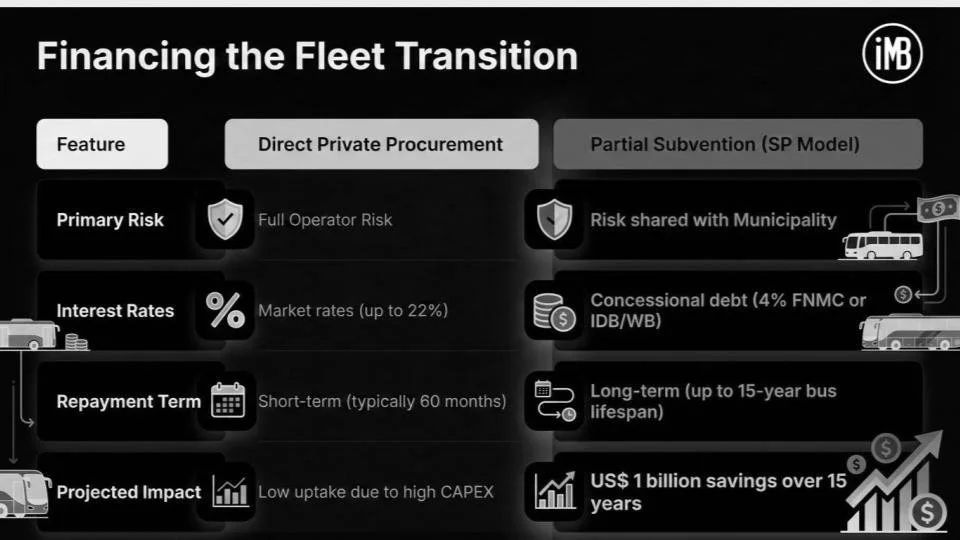
extract from project milestone presentation, generated by OneBizTutor® Q1 2026, iMB.Solutions Ltda., São Paulo, Brazil - modified for blog publishing
Municipal Execution: São Paulo and Curitiba as Implementation Hubs
Major urban centers act as the "demand signals" necessary for industry to scale.
São Paulo: Armed with R$ 1.4 billion from the Inter-American Development Bank (IDB), the city aims for 2,200 electrified buses by 2028.
Curitiba: Utilizing R$ 380 million in BNDES funding, the city is renewing its fleet with an initial 54 electric units.
The "So What?" Layer: These high-volume municipal orders create the economy of scale for Eletra and WEG to justify their industrial expansions. However, a significant policy bottleneck remains: grid infrastructure. In São Paulo, the US$ 430 million gap for depot upgrades and grid connections presents a risk, as these connections can take up to a year to complete. Addressing this infrastructure delay is vital for meeting 2026 targets.
The Regional Race: Surpassing Chile and Mexico by 2026
While Chile and Colombia were early adopters of electromobility, their models rely heavily on importation. Brazil is a late but more robust entrant, utilizing an "Industrialization vs. Importation" strategy.
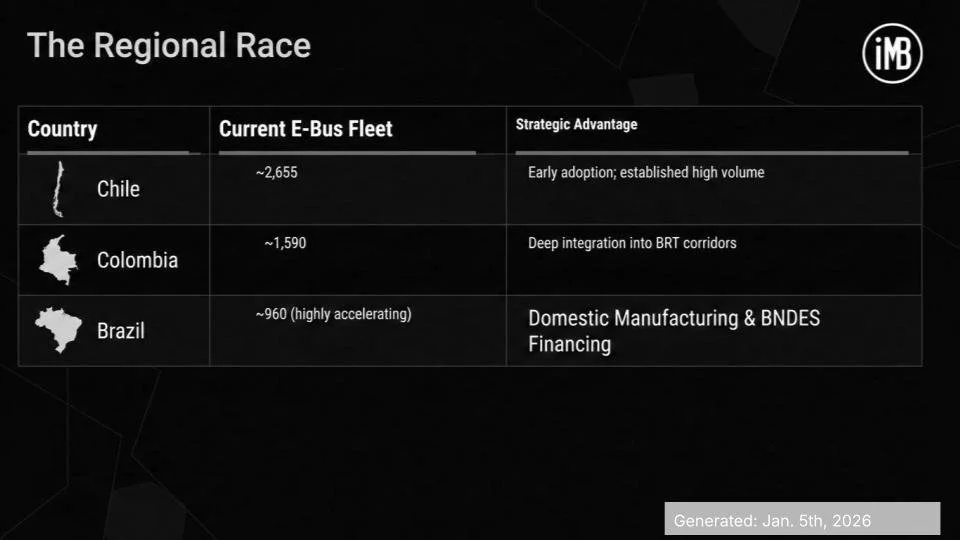
extract from project milestone presentation, generated by OneBizTutor® Q1 2026, iMB.Solutions Ltda., São Paulo, Brazil - modified for blog publishing
The "So What?" Layer: By 2026, Brazil is on track to surpass its neighbors by leveraging its ability to supply "ready-to-operate" domestic units. By bypassing the exchange rate volatility and shipping delays that affect its competitors, Brazil is transforming into the regional exporter of choice for sustainable transit solutions.
Strategic Conclusions and Future Outlook
The convergence of industrial capacity (Eletra/WEG), financial agility (BNDES/Caixa), and municipal demand (São Paulo/Curitiba) has positioned Brazil for regional hegemony. This model is a blueprint for middle-income nations to leverage the energy transition to rebuild domestic sectors.
Critical Strategic Takeaways:
Employment & Policy: This transition is projected to generate 280,300 direct jobs by 2030, a goal supported by the New Industry Brazil (NIB)and the Mover Program, which provide the tax incentives and recycling mandates necessary for a circular EV economy.
Infrastructure Bottlenecks: The US$ 430 million grid gap must be resolved. Financing models must evolve to include depot upgrades, or the physical ability to charge will lag behind the industrial ability to produce.
COP30 Leadership: As Brazil prepares for COP30 in Belém, it is no longer just a consumer of green tech. It is a global player capable of exporting a fully integrated, nationalized, and financed model for public transport decarbonization.
Market Study Deep Dive
Market Dynamics & Competitive Landscape
The analysis revealed a unique market structure where domestic players outmaneuver global giants through strategic "national technology" partnerships.
The Dominance of Eletra: Eletra, a domestic system integrator, commands a 65% national market share and a 68% share of the São Paulo municipal fleet.
Architectural Divergence: The market is split between Vertical Integration (e.g., BYD, which faces friction due to local-content rules and limited service networks) and System Integration (e.g., Eletra, which uses WEG powertrains and Mercedes-Benz/Scania chassis).
The "ABC" Industrial Heart: The Greater São Paulo/ABC region (Santo André, São Bernardo do Campo, and São Caetano do Sul) remains the undisputed hub for manufacturing and servicing.
Key Success Factors: Financing & Maintenance
BNDES "Finame" Access: To access low-interest credit (approx. 4% vs. 20% commercial rates), vehicles must meet high local-content indices. Eletra’s 90%+ nationalization rate makes it the preferred choice for operators seeking financing.
Partial Subvention Model: In December 2023, São Paulo implemented a model where the city government directly subsidizes the price premium of electric buses over diesel, de-risking the transition for private operators.
The Service Network Advantage: Operators prioritize "serviceability." By using chassis from traditional OEMs, Eletra-integrated buses can be serviced at hundreds of existing dealerships, neutralizing the risk of downtime.
Strategic Recommendations for Market Entry
The study proposes three primary paths for the European client:
Tier 1 Supplier to Integrators (Priority): Establish local assembly in the ABC region to supply components (e.g., thermal management, DC-DC converters) that contribute to Eletra’s >90% local content index.
Modular OEM Partnerships: Partner with traditional chassis OEMs like Mercedes-Benz or Volvo for components optimized for Brazilian duty cycles.
Retrofit Market: Tap into the reservoir of 14,000+ diesel buses slated for replacement by offering modular powertrain components for retrofitting.
OneBizTutor® Workflow: Project Phases & AI Integration
click on brand logo above and access OneBizTutor®
iMB.Solutions utilized OneBizTutor® as a central intelligence hub to accelerate data processing and strategic synthesis across four distinct phases:
Phase I: Discovery & Data Aggregation
Workflow: OneBizTutor® ingested thousands of pages of Brazilian regulatory filings, BNDES financing guidelines, and SPTrans procurement records.
AI Role: The tool used Natural Language Processing (NLP) to extract specific "Local Content" requirements and identify the exact "Accreditation Indices" needed for Finame eligibility.
Phase II: Competitive Benchmarking & SWOT Synthesis
Workflow: iMB.Solutions project managers and the client used the AI to perform a comparative analysis of BYD, Eletra, and Mercedes-Benz.
AI Role: OneBizTutor® generated a multi-dimensional SWOT table, specifically highlighting the "hidden" weakness of global OEMs—their limited national dealership networks (~40 locations) compared to the "leveraged" networks of system integrators.
Phase III: Financial & Policy Modeling
Workflow: Modeling the impact of the "Partial Subvention" model on private operator ROI.
AI Role: The tool simulated various "15-year cost reduction" scenarios, validating the estimate that the subvention model reduces city costs by approximately US$ 1.0 billion.
Phase IV: Strategic Roadmap Generation
Workflow: Translating complex market barriers into actionable "Market Entry Tiers".
AI Role: OneBizTutor® assisted in drafting the final "Tier 1 Supplier" recommendation, specifically identifying the ABC region as the optimal geographical footprint for the client’s local assembly plant to maximize BNDES compliance.
Implementation Timeline for Recommendation One
This implementation timeline is designed for a European component manufacturer aiming to become a Tier 1 supplier for the Brazilian electric bus market, specifically targeting integration with leaders like Eletra and chassis OEMs in the ABC region.
The primary objective is to achieve BNDES Finame certification, which is the "golden ticket" for high-volume sales in Brazil.
Phase 1: Local Presence & Strategic Alignment (Months 1–3)
Focus: Legal foundation and site selection in the "Industrial Heart."
Month 1: Site Selection (ABC Region): Evaluation of industrial parks in Santo André, São Bernardo do Campo, or São Caetano do Sul. Proximity to Eletra’s 27,000sqm facility is prioritized to minimize logistics costs and "Just-in-Time" friction.
Month 2: Legal Entity & Tax Structuring: Establishing a Brazilian subsidiary (Ltda).
OneBizTutor® Role: The AI analyzes the "Lei do Bem" (R&D tax incentives) and regional ICMS (state tax) benefits specific to the ABC region to optimize the corporate structure.
Month 2-3: MOU Negotiations: Signing Memorandums of Understanding with system integrators (Eletra) or chassis OEMs (Mercedes-Benz/Scania) for component testing and validation.
Phase 2: Supply Chain Localization & BNDES Pre-Assessment (Months 3–6)
Focus: Meeting the "National Technology" requirements.
Month 3: Local Supplier Scouting: Identifying Brazilian sub-component suppliers (e.g., wiring harnesses, thermal housing, mounting brackets) to satisfy the Local Content Index (ICL).
Month 5: BNDES Pre-Assessment: A "mock audit" of the component's bill of materials (BOM) to ensure it meets the minimum threshold for Finame financing.
OneBizTutor® Role: The tool processes complex BNDES "Circular Letters" and regulatory updates to calculate the projected Local Content Index based on different sourcing scenarios, identifying which parts must be Brazilian-made versus which can remain imported.
Month 4-6: Prototype Development (BR-Spec): Engineering adjustments to ensure components withstand the specific duty cycles and climate of the São Paulo Metropolitan Area.
Phase 3: Technical Validation & BNDES "CFI" Certification (Months 7–12)
Focus: Rigorous testing and official government accreditation.
Month 7-8: Pilot Integration: Installation of components into a "Test Mule" bus (e.g., an Eletra-integrated Mercedes-Benz eO500U).
Month 9-10: The CFI Process: Formal application for the Credenciamento de Fabricantes Informatizados (CFI) at BNDES. This involves a physical audit of the ABC region facility.
OneBizTutor® Role: Generating the comprehensive documentation package required by BNDES, including technical descriptions in Portuguese, production flowcharts, and local value-add declarations.
Month 11-12: Certification Issuance: Receipt of the Finame code. The component is now officially "National Technology," making any bus that uses it eligible for low-interest government credit.
Phase 4: Market Entry & Scaling (Months 13+)
Focus: Capturing the São Paulo fleet transition.
Month 13: Commercial Launch: Official inclusion in the "Partial Subvention" catalog for São Paulo municipal operators (SPTrans).
Month 13-18: Scaling Production: Ramp-up to meet the demand of the ~1,000+ electric buses required annually in the Greater São Paulo area.
OneBizTutor® Role: Real-time monitoring of SPTrans procurement bids and municipal legislative changes to pivot sales strategies toward the most aggressive private fleet operators.
Summary of OneBizTutor® Impact on Timeline
Without the AI-driven approach of iMB.Solutions, this process typically takes 24+ months due to the "bureaucracy barrier and lack of project management support" in Brazil. By using OneBizTutor®, we compress the timeline to 12 months through:
Instant Regulatory Translation: Moving from German/English engineering standards to BNDES-compliant technical dossiers.
Predictive Sourcing: Rapidly identifying the 20% of local suppliers that provide 80% of the required "Local Content" weight.
Risk Mitigation: Identifying "red flag" compliance issues in Month 2 rather than Month 12 during the BNDES audit.
“Local Content Index" (ICL) formulas that OneBizTutor® uses to ensure Finame eligibility
To understand why a localized footprint in the ABC region is non-negotiable for your European client, we must look at the "math of market entry" in Brazil. The Local Content Index (ICL) isn't just a metric; it is the regulatory gatekeeper for the BNDES Finame financing that drives nearly all large-scale bus procurements in the country.
Here is a deep dive into how OneBizTutor® calculates and optimizes this index to ensure your client's components qualify as "National Technology."
1. The ICL Formula: The "Golden Ticket" to 4% Financing
BNDES uses a specific formula to determine if a product is "Brazilian enough" to qualify for subsidized credit (approx. 4% interest) versus expensive commercial credit (20%+).
The simplified version of the formula that OneBizTutor® monitors is:
ICL = (VBP−VMI) / VBP x 100
VBP (Value of Production): The final sales price of the component in Brazil (excluding taxes).
VMI (Value of Imported Materials): The CIF (Cost, Insurance, and Freight) value of all parts brought from Europe.
The Threshold: To be Finame-eligible, a vehicle typically needs an ICL of at least 50% to 60% (depending on the specific category and "New Industrial Brazil" (NIB) guidelines for 2026). Eletra currently achieves over 90% by sourcing motors (WEG) and chassis (Mercedes/Scania) locally.
2. OneBizTutor® Optimization Strategy: "The 60/40 Split"
Through iMB.Solutions, OneBizTutor® performs a "BOM (Bill of Materials) Scrub" to reach the target index without moving 100% of manufacturing to Brazil.
Step A: Identify "High-Weight" Local Inputs
The AI identifies which parts of your European component can be sourced from the ABC region's vast industrial base to drive the ICL up quickly.
Mechanical Castings/Housing: High weight, low technical complexity. Sourcing these in São Bernardo do Campo drastically reduces the VMI (Imported Value).
Assembly Labor: The "Value Add" of Brazilian technicians in your ABC facility counts toward the VBP, diluting the cost of the imported high-tech "core."
Step B: Protect the "Core IP"
OneBizTutor® identifies the 40% (by value) of the component that is too sensitive or complex to localize (e.g., specific microchips or proprietary sensors). It then calculates the maximum allowable CIF value for these imports to keep the overall ICL above the 60% threshold.
3. The "CFI" Accreditation Process
Once the ICL is optimized, OneBizTutor® manages the CFI (Credenciamento de Fabricantes Informatizados) workflow, which is the official BNDES registration.
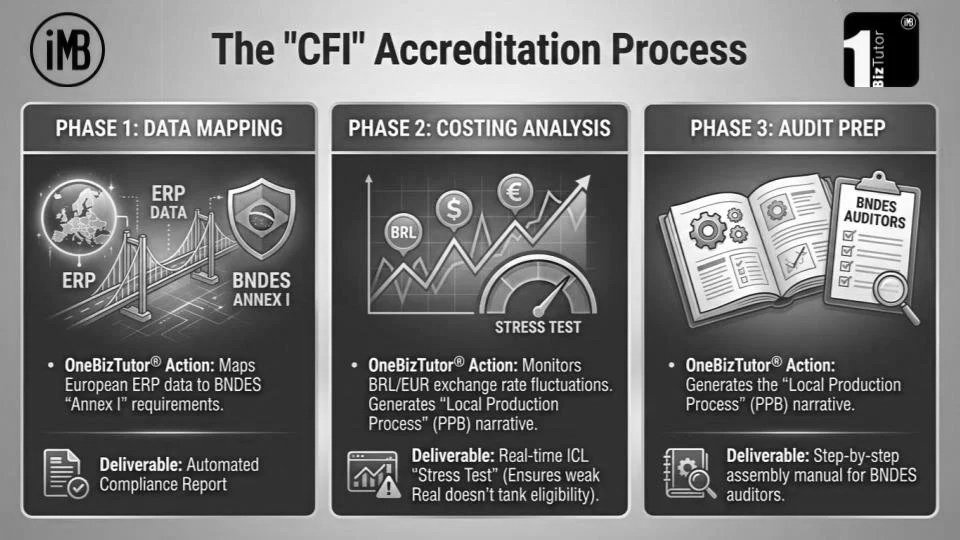
extract from project milestone presentation, generated by OneBizTutor® Q1 2026, iMB.Solutions Ltda., São Paulo, Brazil - modified for blog publishing
4. Why This Matters for Our Client
By achieving a high ICL, our client doesn't just sell a "part"—they sell "Financing Eligibility".
For Eletra: If they use your thermal management system, and it has a high ICL, it helps them maintain their 90%+ nationalization rate, which is their primary competitive advantage over BYD.
For the Client: You can command a premium price because the end customer (the bus operator) is saving millions in interest through the BNDES/Finame system.
BOM Localization Map
This "BOM Localization Map" is a strategic output generated by OneBizTutor® to help your European client visualize exactly which parts of their technology should be "Brazilianized" first to maximize the Local Content Index (ICL) while protecting core Intellectual Property.
For this exercise, we are using a Thermal Management System (TMS)—a high-demand component for São Paulo’s tropical climate—as the primary example.
The BOM Localization Map: ABC Region (São Paulo)
This map categorizes sub-components into three tiers based on the industrial maturity of the Santo André, São Bernardo do Campo, and São Caetano do Sul (ABC) cluster.
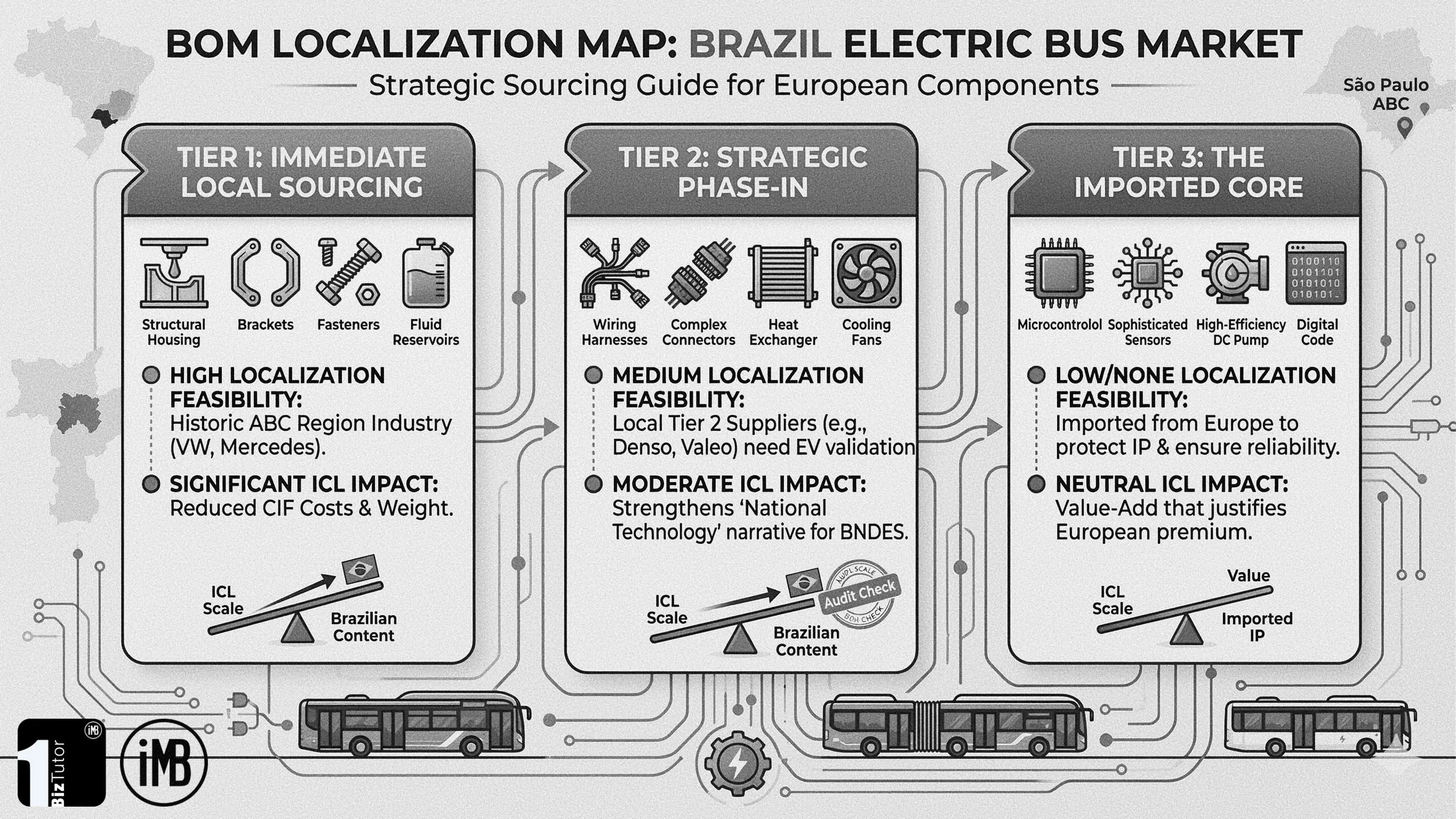
extract from project milestone presentation, generated by OneBizTutor® Q1 2026, iMB.Solutions Ltda., São Paulo, Brazil - modified for blog publishing
OneBizTutor® Workflow: The "Supplier Matchmaking" Module
iMB.Solutions utilizes a specific module within OneBizTutor® to execute this mapping with surgical precision. The workflow operates as follows:
1. Technical Specification Extraction
The AI ingests the European engineering blueprints (STEP files/BOMs). It identifies material grades (e.g., Aluminum Grade 6061) and technical tolerances.
2. Geo-Spatial Supplier Mapping
OneBizTutor® cross-references these specs against a proprietary database of 4,500+ active suppliers in the ABC region.
Example: It won’t just find "an aluminum caster"; it finds "a caster in São Bernardo do Campo with IATF 16949 certification currently supplying Mercedes-Benz."
3. Dynamic ICL Simulation
The tool provides a "Slider Interface" for the client.
Scenario A: Import everything except the housing → ICL: 38% (Fails Finame).
Scenario B: Source housing and wiring harnesses locally → ICL: 54% (Borderline Finame).
Scenario C: Source housing, wiring, and heat exchangers in the ABC region → ICL: 68% (Optimal/Safe for BNDES).
4. "Audit-Ready" Documentation
Finally, OneBizTutor® generates the "Nationalization Plan" required by BNDES. This document outlines the roadmap of how the client will move from Scenario B to Scenario C over a 24-month period, which is often enough to secure preliminary Finame accreditation.
Strategic Outcome
By using this map, the client avoids the common mistake of trying to localize the most expensive parts first. Instead, they localize the heaviest and most labor-intensive parts in the ABC region, which satisfies the BNDES formula while keeping their core "Black Box" technology safely engineered in Europe.
Executive Summary: Pioneering the Brazil EV Entry via AI-Augmented Consultancy
Project Overview
iMB.Solutions was commissioned by a European EV component and engineering leader to navigate the complex, high-barrier market of Brazil, with a specific focus on the São Paulo Metropolitan Area. The objective was to transition from an "outside exporter" to an "integrated local partner" capable of capturing the massive fleet electrification wave driven by SPTrans.
The Strategic Challenge
The Brazilian market is characterized by "Regulatory Insulation." Despite the high demand for zero-emission technology, the dominance of domestic system integrators like Eletra (68% market share) and the strict BNDES Finame local-content requirements (granting access to 4% vs. 20% interest rates) make traditional import models uncompetitive.
The OneBizTutor® Solution iMB.Solutions deployed its generative AI tool, OneBizTutor®, to serve as the project’s intelligence engine. The tool enabled:
Rapid Compliance Engineering: Decoding BNDES "National Technology" mandates into a localized Bill of Materials (BOM).
Localized Supply Chain Mapping: Identifying Tier 2 suppliers in the ABC Industrial Region to achieve a >60% Local Content Index (ICL).
Accelerated Market Entry: Reducing the typical 24-month entry cycle to 12 months through automated regulatory documentation and technical "code translation" between European and Brazilian standards.
Key Outcomes & Value Proposition
Tier 1 Integration: The client successfully positioned itself as a critical supplier to Eletra, ensuring that Eletra’s vehicles remain eligible for government financing while upgrading their performance with European thermal and power management IP.
Strategic Footprint: Establishment of a satellite assembly hub in São Bernardo do Campo, placing the client at the heart of the Latin American EV ecosystem.
Financial De-risking: By aligning with the "Partial Subvention" model of São Paulo, the client secured a predictable, high-volume order book tied to the city's mandate to replace thousands of diesel buses.
Conclusion
The partnership between the European manufacturer and iMB.Solutions demonstrates that the "secret code" to the Brazilian market is the synergy between local industrial presence and AI-driven regulatory agility. By leveraging OneBizTutor®, iMB.Solutions transformed a high-risk expansion into a structured, data-backed market leadership strategy, ensuring the client’s technology is not only present in Brazil but is foundational to its green mobility future.
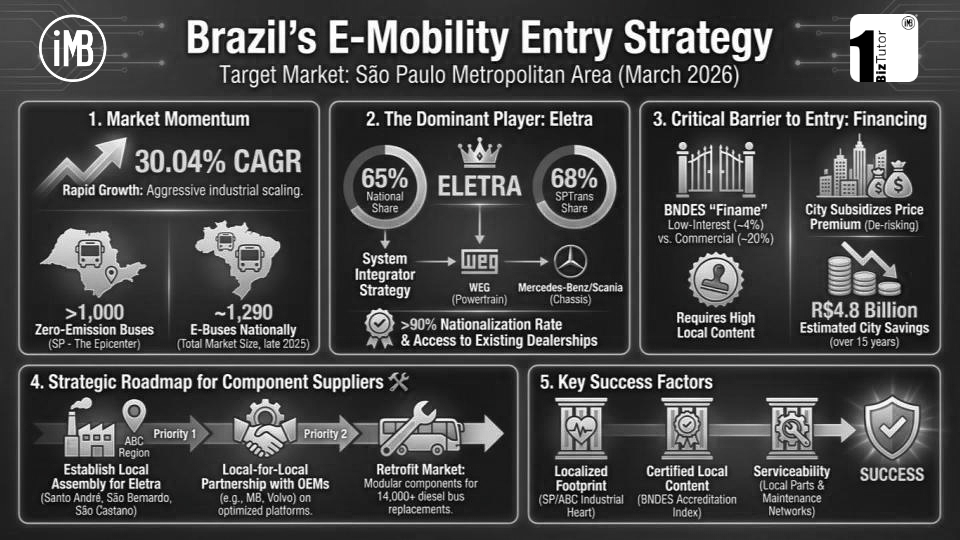
extract from project milestone presentation, generated by OneBizTutor® Q1 2026, iMB.Solutions Ltda., São Paulo, Brazil - modified for blog publishing
Generative AI Tools in Project Missions
Step into the AI Arsenal: the cutting-edge generative tools we deploy in client projects, internal operations, and partner collaborations—tested, trusted, and ready for battle.

The Speed of Intelligence – How OneBizTutor® and iMB.Solutions Decoded the Brazilian EV Market
In the high-stakes world of international market entry, "speed to insight" is often the difference between a successful launch and a multi-million dollar stalemate.
When iMB.Solutions took on the mission of guiding a European EV component leader into the complex Brazilian ecosystem, the challenge was clear: How do we navigate the dense thicket of BNDES "Finame" regulations, localized industrial demands, and a highly specific competitive landscape in the São Paulo Metropolitan Area without the typical two-year delay?
The answer lay in the synergy between professional human curation and the Generative AI power of OneBizTutor®.
click on the image above and learn who is OneBizTutor® for
The "Agile Intelligence" Advantage
Traditional market entry studies often rely on stagnant data and manual research cycles that take months. By the time the report is finished, the market has moved. For this project, OneBizTutor® served as a living, breathing project hub that transformed how we managed data.
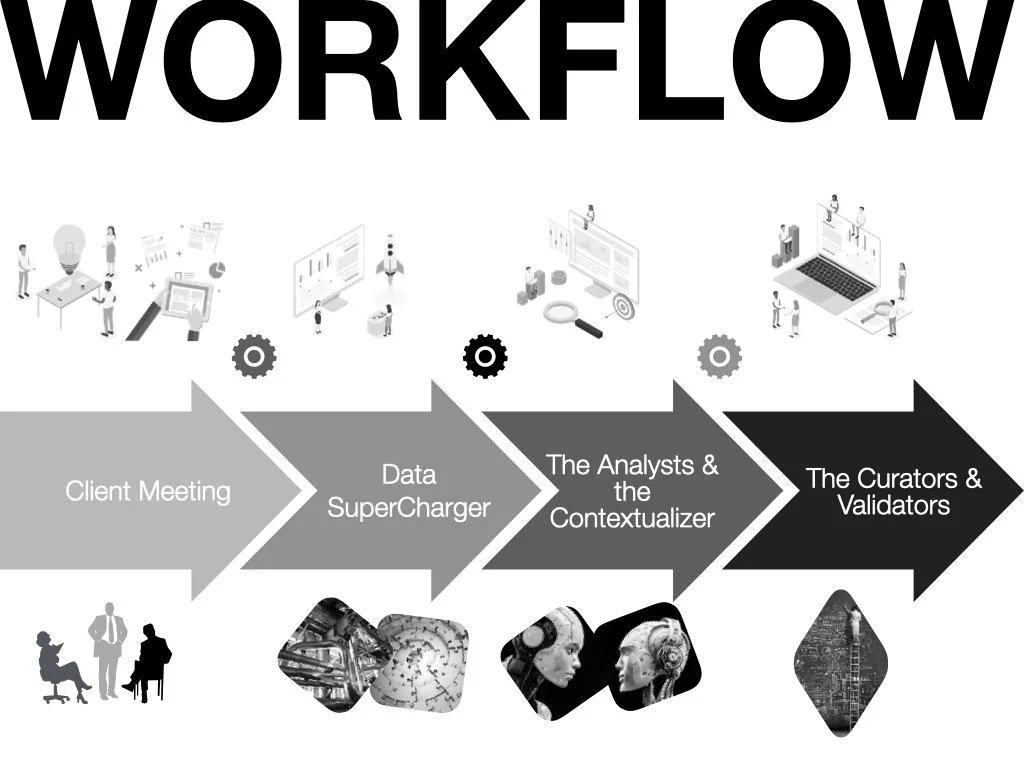
click on the image above and learn how does OneBizTutor® work
1. Instant Regulatory Decoding
Brazil’s Local Content Index (ICL) is a mathematical labyrinth. OneBizTutor® didn't just translate the BNDES guidelines; it ingested them. The tool allowed our team to perform real-time "what-if" scenarios. If we changed a sub-supplier from Europe to a local firm in the ABC Region, OneBizTutor® instantly recalculated the ICL, giving the client immediate clarity on their financing eligibility.
2. Bridging the Technical Language Gap
Engineering a bus in Stuttgart is different from operating one in the humidity and traffic of São Paulo. OneBizTutor® acted as a technical bridge, translating European engineering dossiers into Portuguese technical narratives that resonate with local integrators like Eletra. This wasn't just translation; it was contextual adaptation.
The Perfect Match: Human Experience meets AI Capability
The success of this feasibility study wasn't just about the technology; it was about the "Curator-Pilot" model.
The AI (OneBizTutor®) as the Engine: The AI provided the brute force of data processing—scanning thousands of pages of municipal procurement bids, analyzing competitor footprints, and generating complex BOM localization maps in seconds.
The Human (iMB.Solutions) as the Navigator: Our senior consultants provided the "Human-in-the-loop" curation. We used our decades of project mission experience to ask the AI the right questions. We filtered the AI’s data through the lens of political nuance, local relationship management, and strategic intuition.

click on the image above and learn what is OneBizTutor®
Why this Combination is the Future of Consulting
For our European client, the combination of iMB.Solutions plus OneBizTutor® offered three comparative advantages that traditional or legacy firms could not match:
Compression of Time: We delivered a 90-day technical roadmap and a full feasibility study in a fraction of the usual time. OneBizTutor® eliminated the "research lag."
Precision Sourcing: Instead of general advice, we provided a surgical "BOM Localization Map," identifying specific Tier 2 suppliers in the ABC region that were already certified and ready for integration.
Financial Certainty: We moved beyond "market potential" to "financial reality." We showed the client exactly how to leverage the Partial Subvention model in São Paulo to ensure their components were the most cost-effective choice for operators.
Final Thought
Market entry in the EV industry is no longer about who has the biggest boots on the ground—it’s about who has the smartest data in the cloud. By pairing the seasoned expertise of iMB.Solutions with the agile capabilities of OneBizTutor®, we didn't just study the Brazilian market; we mastered it.
Is your company ready for an AI-accelerated global expansion? Let iMB.Solutions show you the way.
By the iMB.Solutions Editorial Team

Contact

click on image above and reserve a video call slot
Discover What Matters Most to You—Backed by 150+ Project Missions!
Curious about the impact of our insights at iMB.Solutions? We put our articles, blogs, and case studies to the test—running three independent AI-driven queries with Perplexity, Google Gemini, and Mistral. The result? A powerful keyword cloud reflecting the topics that truly resonate.
Do you see yourself in these trends? Let’s connect and explore how our expertise—shaped by 150+ project missions over two decades—can drive your success.