

Disclaimer & Disclosure of Interests
This newsletter is prepared and published by iMB.Solutions Ltda. for informational, research, and editorial purposes only.
Professional Scope & Geographic Reach: iMB.Solutions Ltda. possesses extensive advisory and operational experience in the mining and commodity sectors. To date, the firm has delivered project assignments across Brazil,Argentina, Bolivia, and Chile for international clients based in North America (the United States and Canada),Europe, Brazil, and Chile, spanning engineering, machinery and plant construction, and technical service sectors.
Institutional Ties: The firm maintains long-standing professional relationships across multiple industrial segments with the Brazilian National Development Bank (BNDES), as well as direct institutional dialogue with Brazil’s Ministry of Mines and Energy (MME).
Specific Rare Earth Project Disclosure: In accordance with transparent editorial and advisory standards, readers should be advised that since the second quarter of 2026 (Q2 2026), iMB.Solutions Ltda. has been actively involved in two distinct project engagements focused on rare earth elements (REEs) located north of Brasília in the state of Goiás.
Non-Advisory Statement: The views, data, and commentary contained herein represent independent industry analysis and do not constitute financial, investment, legal, or commercial advice, nor do they represent a solicitation, recommendation, or offer to buy or sell any asset, security, or commodity. iMB.Solutions Ltda. accepts no liability for decisions or actions taken based on the contents of this publication.
Rare Earths’ Time to Shine
Although it mined few votes, one of the few issues brought to debate during this electoral campaign was the development of critical minerals (including rare earths), a sector that could place Brazil in a privileged position in the global arena.
In September 2026, The Brazilian government signed into law the National Policy on Critical and Strategic Minerals, which provides R$ 7 billion in incentives, the creation of a council, and measures to stimulate the processing and recycling of these minerals. The goal is to move beyond the simple extraction of raw materials and add value and technological development to the sector.
Rare earths are 17 chemical elements used in permanent magnets found in electric vehicles, wind turbines, and electronic products.
Geological surveys on rare earths remain incomplete. Even so, Brazil holds the world's second-largest reserves, with around 20%. However, it still has little participation in refining and subsequent industrial processing stages.
A study by the Center for Strategic Studies and Management (CGEE) shows that the global market for oxides, metals, and alloys generates US$ 5 billion per year, while the market for end products, such as permanent magnets, reaches US$ 40 billion.
The plan envisions a first industrial separation plant between 2026 and 2030 and, following that, the development of domestic capacity to produce high-purity oxides, metals, alloys, and magnets. Today, Brazilian production accounts for less than 1% of the global total.
According to national universities and the industry operating in Brazil, the primary bottleneck in Brazil is converting technology developed in laboratories into industrial processes that can achieve scale and competitiveness.
It is noted that the industry demands high capital investment and a skilled workforce. In Brazil, there are fewer than 50 researchers with specialized training in separating these elements, leaving the country far from competing with large-scale producers like China.
Mineral Overview
Share of Countries in Global Reserves and Production of Rare Earths (in %)
Brazil Faces Challenge in the Exploration of Rare Earths
Brazil faces the challenge of creating public policies for the rare earth elements sector without readily available expertise. This knowledge is held by very few people, who are not available.
Currently, the government is anticipating the approval of Bill 2780 (PL 2780), which will consolidate the regulation of critical minerals, he commented, emphasizing that it is no longer fitting for Brazil to remain a "mere exporter".
When Brazil began addressing the subject a year and a half ago, foreign companies said that Brazil had always been an ore supplier and never had a policy for adding value to the minerals. Today, however, Brazil has another window of opportunity. The nation has significant reserves, but low production. To turn potential into wealth, Brazil needs a strategy.
In recent history, the mining sector only reached the Planalto (presidential palace) due to negative events. Today it is a strategic asset; Brazil needs to take advantage of this attention to enact policies that make sense for the country.
The Risk of Selling the Future Prematurely!
““With Brazilian rare earths, the Sugarloaf Mountain Nation is on the verge of repeating the history of exporting wealth and importing dependence.””
Much has been discussed about how Brazil should negotiate with the US regarding the tariff surge. As in any negotiation, multiple aspects must be considered, with national sovereignty serving as the foundational pillar. A balanced and solid agreement must also weigh political, economic, legal, and geostrategic factors.
Sovereignty means ensuring that no agreement violates the Constitution, domestic laws, or compromises control over strategic resources. Other vital aspects include technological, industrial, and military autonomy. Excessive dependence on a single trading partner must be avoided. Likewise, any agreement must seek economic balance and geopolitical alignment, while remaining fully integrated with environmental, social, and governance standards.
However, the Brazilian government and the opposition is apparently failing to consider all of these dimensions. This is evident when the Minister of Finance and the opposition candidate for the presidential race in 2026 raised the possibility of putting critical minerals on the negotiating table right from the start. Doing so creates a serious risk of trading away a strategic trump card for short-sighted concessions with low returns. Moreover, a clear initial asymmetry must be observed in this arena. The US, the EU, and Japan already have comprehensive strategic plans for critical minerals, complete with targets to reduce reliance on China, dedicated financing lines, strategic stockpiles, and industrial coordination. Brazil, by contrast, has no integrated national plan for strategic minerals, no clear criteria for reciprocal benefits, and no evaluation of market timing or bargaining power.
The Brazilian position is fragile and our commercial production minimal; the nation has only one major mine (Serra Verde) currently in operation. Brazil lacks chemical separation facilities and magnet manufacturing plants—which reduces us to a "concentrate supplier" rather than a producer of high-value-added goods. As a result, Brazil runs the risk of selling ourselves cheap.
According to the US Geological Survey, China's known reserves of rare earth elements stand at approximately 44 million metric tons; Vietnam holds 22 million tons; Brazil around 21 million tons, while the US holds 1.9 million tons. China controls roughly 70% of mining and over 90% of global rare earth refining/processing, employing this advantage as an economic coercion tool for strategic purposes. A recent article in The Economist, however, argues that firing this "weapon" tends to backfire, as it compels the West to diversify mining, processing, and magnet manufacturing—a movement already underway. This creates a strategic window of opportunity for Brazil, provided we generate value beyond raw ore. We are on the brink of repeating the history of exporting wealth and importing dependency—with free shipping included.
BNDES Sees R$ 85.2 Billion Investment Potential in Rare Minerals
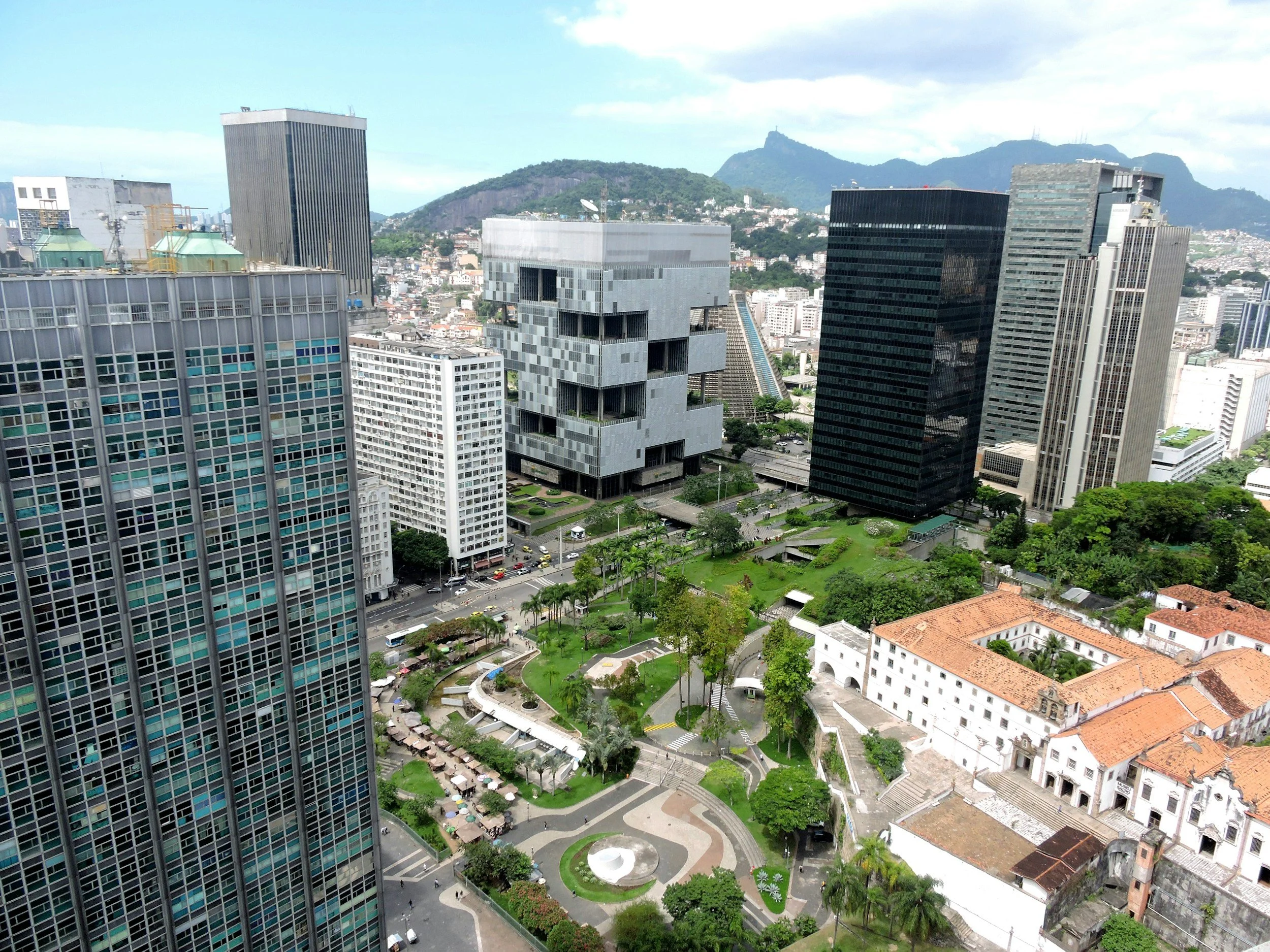
BNDES HQ
Headquarters of BNDES, Rio de Janeiro (RJ), Brazil
Following a public call, the development bank received 124 business proposals, highlighted by initiatives targeting the exploration of rare earths, lithium, copper, and graphite
The Brazilian National Development Bank (BNDES) received submissions for 124 business plan proposals for investments in strategic minerals under the public call opened in partnership with the Brazilian Innovation Agency (Finep). The potential investment of the projects totaled R$ 85.2 billion, highlighted by initiatives focused on rare earths, lithium, copper, and graphite. Applications for the public call, launched under the Nova Indústria Brasil program, closed the week before last.
According to the Ministry of Mines and Energy (MME), Brazil holds the third-largest rare earth reserves in the world, in addition to possessing other critical minerals. According to the Guide for Foreign Investors in Critical Minerals for the Energy Transition in Brazil, published in March by the MME, there are 48 active projects across nine states in four regions. They are most numerous in Minas Gerais (13), Bahia (12), and Pará (10) (more information on page B2).
According to BNDES, "the projects were submitted by 136 economic groups for investment across 23 states in all regions of the country".
The elements with the most proposals were rare earths (27 projects), lithium (25), copper (24), and graphite (20).
The development bank also reported that "according to the public notice, the plans must include investments in productive capacity and research, development, and innovation (RD&I) for processing strategic minerals and obtaining processed materials or manufactured goods for the energy transition and decarbonization".
Of the R$ 85.2 billion in potential investments presented, R$ 6.4 billion is dedicated to technological development and R$ 67.8 billion to the industrial scaling of these projects.
The notice provided support for mineral processing projects involving aluminum, cobalt, copper, tin, graphite, lithium, manganese, platinum group metals (PGMs), molybdenum, niobium, nickel, silicon, tantalum, rare earths, titanium, tungsten, uranium, vanadium, and zinc.
The elements with the highest number of submitted proposals were rare earths (27 projects), lithium (25), copper (24), and graphite (20).
The call foresees R$ 5 billion in project funding, comprising R$ 4 billion from BNDES and R$ 1 billion from Finep. The proposals received will be evaluated according to the criteria defined in the public call.
Brazil combines unique advantages to attract these investments: vast mineral reserves, a predominantly clean energy matrix, a robust innovation ecosystem, and, above all, geopolitical neutrality.
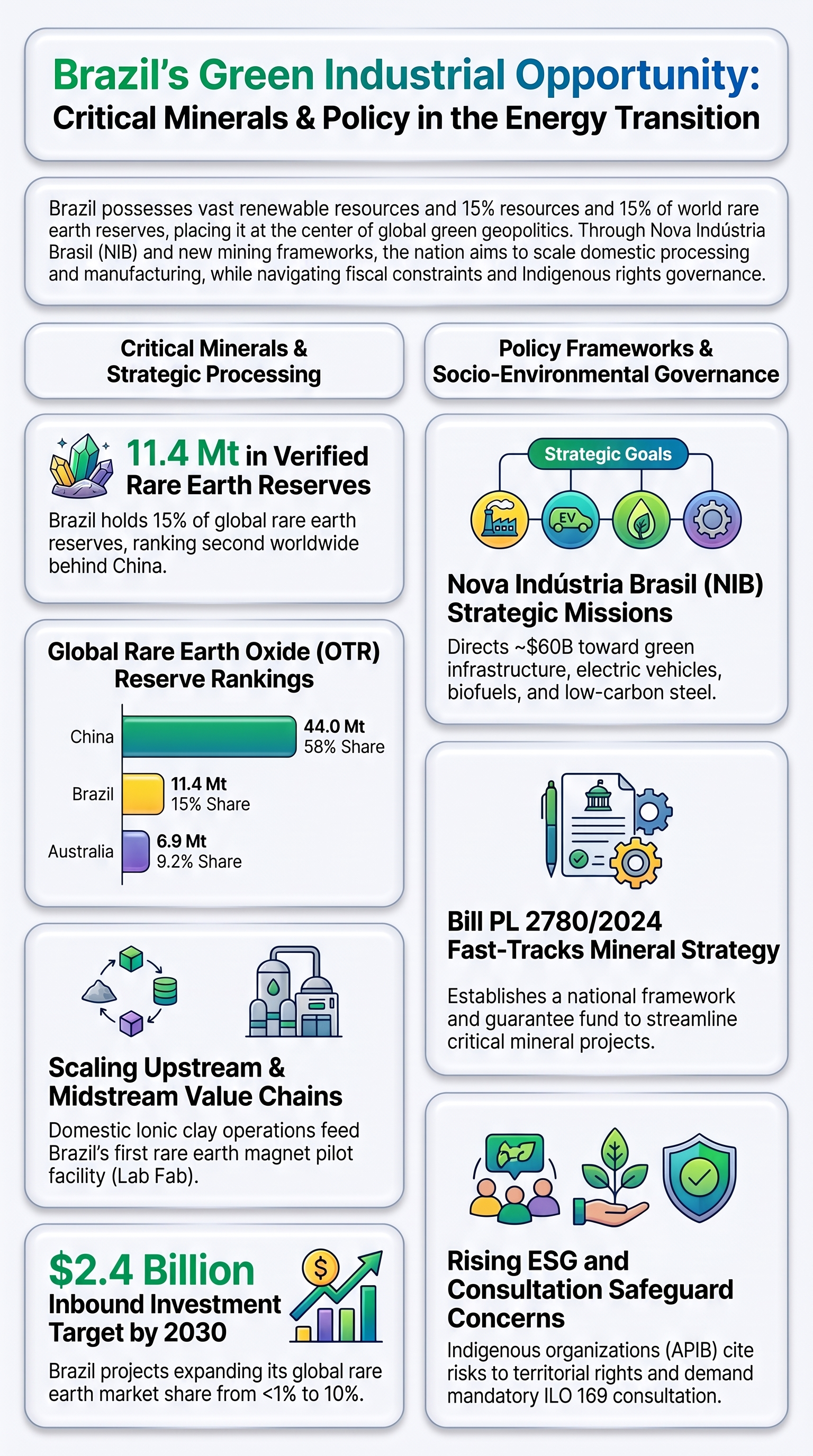
generated by OneBizTutor®, iMB.Solutions Ltda., São Paulo, Brazil, Nov. 2nd, 2026 - 03:32PM
Can a Mining Powerhouse Reindustrialize the World? 5 Mind-Bending Realities of Brazil’s Green Transition
1. Introduction: The Geopolitical Pivot
How can a nation that has suffered decades of severe premature deindustrialization pivot to become an indispensable superpower of the 2050 global green economy? Brazil stands at a rare, pivotal junction in global economic history. The country possesses an enviable synthesis of critical transition minerals, world-leading biological capacity, an extraordinarily clean electricity grid, and proven technological capabilities in advanced manufacturing—exemplified by global industrial champions like Embraer in aviation and Petrobras in deepwater energy extraction.

To capitalize on this structural moment, the Brazilian government launched Nova Indústria Brasil (NIB), a flagship green industrial policy designed to reposition the nation within a reconfiguring geopolitical landscape alongside China, the United States, and Russia. However, translating vast natural resource wealth into domestic industrial sophistication is fraught with historic traps and economic tensions. The following five takeaways reveal the counter-intuitive realities, strategic technological bets, and institutional friction points driving Brazil’s ambitious green transition.
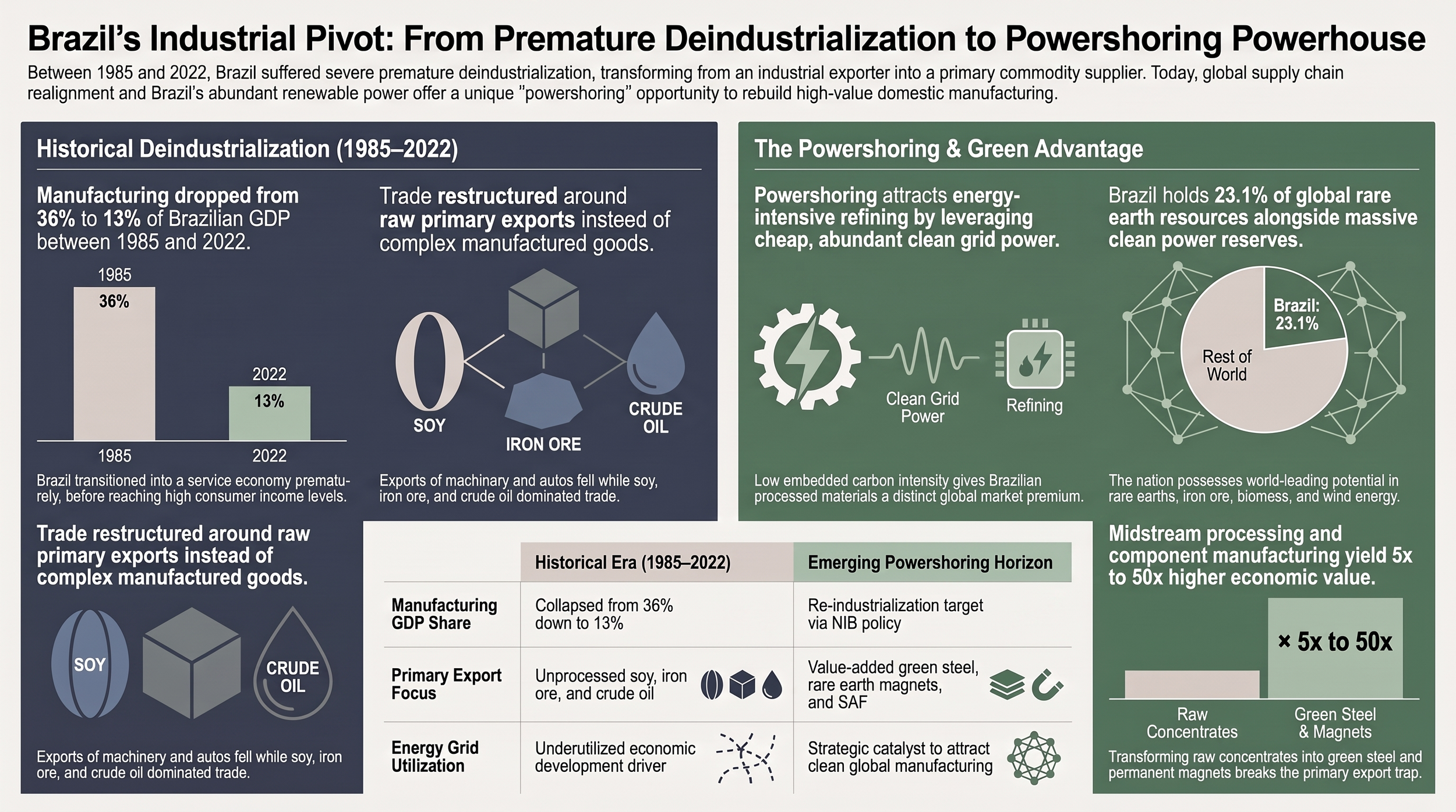
extracted from client project (client name classified), May 2026, iMB.Solutions Ltda., São Paulo, Brazil
1. 'Powershoring': Moving Factories to Where Cheap, Clean Energy Lives
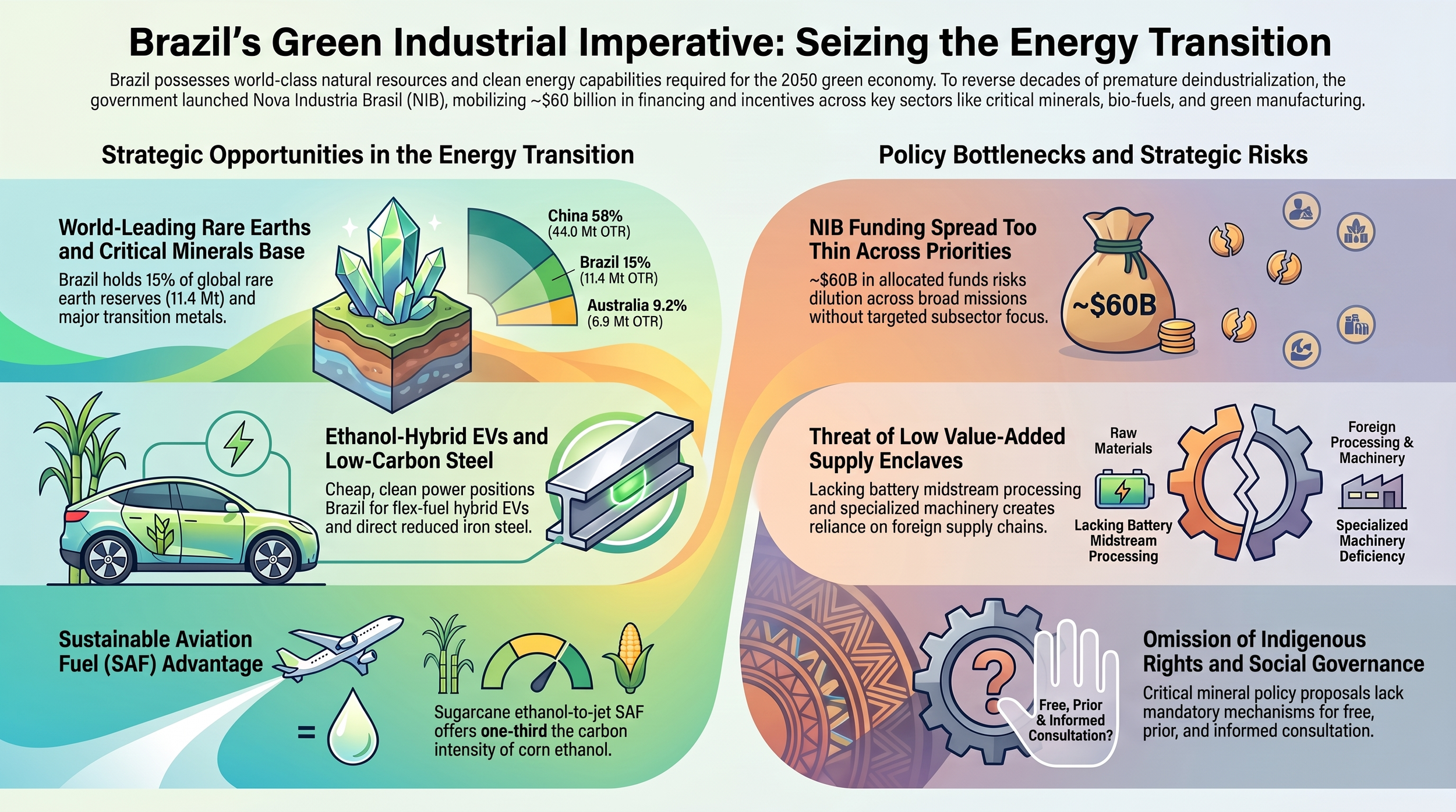
Brazil's strongest strategic leverage point to reverse its long-standing premature deindustrialization is "powershoring"—the structural relocation of energy-intensive manufacturing directly to regions offering an abundant, low-cost, and renewable electricity grid. Between 1985 and 2022, manufacturing's share of Brazil's GDP collapsed from 36% to just 13%. This domestic hollow-out coincided with a deep trade restructuring with China. While China became Brazil's primary trading partner, the bilateral dynamic accelerated a process of economic "primarization"—relegating Brazil to an exporter of unrefined primary commodities:
Soybeans: $30 billion shipped to China in 2021 (accounting for 30% of total Brazilian exports to China and nearly 10% of Brazil's entire global export basket).
Iron Ore: $33.4 billion in 2021 (representing 34% of trade with China and 11% of total national exports).
Crude Oil: $14.8 billion exported as raw unrefined crude, leaving high-value refining and chemical processing steps overseas.
This heavy reliance on primary commodity exports exposed the macroeconomy to classic "Dutch Disease" pressures and heightened currency volatility tied directly to global commodity cycles. Powershoring offers a concrete mechanism to break this extraction dependency. By deploying its low-carbon power grid, Brazil can compel energy-intensive industrial processing to locate within its borders. Primary opportunities include green hydrogen-based direct reduced iron (DRI), low-carbon steel, direct lithium processing, and local machinery manufacturing for wind and battery supply chains.
Recent multi-billion-dollar commitments by major Chinese industrial firms—such as BYD and Great Wall Motors (GWM) establishing electric vehicle (EV) hubs, alongside wind turbine titan Goldwind expanding its domestic manufacturing footprint—demonstrate that foreign capital can be systematically anchored to rebuild domestic value-added manufacturing if governed with strategic intentionality.
Renowned techno-economic paradigm theorist Carlota Perez has long emphasized that resource-rich nations are not doomed to perpetual primary extraction if the state actively fosters dense domestic supply linkages. As Perez articulated:
> "Natural resources are a 'springboard for industrialization and economic development' beyond resource dependence, as long as linkages are created and maintained."
2. The $60 Billion Trap: Why Broad 'Missions' Threaten to Dilute Success
Despite its transformative vision, Nova Indústria Brasil (NIB) exhibits three critical structural vulnerabilities that threaten to undermine its execution:
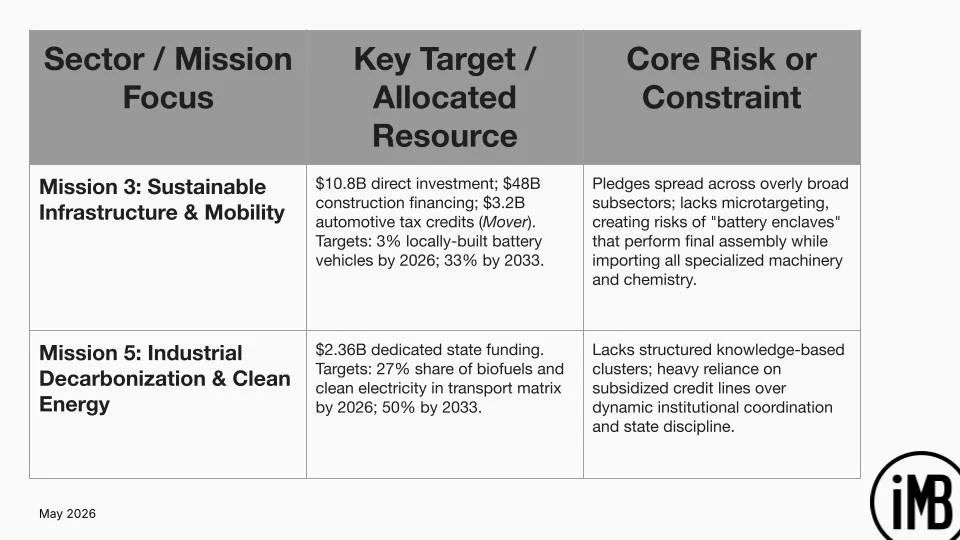
Overly Broad Mission Scope: Unlike hyper-focused industrial interventions, NIB organizes its objectives around wide inter-sectoral "missions" (most notably Mission 3 on sustainable infrastructure/mobility and Mission 5 on industrial decarbonization). These missions lack narrow, subsector-level microtargeting, making it difficult to formulate precise, dynamic policy interventions.
Dilution of Capital: NIB’s allocated direct funding and credit line pledges—totaling roughly $60 billion—risk being spread too thin across dozens of competing priorities rather than concentrated to build globally dominant industrial verticals.
Coordination and Cluster Gaps: NIB leans heavily on traditional subsidized credit lines rather than establishing structured collaboration mechanisms among state development finance, private enterprise, labor unions, and research institutions. Without institutionalized knowledge clusters and dynamic experimentation networks, public capital risks turning into passive corporate welfare.
This approach contrasts with historical Brazilian industrial frameworks like the PITCE (2004–2007), PDP (2008–2010), and PBM (2011–2015). While PITCE maintained a sharper focus on innovation, subsequent plans broadened their scope to build political coalitions, ultimately diluting their capacity to upgrade national economic complexity. NIB advances the model by introducing inter-sectoral mission framing, yet still relies heavily on credit supply rather than dynamic technological coordination.
extracted from client project (client name classified), May 2026, iMB.Solutions Ltda., São Paulo, Brazil
3. Forget Pure EVs: Brazil’s Big Automotive Bet is the Ethanol-Battery Hybrid
Rather than blindly following the global technological standard of pure Battery Electric Vehicles (BEVs), Brazil is carving out a distinct, highly pragmatic trajectory centered on ethanol-battery flex-hybrids. This strategy builds directly upon the country's multi-decade biofuel distribution infrastructure and formidable agricultural energy base.
Following major plant shutdowns by traditional automotive OEMs like Ford and Mercedes-Benz, clear policy signals have reignited the sector. Driven by predictable regulatory frameworks, global automakers have committed over $20 billion in new domestic investments through 2033:
Stellantis: $5.0 billion (Hybrid engine and vehicle manufacturing in São Paulo)
Hyundai: $3.8 billion (Hybrid production expansion in São Paulo)
Toyota: $2.2 billion (Flex-hybrid localized manufacturing in São Paulo)
Volkswagen: $1.8 billion (Hybrid/EV development supported by BNDES credit)
Great Wall Motors (GWM): $1.66 billion (Hybrid/EV assembly plant in São Paulo)
General Motors (GM): $1.4 billion (Hybrid vehicle footprint in São Paulo)
BYD: $0.91 billion (Integrated hybrid/EV industrial cluster in Bahia)
Renault: $0.85 billion (Hybrid platform production in Paraná)
CAOA Chery: $0.75 billion (Hybrid manufacturing expansion in Goiás)
State programs like Mover back this technological choice by offering $3.2 billion in performance-tied tax credits linked to carbon intensity metrics and localized R&D expenditures. To accelerate local capital investment, import tariffs on foreign EVs are being progressively raised up to 35%.
However, an acute economic vulnerability remains: if Brazilian plants merely perform final vehicle assembly while importing cell chemistries, processed anodes, cathodes, and specialized production equipment, the country will create a low-value "battery enclave." Capturing real economic returns requires targeted policies that build the domestic upstream chemical processing and capital machinery ecosystem.
extracted from client project (client name classified), May 2026, iMB.Solutions Ltda., São Paulo, Brazil
4. The Rare Earths Shift and the Shadow over Indigenous Rights
Brazil’s critical minerals landscape is experiencing major reserve revaluations, downstream magnet production strides, and severe legislative friction over socio-environmental governance.
Reserve Revisions & Ionic Clays
Following alignment with international CRIRSCO reporting standards by the National Mining Agency (ANM), Brazil’s official rare earth reserves were adjusted from 21 million metric tons (Mt) down to 11.4 Mt of Total Rare Earth Oxides (OTR). Concurrently, the global reserve baseline shifted from 85 Mt down to 75.4 Mt OTR. Despite this statistical adjustment, Brazil firmly retains 2nd place globally, holding 15% of total worldwide reserves.
A major commercial frontier is the breakthrough exploitation of ionic clay deposits, which feature lower operational costs, minimal radioactive element content, and higher concentrations of heavy rare earths compared to traditional hard-rock carbonatites. The Serra Verde operation in Minaçu (Goiás) represents the first commercial production of ionic clay rare earths outside Asia, exporting Mixed Rare Earth Carbonate (MREC). To support upstream critical mineral processing, BNDES and Finep established a $167 million Critical Minerals Fund alongside an $833 million joint credit line. Furthermore, a joint state program selected 56 strategic mineral projects across the country, allocating up to R$ 5 billion (~$1 billion USD) in public financial instruments (credit, grants, and equity) within a total projected capital expenditure pipeline of R$ 45.8 billion.
Downstream Magnet Supply
To capture high-value midstream and downstream segments, international developers St. George Mining (Araxá project) and Meteoric Resources (Caldeira project) executed supply agreements with the Federation of Industries of the State of Minas Gerais (Fiemg) and SENAI. These deals supply MREC into the Lab Fab facility in Minas Gerais—a pilot unit scaling from 100 to 200 tons per year to establish the Southern Hemisphere's first large-scale permanent rare earth magnet (NdFeB) production facility.
Social and Legislative Conflicts
This rapid extractive expansion faces fierce resistance from Indigenous organizations, led by the Articulation of Indigenous Peoples of Brazil (APIB), regarding PL 2780/2024 (National Critical & Strategic Minerals Policy). Accelerated via a Congressional Special Commission substitute in May 2026, the bill uses the rhetoric of "clean energy" to fast-track mining approvals and territorial leasing.
A PIB highlights that PL 2780/2024 fails to guarantee Free, Prior, and Informed Consent (FPIC) as mandated under ILO Convention 169, nor does it respect constitutional land protections under Article 231. Furthermore, the proposed governing structure—the Special Council for Critical Minerals—concentrates decision-making power within fifteen executive economic agencies while excluding Indigenous representation.
Speaking on behalf of APIB's legal leadership, Ricardo Terena emphasized the profound democratic tension embedded in fast-tracking extraction under the guise of global climate action:
"Economic development cannot be built at the expense of rights violations... There is no sustainable future, nor legitimate development, without full respect for Indigenous peoples and the environment."
5. Rescuing Agriculture: How Green Jet Fuel Prevents Biofuel Obsolescence
The rapid global adoption of passenger electric vehicles poses a structural threat to Brazil’s agricultural engine by risking severe domestic demand destruction for sugarcane ethanol. Sustainable Aviation Fuel (SAF) provides a vital strategic market "opening" (brecha) to connect Brazil's agro-energy matrix to highly regulated, international LCFS and CORSIA decarbonization markets.
Brazil is positioning itself across two principal industrial SAF pathways:
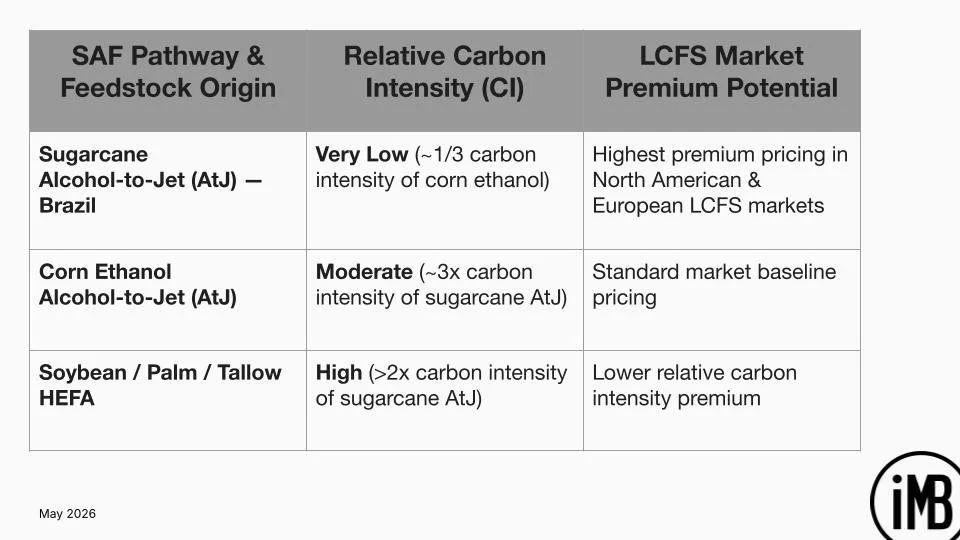
HEFA Pathway: Utilizing animal tallow, soybean oil, and palm oil (projects led by Petrobras, Brasil BioFuels, and Essential Energy USA).
Alcohol-to-Jet (AtJ) Pathway: Converting Brazil's massive sugarcane ethanol output (35.4 billion liters in 2023) into drop-in jet fuel.
extracted from client project (client name classified), May 2026, iMB.Solutions Ltda., São Paulo, Brazil
Because international Low-Carbon Fuel Standards (LCFS) pay financial incentives proportional to emissions reductions against fossil benchmarks, Brazilian sugarcane AtJ SAF commands premium pricing. This structural carbon advantage prevents Brazil from remaining a passive exporter of raw ethanol, turning external environmental mandates into domestic industrial performance conditions.
Domestic demand is secured by the landmark Fuel of the Future law, which mandates that airlines operating in Brazil reduce jet fuel carbon emissions by 1% in 2027, scaling to 10% by 2037. This mandate has already driven nearly $3 billion in private SAF project announcements, complemented by a joint $1 billion public call for proposals from BNDES and FINEP that attracted an astonishing $20 billion in project submissions.
The Path Forward: From Primary Exporter to Industrial Innovator
Brazil’s trajectory toward green reindustrialization validates economist Carlota Perez’s framework: natural resources can serve as a functional springboard for structural transformation, provided the state constructs dense, technologically sophisticated production networks rather than remaining trapped in raw commodity extraction.
To avoid repeating historical industrial policy failures, Brazil must systematically resolve its structural execution gaps:
Subsector Microtargeting: Nova Indústria Brasil must narrow its focus from broad multi-sector missions to specific technological verticals (such as direct reduced iron, green anodes, permanent magnets, and AtJ refining) where domestic firms can secure defensible positions in global supply chains.
Institutional Discipline & Coordination: State strategy must move beyond supplying cheap credit lines. It requires institutionalized, conditional coordination between development banks (BNDES), regulatory agencies, labor unions, and private capital to enforce industrial performance targets.
Targeted Human Capital Investment: To close the national industrial skill deficit—where an estimated 14 million formal workers require technical retraining—Brazil must align vocational education across the Institutos Federais (backed by 100 new campuses under the PAC program) and SENAI directly with emerging regional green technology clusters.
Historical co-development models—such as the creation of Embraer alongside the Aeronautical Technology Center (ITA), and Petrobras paired with its deepwater research institution (Cenpes)—prove that Brazil can build world-class technological champions when state policy, scientific infrastructure, and industrial capital align.
As global powers deploy aggressive green trade barriers and domestic subsidies, a fundamental question defines the era:
Can emerging, resource-rich nations force global green supply chains to build high-value manufacturing locally, or will geopolitical pressures reduce them once again to raw resource extractors?

Get Out
Bridging Continental Scale: Why Targeted Logistics Drive Brazil’s Rare Earth Frontier
Brazil’s continental dimensions—comparable in landmass to the contiguous United States—present a foundational logistical reality for the commodity and mining sectors. As global attention converges on critical minerals and rare earth elements (REEs), the geography of deposit development increasingly demands navigating remote interior regions,spanning key hubs across Goiás, Minas Gerais, and Bahia. In this operating environment, rapid physical mobility directly dictates project velocity and governance.
At iMB.Solutions, addressing these distance hurdles has long defined frontline project execution. During the intensive cycle between 2011 and 2016 in the oil and gas industry, corporate and chartered flights served as a standard operational necessity. A similar logistical reality underpinned our mining assignments across Bolivia, Chile, and Argentina in 2023 and 2024. In 2026, as project engagements continue across Brazil’s critical minerals landscape, private air mobility remains just as vital.
In the rare earths sector, operations and advanced exploration hubs—such as commercial operations in Minaçu or prospective clay deposits in central and southeastern basins—often sit hundreds of kilometers from commercial aviation hubs. Navigating these destinations via commercial itineraries typically translates into multi-day transit times, missed windows with regional authorities, and delays in on-site engineering assessments.

While corporate and chartered aircraft represent a visible upfront expenditure, their value becomes clear when evaluated against overall project dynamics and the bottom line. Reducing days lost in transit, facilitating multi-site technical audits in a single day, and ensuring immediate access for senior specialists and investors protect the critical path of multi-million-dollar capital programs. In the high-stakes race to develop Brazil’s critical mineral reserves, dedicated air travel is not an extravagance—it is an indispensable productivity tool.