

The global shift toward sustainable urban mobility is accelerating, and nowhere is this transformation more dynamic than in Brazil. In our newly generated audio overview, "Brazil's Massive Electric Bus Fleet Overhaul," listeners are treated to an immersive exploration of the policies, financial models, and industrial strategies driving Latin America's largest economy toward a zero-emission future.
The Scale of the Transition: Electrifying 14,000 Buses
The electrification of Brazil’s public bus fleet represents one of the most highly effective strategies for reducing greenhouse gas emissions and improving urban air quality. The audio overview unpacks the staggering scale of this ambition, detailing how more than 14,000 diesel buses across the country's major metropolitan regions are currently poised to be replaced by electric alternatives. This replacement focuses heavily on older, highly polluting vehicles, such as those meeting Euro III through Euro V standards. To catalyze this transition, a newly established EUR 80 million Brazil E-Bus Credit Enhancement Fund aims to introduce more than 1,700 electric vehicles and associated charging infrastructure by the year 2030.
The Power of Local Manufacturing
Listeners will also discover how Brazil is insulating itself against global supply chain shocks by aggressively building out its domestic value chains. The audio overview details the strategic moves of companies like Eletra, a Brazilian manufacturer that currently commands a 65% share of the national market for electrified buses. Eletra is investing R$ 40 million to expand its manufacturing facility in São Bernardo do Campo, scaling its capacity to produce up to 3,000 electric vehicles annually using 100% Brazilian-made chassis.
The overview also covers the heavy investments by international giants looking to localize their production. You will hear about BYD's massive R$ 5.5 billion manufacturing complex in Camaçari, Bahia, designed to produce commercial electric chassis and passenger vehicles. Furthermore, the transition includes technological milestones like Goiânia's deployment of the world's first fleet of 28-meter electric bi-articulated buses, manufactured by Volvo and Marcopolo.
Innovative Financing: The São Paulo Subvention Model
A core theme of the audio overview is overcoming the financial barriers of e-mobility. While the total cost of ownership for electric buses is typically lower than their fossil-fueled counterparts over a 15-year lifecycle, the high initial capital cost remains a significant hurdle. The audio overview thoroughly examines the city of São Paulo's groundbreaking "partial subvention" model. Implemented in late 2023, this financing structure allows the municipal government to subsidize the upfront acquisition costs of electric buses directly, leveraging the city's ability to secure lower-cost financing compared to private operators. By adopting this approach rather than traditional financing, the city of São Paulo stands to save an estimated R$ 4.8 billion over the lifespan of the bus fleet.
"Brazil's Massive Electric Bus Fleet Overhaul" is an essential listen for stakeholders across the automotive, financial, and public policy sectors. It offers unparalleled insights into how coordinated public procurement, domestic manufacturing, and innovative subventions are converging to create a greener, more sustainable public transit ecosystem. Access the audio overview today to understand the mechanics behind Brazil's electrified transit hegemony.
Executive Summary: Brazil's Zero-Emission Bus Roadmap Infographic
The infographic, "Brazil's Zero-Emission Bus Roadmap," provides a comprehensive visual breakdown of the policies, investments, and manufacturing strategies driving the largest urban transit electrification initiative in Latin America.
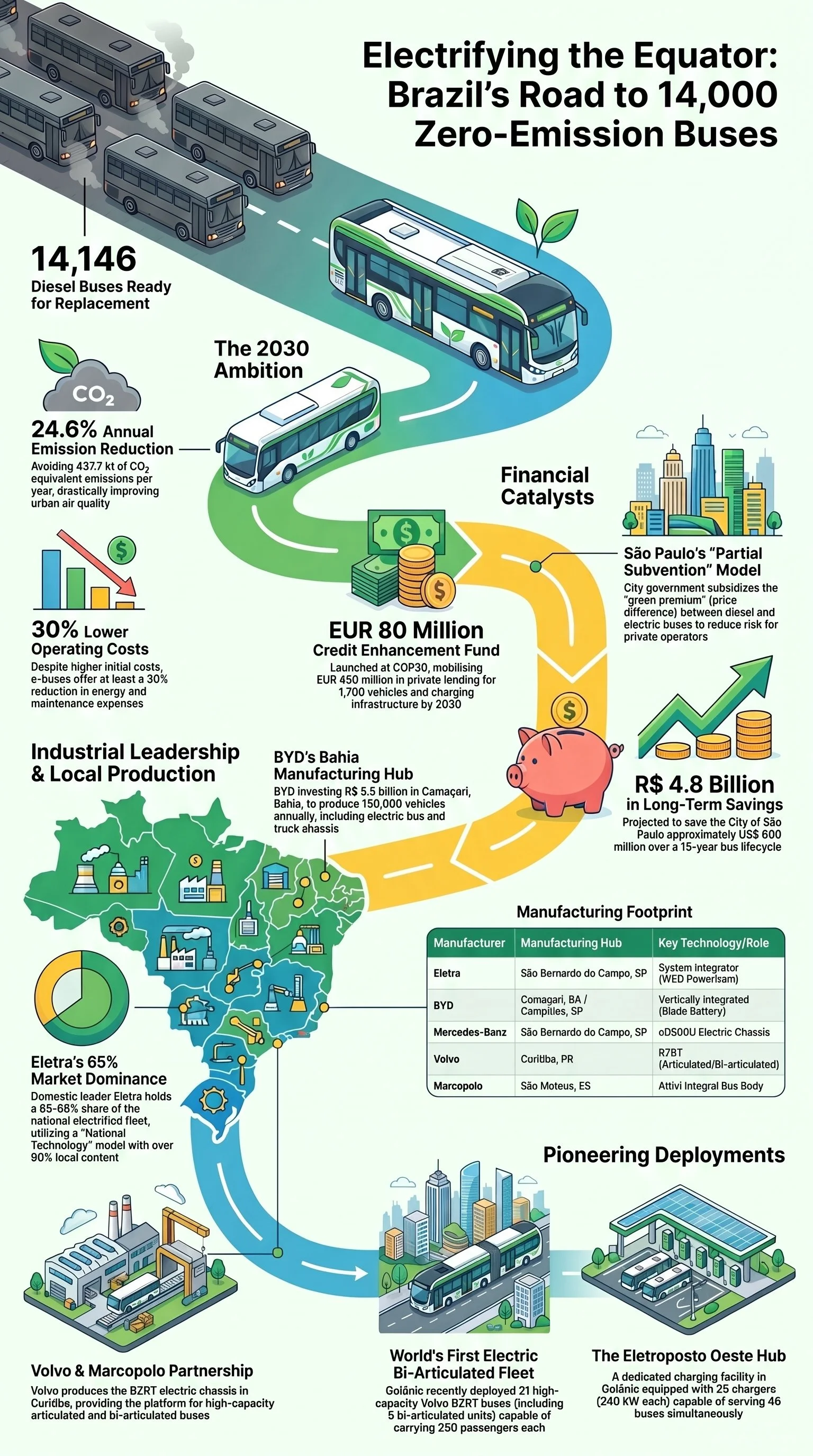
generated by iMB.Solutions Ltda., São Paulo, Brazil as part of the client project mission, Q1 2026
Designed for stakeholders across the mobility, finance, and public policy sectors, the infographic synthesizes the following core elements of Brazil's electric bus (e-bus) transition:
Massive Scale of Fleet Replacement: The focal point of the visual is the staggering ambition to replace over 14,000 aging, highly polluting diesel buses with zero-emission electric buses across Brazil's major metropolitan regions by 2030.
Strategic Financial Catalysts: To overcome the barrier of high upfront capital costs, the infographic highlights two critical financial mechanisms:
The EUR 80 Million Fund: The establishment of the Brazil E-Bus Credit Enhancement Fund, which aims to mobilize private lending to deploy more than 1,700 e-buses and related charging infrastructure by 2030.
São Paulo’s Partial Subvention Model: A visual breakdown of the city of São Paulo's innovative financing approach. Instead of operators bearing the full premium cost of an electric bus, the municipal government directly subsidizes the difference. By leveraging the city's ability to secure cheaper debt, this model de-risks the transition for private fleet operators and is projected to save the city R$ 4.8 billion over the 15-year lifecycle of the buses.
Domestic Market Dominance (Eletra): The infographic illustrates the supremacy of local industry, specifically highlighting the Brazilian system integrator, Eletra. Eletra currently commands a 65% national market share and is utilizing a R$ 40 million investment to expand its São Bernardo do Campo facility, boosting its production capacity to 3,000 vehicles per year using 100% Brazilian-made electric chassis.
Localized Global Investments: Finally, the visual maps out the localization strategies of international heavyweights. It features BYD's massive R$ 5.5 billion manufacturing complex in Camaçari, Bahia, which is localizing electric bus chassis production. It also highlights Volvo's production of electric articulated and bi-articulated bus chassis (BZRT) at its Curitiba plant, which are subsequently bodied by Marcopolo to supply record-breaking 28-meter e-buses to cities like Goiânia.
Conclusion: In summary, the infographic visually communicates that Brazil's transition is not simply an environmental initiative, but a robust industrial strategy. By combining agile municipal subventions with strict local manufacturing ecosystems, Brazil is successfully building an electrified transit hegemony that insulates its supply chains and accelerates urban decarbonization.