

Edition April 2026
Prime Story

China Accelerates Brazil's Green Shift: Electrified Vehicles Hit 11% Share in 2025—Years Ahead of Forecast
The pace of electrification in Brazil's automotive market is not just quick—it's electrifyingly ahead of schedule, and that's something worth celebrating! What was once projected as a distant milestone has arrived far sooner, thanks to a powerful combination of strategic Chinese investments, smart local partnerships, infrastructure growth, and innovative policies. Brazil's hybrid and electric vehicle market share in 2025 has surged higher than experts anticipated for 2027, marking a true revolution in mobility.

Chinese Brands Surge: From Newcomers to Market Shakers
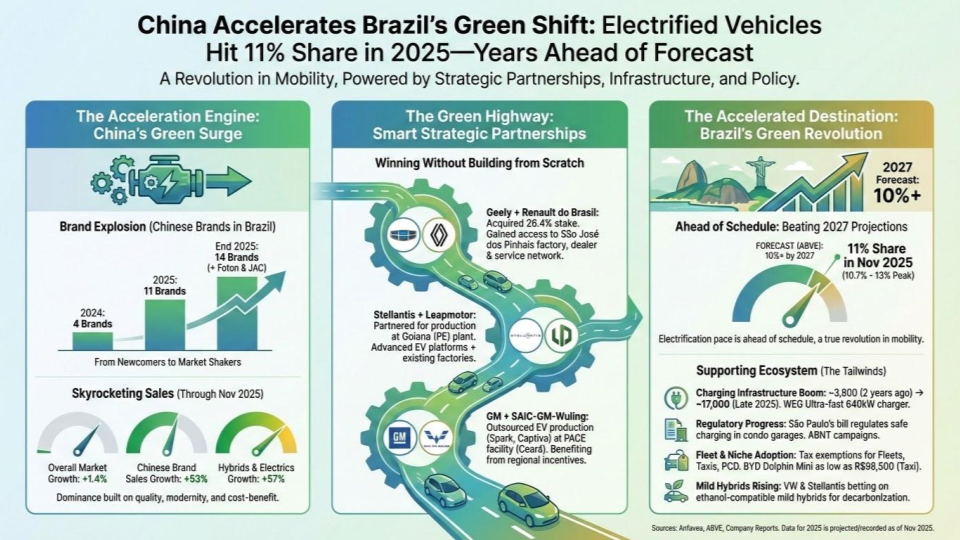
Let's start with the driving force: Chinese automakers. In 2024, only four Chinese car brands operated in Brazil. By 2025, that number exploded to 11, and by year's end, it reached 14—with additional truck players like the established Foton and newcomer JAC joining the fray.
The numbers tell an inspiring tale of momentum. While the overall vehicle market grew a modest 1.4% through November 2025 (per Anfavea data), Chinese brand sales skyrocketed by 53%. Hybrids and electrics—China's sweet spot—grew even faster at 57%. This isn't mere market entry; it's dominance built on quality, modernity, and unbeatable cost-benefit ratios. Chinese manufacturers have evolved from technology followers to undisputed leaders, shattering old perceptions and delivering vehicles that Brazilians trust and love.
This shift isn't accidental. China's long-term vision—backed by consistent government industrial policies—has built a robust ecosystem for affordable, competitive electric cars. Now, that expertise is landing squarely in Brazil.
Smart Partnerships: Winning Without Building from Scratch
Early on, Chinese brands eyed Brazil's massive market (the world's sixth largest) primarily for exports. But 2025 changed everything with local factories from GWM and BYD. The real game-changer? Strategic alliances that leverage existing infrastructure—no new bricks required.
A standout example: Geely acquired a 26.4% stake in Renault do Brasil, gaining access to the São José dos Pinhais factory (capacity: 400,000 units annually, but running at about half), plus Renault's established dealer network and service structure. This fills idle capacity while accelerating Geely's entry.
Globally, Stellantis partnered with Leapmotor, enabling production at the Goiana (PE) plant. These "frenemies" collaborations benefit everyone: Chinese brands bring advanced EV platforms, Europeans provide factories and scale. It's innovative thinking at its best—turning potential rivals into allies for mutual growth.
Even General Motors joined the wave, outsourcing production of electric models (like the Spark and Captiva) via a partnership with SAIC-GM-Wuling at the PACE facility in Ceará—a former Troller site now under Brazilian group Comexport, benefiting from regional tax incentives.
Brazil has become a global "laboratory" for Chinese automotive strategy, with the world watching closely.

Electrification Ahead of Schedule: Beating 2027 Projections in 2025
The impact is undeniable. The Brazilian Electric Vehicle Association (ABVE) once forecasted that hybrids and electric vehicles would hit 10%+ market share by 2027. Yet by November 2025, the figure reached nearly 11% (around 10.7% in some reports), with year-end data showing electrified vehicles at 9% for the full year in a 2.55 million unit market, and peaks hitting unprecedented levels like 13% in certain metrics.
This acceleration stems from multiple tailwinds:
Charging Infrastructure Boom: Public charging points surged from around 3,800 two years ago to nearly 17,000 by late 2025 (per ABVE). Innovations like WEG's ultra-fast 640kW charger (handling four vehicles at once and juicing a Porsche in under 30 minutes) are game-changers. WEG also offers vehicle-to-home energy storage, letting cars charge off-peak and discharge during high-cost periods—smart, sustainable integration!
Regulatory Progress: São Paulo's new bill regulates safe charging in condo garages, ending Fire Department controversies and likely inspiring nationwide standards. ABNT awareness campaigns for managers, insurers, and technicians further build confidence.
Fleet and Niche Adoption: Tax exemptions for locally produced vehicles supercharge rentals, taxis, and PCD (people with disabilities) sales. BYD's Dolphin Mini, for instance, retails at around R$119,900 but drops to R$107,000 for fleets, R$99,900 for PCD, and R$98,500 for taxis—making it incredibly accessible.
Mild Hybrids Rising: Veterans like Volkswagen and Stellantis are betting big on ethanol-compatible mild hybrids (not counted in ABVE's plug-in figures but vital for decarbonization). These offer fuel savings and lower emissions without charging needs—ideal "entry-level" electrification. Stellantis predicts hybrid sales will surpass pure combustion in five years.
Experts agree: Mild hybrids with ethanol could outperform pure electrics in lifecycle emissions, preserving domestic engineering and parts chains.
infographic generated by OneBizTutor® - Mar. 18, 2026 - 02:16 PM - São Paulo - Brazil
Looking Ahead: Even Brighter Horizons
Preliminary 2025 totals point to 265,000–270,000 electrified units sold (including mild hybrids). Projections for 2026 exceed 400,000, driven by lower-cost hybrids, no infrastructure barriers, and MOVER program incentives for efficiency and emissions.
This isn't hype—it's substantiated progress. Brazil's electrification leap is a model of proactive innovation, blending global expertise with local advantages like ethanol and incentives.
The revolution is here, and it's accelerating. Brazil isn't just catching up—it's leading the way in affordable, sustainable mobility. Let's keep championing this momentum—because the future of driving looks brighter (and greener) than ever! What excites you most about this shift? Share your thoughts—we are all ears.—iMB.Solutions, São Paulo, Brazil
The LatAm Story
The Milei Mirage? Why Argentina’s Economic Miracle is Stalling
By early 2025, Javier Milei seemed to have performed a macroeconomic exorcism. His aggressive shock therapy appeared to be working, with GDP growth peaking at 7.8% in April and monthly inflation cooling to a post-pandemic low of 1.5% in May. Today, however, the engine of the Argentinian recovery has begun to sputter and cough, raising the uncomfortable question of whether the miracle was merely a temporary statistical spike.
The "Ghost" Inflation Numbers
The most alarming indicator of this reversal is the resurgence of inflation, which climbed to 2.9% in January. While lower than the triple-digit chaos of 2023, this figure translates to a punishing annual rate of over 40%. These figures dismantle the promise of a swift return to price stability and suggest that the "disinflation" narrative is rapidly losing its grip on reality.
The crisis deepened last week when the head of the national statistical authority resigned in protest on Monday. This departure followed a blatant breach of institutional trust: the Milei administration blocked an essential update to the inflation-calculation methodology. The government continues to rely on a 2004 household spending survey that drastically underweights the cost of services, essentially using a twenty-year-old map to navigate a modern economy.
The administration’s refusal to adopt more accurate metrics is a transparent case of political interference designed to keep headline numbers artificially low. When pressured to allow the statistical authority to do its job, the administration countered that no changes would be permitted until a specific milestone was met. The government stated they would wait until:
"The process of disinflation has been consolidated."

The Stalled "V-Shaped" Recovery
President Milei’s central economic promise was a "V-shaped" recovery—a short, sharp recession followed by a rocket-like ascent. While the second half of 2024 showed promise, recent data suggests the "V" is flattening into a period of prolonged stagnation. Instead of the predicted boom, the economy actually shrank in October and November of 2025.
This lack of momentum has effectively erased the gains made during the brief spring of 2025. By November, Argentina's GDP recorded a 0.3% year-on-year decline, signaling that the initial rebound lacked the structural depth to sustain itself. The "shock" of Milei's therapy has certainly been felt, but the "recovery" remains frustratingly elusive for most Argentinians.
The Mining Boom Milei Didn't Build
The administration often points to a 30% growth in mining exports as a victory for its pro-market reforms. In reality, Milei is merely a passenger on a "commodity lottery"driven by global demand for Lithium, Silver, and Copper. Furthermore, the surge at the Vaca Muerta oil and gas field is the result of long-term investments that predated the current presidency.
The fragility of this growth is hidden in the specifics: Gold accounts for 70% of mining exports. Argentina has benefited immensely from a two-year surge in global gold prices, a factor entirely outside of Milei’s control. This leaves the national treasury dangerously reliant on global commodity prices, turning a structural economic strategy into a gamble on international market volatility.
The Investment Paradox
Milei’s reforms have created a bizarre paradox where pro-market policies are facilitating a corporate exodus. While mining giants like Rio Tinto and Glencore have made cautious entries, the departure of Exxon, Petronas, and Total tells a more sobering story. This churn resulted in negative net foreign investment in 2025 for the first time since 2003.
Rather than acting as a magnet for new capital, Milei’s reforms are providing an "exit ramp" for long-term investors. By stabilizing the peso and easing capital controls, the administration has made it easier for departing firms to sell their assets at a fair price and liquidate their positions.
Investors are not fleeing Milei’s specific policies; they are fleeing the deep-seated anxieties about the stability of its politics that make any long-term commitment feel like a trap.
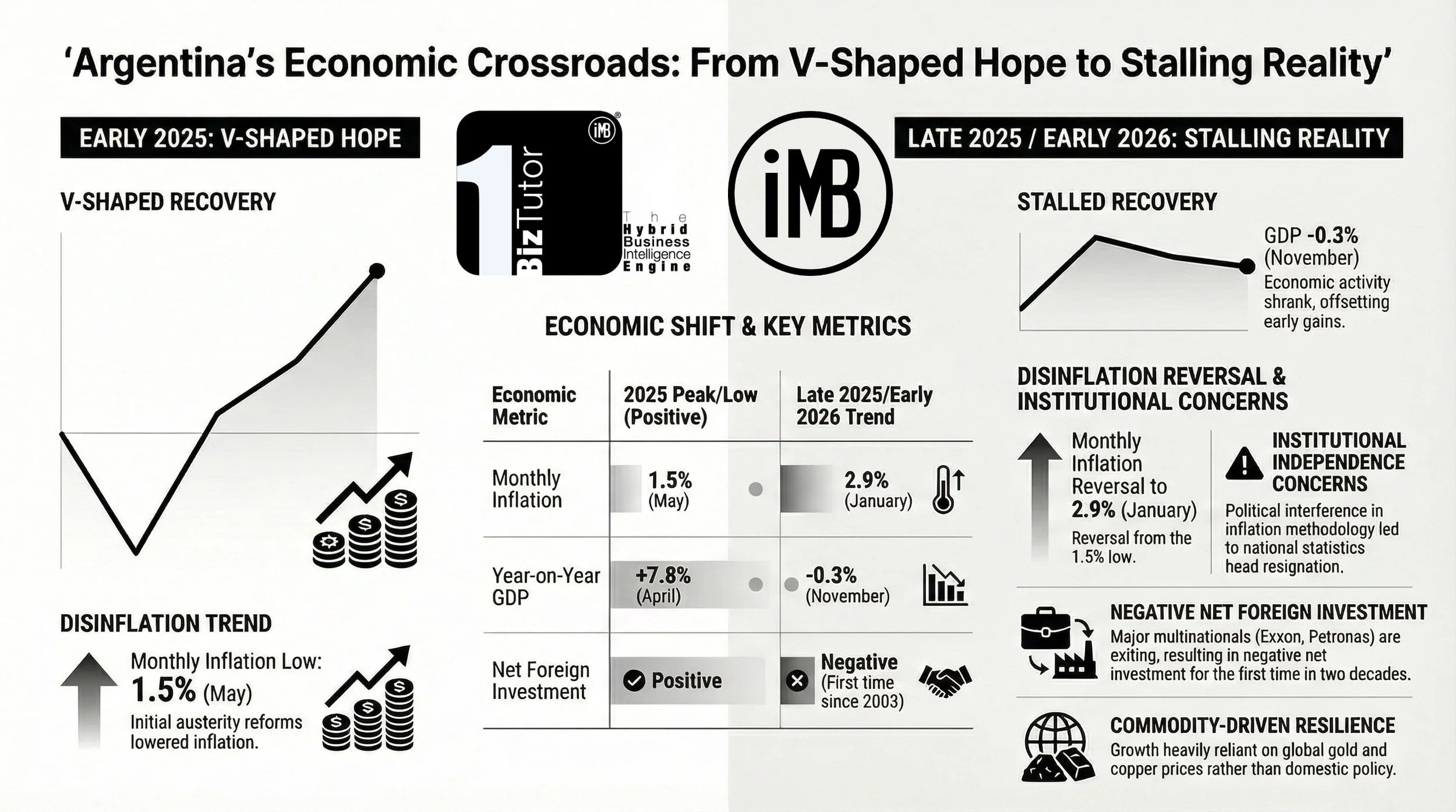
generated by OneBizTutor®, Mar. 30, 2026, Montevideo, Uruguay
A Political Pickle
Javier Milei now finds himself in a significant political pickle, having overpromised a level of stability that his "shock therapy" has yet to provide. The early statistical victories of 2025 have evaporated, replaced by the grim reality of a shrinking economy and a credibility crisis at the national statistical office. The electorate’s patience for "shock" is finite, especially when the promised "therapy" feels like a moving target.
The ultimate question for Argentina is not whether Milei’s specific brand of libertarianism is correct, but whether any leader can overcome the country’s historic instability. If the current stagnation continues, the 2025 recovery will be remembered not as a turning point, but as just another fleeting mirage in a century of economic disappointment.—iMB.Solutions Team ARG, Montevideo (URG) & Buenos Aires (ARG)
Generative AI Tools in Project Missions
Step into the AI Arsenal: the cutting-edge generative tools we deploy in client projects, internal operations, and partner collaborations—tested, trusted, and ready for battle.

The Next Wave in AI: Big AI (LLM) vs Small AI (SLM) – Why the Bifurcation Is Unlocking New Markets in 2025
Dear Subscribers,
exciting times ahead in the world of artificial intelligence! As we are closeing in 2025, one trend stands out boldly: the AI landscape is bifurcating into two powerful paths – Big AI (powered by Large Language Models, or LLMs) and Small AI (driven by Small Language Models, or SLMs). This isn't just a technical split; it's a strategic revolution that's unlocking new possibilities and reshaping how businesses deploy AI. Let's dive in – we promise, by the end, you'll be motivated to explore which side of this wave your organization should ride!

Understanding the Bifurcation
At its core, we're seeing a clear divide:
Big AI (LLMs): These are the hosted frontier models from giants like OpenAI, Anthropic, and Google. Think GPT-4o, Claude Opus, or Gemini Ultra – massive, cloud-based powerhouses excelling in complex reasoning, creative tasks, and broad knowledge applications.
Small AI (SLMs): Self-hosted or on-device models that prioritize privacy, low latency, and cost efficiency. Models like Phi-3, Llama 3 8B, or Qwen variants are leading the charge here.
This shift isn't about one replacing the other – it's about the right tool for the job. As recent reports highlight, enterprises in 2025 are discovering that 70-80% of use cases fit SLMs or hybrids perfectly, reserving LLMs for those deep, uncertain reasoning scenarios.
Why Small AI Is Unlocking Massive Markets
Here's the game-changer: Many industries simply won't ship sensitive intellectual property to third-party clouds. Legal firms handling confidential contracts, medical providers dealing with patient data, financial institutions managing regulated transactions, and media companies protecting workflows – all demand ironclad privacy.
SLMs shine here by running on-device or in private infrastructure, eliminating data leakage risks while delivering lightning-fast responses (think milliseconds vs. seconds) and drastically lower costs (often 100x cheaper per query than LLMs).
In 2025, we're seeing explosive adoption:
Healthcare: Privacy-preserving diagnostics and document analysis.
Finance: Compliance-focused chatbots and real-time fraud detection.
Legal: Contract review and case prediction without exposing sensitive info.
This isn't hype – MIT Technology Review named small language models one of the 10 Breakthrough Technologies of 2025, and NVIDIA researchers argue SLMs are the future of agentic AI.
The Skills That Will Compound Your Career
If you're in AI (or aspiring to be), here's our clear opinion:
Bet on Small AI skills – they're the ones that will compound exponentially.
Master these, and you'll be indispensable:
Fine-tuning: Adapting base models to domain-specific tasks using techniques like LoRA or QLoRA.
Evals: Rigorous evaluation frameworks to measure accuracy, bias, and performance.
Deployment: On-device or edge optimization for real-world scalability.
Optimization: Quantization, pruning, and privacy-preserving methods (e.g., federated learning).
Privacy-preserving systems: Ensuring compliance in regulated environments.
These aren't fringe skills – they're the foundation for building secure, efficient AI that enterprises crave. Start experimenting today with open-source tools like Hugging Face or LlamaFactory; the barriers are lower than ever!
Final Thoughts - Ride the Wave Proactively
Colleagues, this bifurcation is your opportunity.
Don't wait for Big AI to dominate everything – innovate outside the box by embracing Small AI for the markets it's uniquely unlocking. Whether you're an engineer fine-tuning models or a leader planning deployments, the future is bright, efficient, and private.
What do you think – is your team leaning toward Big, Small, or a smart hybrid? Reply and let's discuss!
Stay innovative,
Your AI Insights Editor from iMB.Solutions—from SXSW 2026, March 2026, Austin (TX), U.S.A.
Powered by forward-thinking trends – and a dash of humor: Remember, in AI, sometimes smaller really is smarter!

Strategic Announcement: Kai Schwarz Appointed Associate Partner for Logistics and Supply Chain Excellence
iMB.Solutions Ltda. has served the market for 21 years, executing over 150 projects for clients in Brazil, Europe, and North America. Logistics and supply chain management remain foundational to our portfolio. Recent sector dynamics—including blockchain advancements and the shift toward nearshoring, friendshoring, and greenshoring—underscore the imperative for specialized expertise, complementing core competencies in business development, finance, production, sales, and after-sales service.
We are pleased to announce the appointment of Kai Schwarz as our Associate Partner for logistics and supply chain project assignments. Our long-standing relationship with Kai, a proven authority in these domains, positions us to deliver enhanced value to clients.
A German native with degrees in linguistics and economics, Kai brings 25 years of executive leadership at international logistics firms in Europe and Brazil. Now operating as a consultant and interim manager from São Paulo, he will drive strategic project management and advisory services for iMB.Solutions Ltda.
For projects requiring this level of precision, contact us to engage Kai's expertise.

Kai Schwarz - Appointed Associate Partner for Logistics and Supply Chain Excellence - April 2026
Contact

Discover What Matters Most to You—Backed by 150+ Project Missions!
Curious about the impact of our insights at iMB.Solutions? We put our articles, blogs, and case studies to the test—running three independent AI-driven queries with Perplexity, Google Gemini, and Mistral. The result? A powerful keyword cloud reflecting the topics that truly resonate.
Do you see yourself in these trends? Let’s connect and explore how our expertise—shaped by 150+ project missions over two decades—can drive your success.